On eBird ↗
Golden-capped Parakeet
Live sightings near you, the range map, bar charts of when it is seen, and Macaulay Library photos and recordings.
Golden-capped Parakeet
Aratinga auricapillus
The golden-capped parakeet (Aratinga auricapillus) is a species of parrot in the family Psittacidae endemic to Brazil. Its natural habitats are subtropical or tropical dry forest, subtropical or tropical moist lowland forest, dry savanna, and plantations. It is threatened by habitat loss. The A. auricapillus is a good biological indicator because of its vulnerability, high detectability as well as its sensitivity to forest fragmentation.
From the article Golden-capped parakeet on Wikipedia (CC BY-SA), quoted section by section
Description
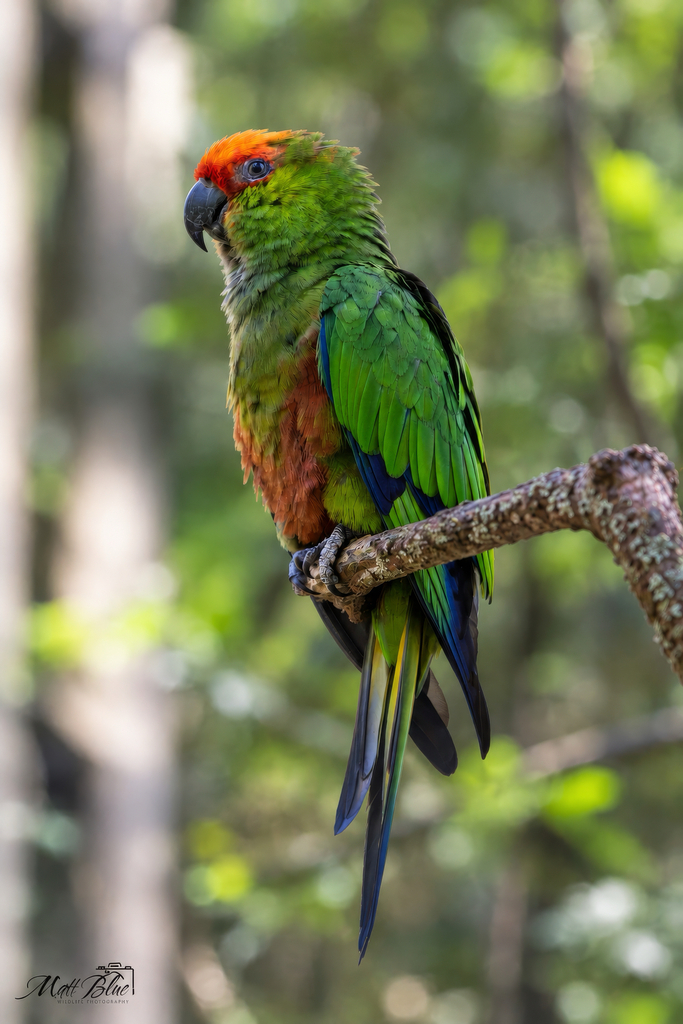
It is 30 cm (12 in) long and mostly green with a black beak, white eyerings, orange-red belly, and red face fading to yellow over the crown. Juvenile members of the A. auricapillus group develop their yellow head markings and red coloration on the lower body in adulthood. The approximate weight for golden-capped parakeets is 4.9-5.25 oz.
Range & habitat
The Aratinga auricapillus inhabits mostly the semi-deciduous forests in northeastern Brazil, although through time it has adapted to rural agricultural areas and sometimes even urban cities, spreading throughout the states of Bahia, Minas Gerais, Espírito Santo, Rio de Janeiro, São Paulo, Goiás, and Paraná.
Wikipedia: “Habitat”
What it does
As members of the Aratinga solstitialis subspecies, golden-capped parakeets tend to populate their areas of residence within forests in groups, which can range from 4 to 15 individual parakeets. The breeding season occurs during the austral summer, which in the southern hemisphere is from December to March, with pairs being sighted around November and dependent young around March. Golden-capped parakeets have a clutch size of around 3 to 5 eggs per nesting; the incubation period for these eggs is estimated to be around 25 days, and young fledglings take around 7–8 weeks before they are able to take flight.
Wikipedia: “Behavior”
Listen
Looking for field recordings…
Where it lives
Recorded sightings
—
geo-referenced records in GBIF, from museums, herbaria and field observers.
Drag the globe to turn it. Dots are where records exist, not a range map; darker means more records.
In the stacks
Searching the stacks…
Every page naming Aratinga auricapillus in the Biodiversity Heritage Library →
This page is assembled live from iNaturalist, GBIF, Wikipedia, the Source Library and the Internet Archive. It is not yet part of the hand-edited codex. iNaturalist taxon 72522.