On eBird ↗
Brown Teal
Live sightings near you, the range map, bar charts of when it is seen, and Macaulay Library photos and recordings.
Brown Teal
Anas chlorotis
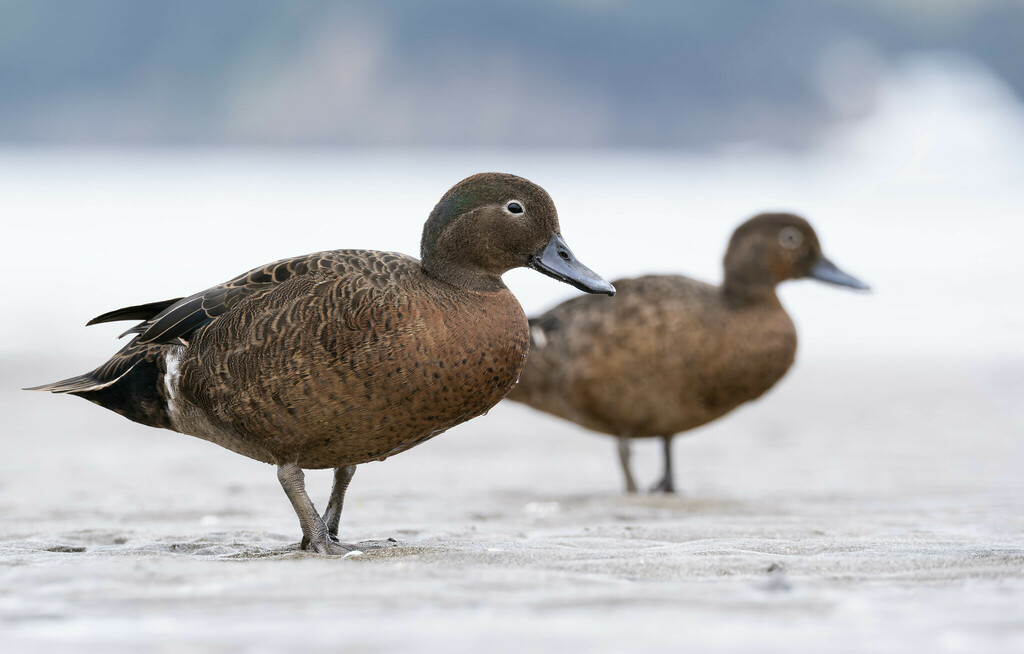
The brown teal (Anas chlorotis; Māori: pāteke) is a species of dabbling duck of the genus Anas native to New Zealand. It was long considered conspecific with the flightless Auckland and Campbell teals as Anas aucklandica; the name "brown teal" has also been largely applied to that entire taxon. Common in the early years of European colonisation, the species was heavily harvested as a food source. Its numbers quickly fell, especially in the South Island, and in 1921 it became fully protected. Captive breeding and releasing into predator-controlled areas was successful in establishing localised re-introduced populations after 2003.
From the article Brown teal on Wikipedia (CC BY-SA), quoted section by section
Description
There are no distinctive differences between a male, female and a juvenile brown teal during non-mating season. They all have a white ring around their eyes as well as a mottled brown colour on their heads and throat. During breeding season the male will begin to change colour, now having a green coloured head, chestnut coloured breast and a white stripe on each side of their body. They will sometimes also have a white clerical neck band. This does vary as some males do tend to be more colourful than others.
Range & habitat
This species is endangered and occurs predominantly on offshore islands but also in predator-proof sanctuaries on the mainland such as Tawharanui Regional Park. Formerly, it was widespread on the New Zealand mainland, but it disappeared there due to introduced predators like cats, dogs and rats, which easily preyed on this unwary, weakly flying bird. According to the IUCN categorization as VU D1, fewer than 1000 adult birds remain. The species has recently been upgraded to endangered by Birdlife International (Birdlife 2007), and the change will be reflected in the next update of the IUCN red list. Apart from Fiordland's Arthur Valley, there is only one other site in the South Island where brown teal live in the wild: since 2017, the Department of Conservation and Project Janszoon have released just under 300 of the waterfowl in the Awapoto River in Abel Tasman National Park. The birds are successfully breeding in that location.
Wikipedia: “Distribution and conservation”
What it does
The brown teal is largely nocturnal in habit by dabbling duck standards. This is an evolutionary response to natural diurnal predators such as the New Zealand falcon, Eyles' harrier, or skuas further south in their range. Brown teal have no defense against introduced cats, dogs, stoats & ferrets, which can kill adults & ducklings, or against rats which eat eggs.
Wikipedia: “Behaviour”
Listen
Looking for field recordings…
Where it lives
Recorded sightings
—
geo-referenced records in GBIF, from museums, herbaria and field observers.
Drag the globe to turn it. Dots are where records exist, not a range map; darker means more records.
In the stacks
Searching the stacks…
Every page naming Anas chlorotis in the Biodiversity Heritage Library →
This page is assembled live from iNaturalist, GBIF, Wikipedia, the Source Library and the Internet Archive. It is not yet part of the hand-edited codex. iNaturalist taxon 72502.