On eBird ↗
Yellow-faced Parrot
Live sightings near you, the range map, bar charts of when it is seen, and Macaulay Library photos and recordings.
Yellow-faced Parrot
Alipiopsitta xanthops
The yellow-fronted parrot (Poicephalus flavifrons) from Africa is occasionally called "yellow-faced parrot".
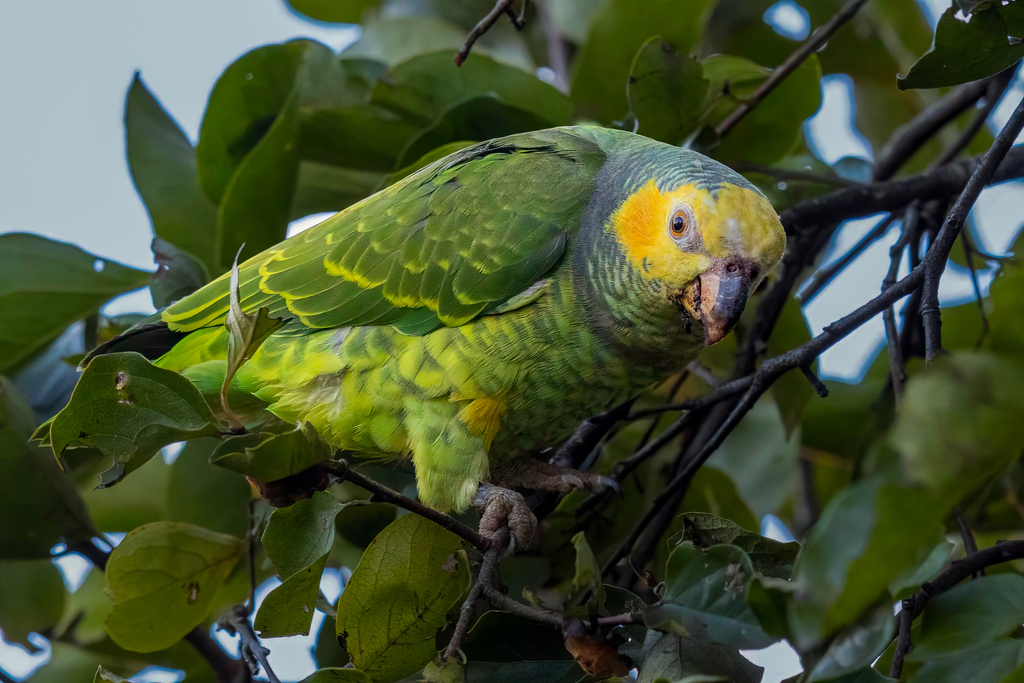
The yellow-faced parrot (Alipiopsitta xanthops), formerly also known as the yellow-faced amazon, is the only species of the genus Alipiopsitta. It is a Neotropical parrot (tribe Arini), and was classified in the genus Amazona for many years. It is a predominantly green and yellow-plumaged bird with a yellow head. It is a semi-nomadic species found in the cerrado region of Brazil and adjacent Bolivia. As the yellow-faced parrot has disappeared from parts of its former range due to habitat destruction and generally occurs in low densities, it was considered vulnerable by the IUCN, but it remains locally fairly common, occurs in several protected areas and can survive in fragmented habitats, leading to its downlisting to near-threatened.
From the article Yellow-faced parrot on Wikipedia (CC BY-SA), quoted section by section
Description
Measuring about 27 cm (11 in) in length, the yellow-faced parrot has a stocky body and short tail. It is a predominantly green and yellow-plumaged bird that in adults has a yellow crown, lores, cheeks and auriculars. The rest of the head, upperparts and chest are green with some yellowish-green scalloping. The sides of the belly are often mottled orange and yellow, and the belly is often yellow. However, there are significant variations in the amount of yellow to the underparts, and some show virtually none. The wings are predominantly green, occasionally with some yellow spots. There is blue edging on the primary coverts. The central feathers of the short tail are green, while the lateral ones are more yellow-green and have orange-red bases. The bill is yellowish-horn with a dark culmen, the cere is pinkish, and the iris is yellow. The legs are light grey. There is no sexual dimorphism; the male and female are alike in plumage and size. Immatures have less yellow to the head.
Range & habitat
The majority of its range is in central and eastern Brazil, where found from Maranhão and Piauí to São Paulo and Mato Grosso do Sul. It inhabits the cerrado on the plateau of Brazil, as well as the dryer Caatinga scrubland. There are two records from Beni in northeastern Bolivia. Despite occasionally being listed for Paraguay, evidence supporting its presence in this country is lacking. Within its range it appears to be semi-nomadic. Much of its habitat is being converted to agricultural land and the populations are declining.
Wikipedia: “Distribution and habitat”
What it does
The yellow-faced parrot forages for and eats the fruit and seeds of trees including Anacardium species, Salacia crassifolia and Astronium fraxinifolium. Flocks have also been recorded raiding crops of mango and unripe guava trees. Termites are another diet item. Until recently, comparatively little was known of its habits. It has been studied in Emas National Park in Brazil. Its breeding season there is May to October. Nests are hollows in termite mounds. The eggs are incubated for 19–22 days, while the young take up to 45 days to leave the nest. Like most species of parrots, the yellow-faced parrot is protected by the Convention on International Trade in Endangered Species of Wild Fauna and Flora (CITES) with its placement on the Appendix II list.
Wikipedia: “Behaviour”
Listen
Looking for field recordings…
Where it lives
Recorded sightings
—
geo-referenced records in GBIF, from museums, herbaria and field observers.
Drag the globe to turn it. Dots are where records exist, not a range map; darker means more records.
In the stacks
Searching the stacks…
Every page naming Alipiopsitta xanthops in the Biodiversity Heritage Library →
This page is assembled live from iNaturalist, GBIF, Wikipedia, the Source Library and the Internet Archive. It is not yet part of the hand-edited codex. iNaturalist taxon 72484.