On eBird ↗
Unicolored Blackbird
Live sightings near you, the range map, bar charts of when it is seen, and Macaulay Library photos and recordings.
Unicolored Blackbird
Agelasticus cyanopus
The unicolored blackbird (Agelasticus cyanopus) is a species of bird in the family Icteridae. Found in Argentina, Bolivia, Brazil, and Paraguay, its natural habitat is swamps and nearby grassland. It is a fairly common bird and the International Union for Conservation of Nature has rated it a "least-concern species".
From the article Unicolored blackbird on Wikipedia (CC BY-SA), quoted section by section
Description
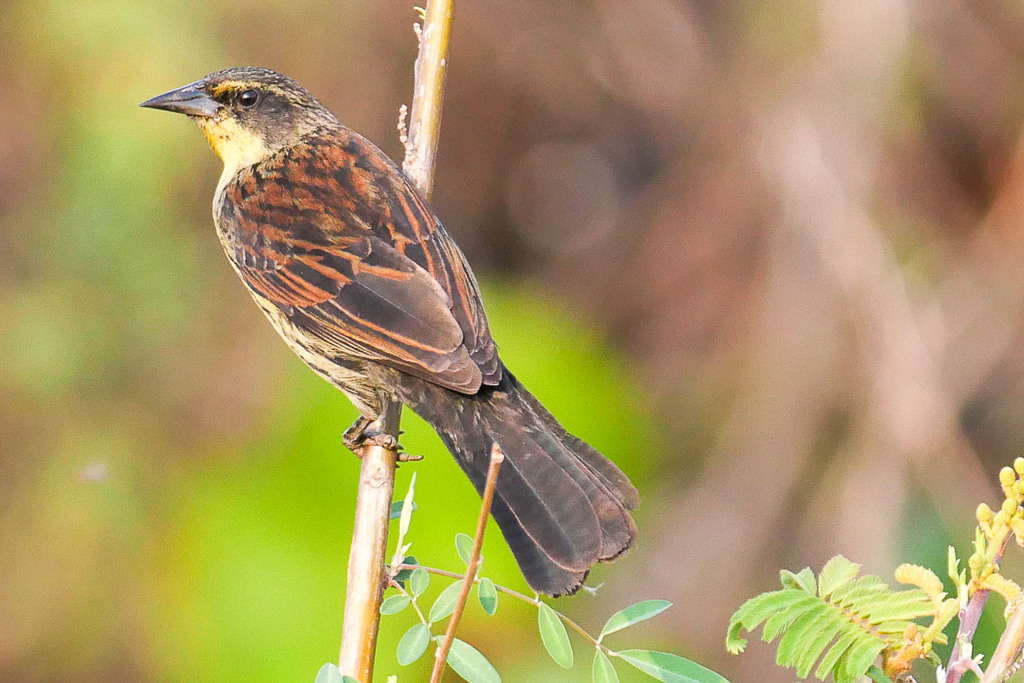
The unicolored blackbird is about 18 to 21 cm (7.1 to 8.3 in) long. Males weigh an average of 40.6 g (1.4 oz) and females average 37.4 g (1.3 oz). The species is sexually dimorphic. Adult males of all four subspecies are entirely black with a faint bluish gloss. Adult females of the nominate subspecies A. c. cyanopus have a brown crown, a thin yellowish supercilium, and blackish ear coverts. Their upperparts are brown with heavy black streaks. Their upperwing is brownish with rufous edges on most feathers. Their tail is blackish. Their underparts are mostly pale yellow with dusky streaks on the flanks and sometimes on the breast. Their underwing coverts are pale yellow. Juveniles are similar to adult females but are more buffy yellow underparts and have heavier streaking on both the upper- and underparts. Females of subspecies A. c. atroolivaceus are overall much darker than the nominate. Their underparts are dark brownish olive with a yellowish wash. Females of subspecies A. c. beniensis have darker upperparts than the nominate and their underparts are intermediate between those of the nominate and atroolivaceus. Females of A. c. xenicus have an olive-washed blackish head, mantle, and breast and a dark olive-yellow belly. Both sexes of all subspecies have a dark brown iris and black legs and feet. …
Range & habitat
The unicolored blackbird has a disjunct distribution; sources differ significantly in the ranges of the subspecies. The article's map approximates the range descriptions of the Cornell Lab of Ornithology's Birds of the World.
A. c. atroolivaceus: coastal eastern Brazil from Espírito Santo south to Paraná or "eastern Brazil, from Minas Gerais and southwestern Bahia southward to coastal southeastern Brazil (Espírito Santo to São Paulo)" A. c. cyanopus: "eastern Bolivia and southwestern Brazil (western Mato Grosso and Mato Grosso do Sul) to Paraguay and northern Argentina" or "eastern Bolivia and south-central Brazil to Paraguay, northern Argentina, and Uruguay" A. c. unicolor (A. c. xenicus): Amapá, northeastern Pará, and northern Maranhão in northeastern Brazil; possibly French Guiana or "northeastern Brazil (Amapá to Pará and northwestern Maranhão) southward through central Brazil to northwestern Paraná and western São Paulo" A. c. beniensis: northeastern Bolivia According to AviList A. c. atroolivaceus and A. c. xenicus intergrade in São Paulo. The South American Classification Committee has confirmed records of the species in Peru and lists it as a vagrant there. The unicolored blackbird primarily inhabits marshes and other wetlands as long as they have abundant floating (e.g. Pistia water-cabbage and Lemna duckweed) and emergent (e.g. …
Wikipedia: “Distribution and habitat”
What it does
The unicolored blackbird feeds primarily on insects, small vertebrates (especially fish), and seeds; arthropods other than insects are a smaller part of its diet. In the non-breeding season corn (Zea mays) and other crop seeds are a significant part of its diet. In marshes it often hunts prey while walking on floating vegetation, picking it from the water and the tops and bottoms of plants. It also forages on the ground. In the breeding season it usually forages in flocks of up to about 10 individuals but in the non-breeding season may be in flocks of 100 that may include other icterid species.
Wikipedia: “Feeding”
Listen
Looking for field recordings…
Where it lives
Recorded sightings
—
geo-referenced records in GBIF, from museums, herbaria and field observers.
Drag the globe to turn it. Dots are where records exist, not a range map; darker means more records.
In the stacks
Searching the stacks…
Every page naming Agelasticus cyanopus in the Biodiversity Heritage Library →
This page is assembled live from iNaturalist, GBIF, Wikipedia, the Source Library and the Internet Archive. It is not yet part of the hand-edited codex. iNaturalist taxon 72471.