On eBird ↗
Scrubtit
Live sightings near you, the range map, bar charts of when it is seen, and Macaulay Library photos and recordings.
Scrubtit
Acanthornis magna
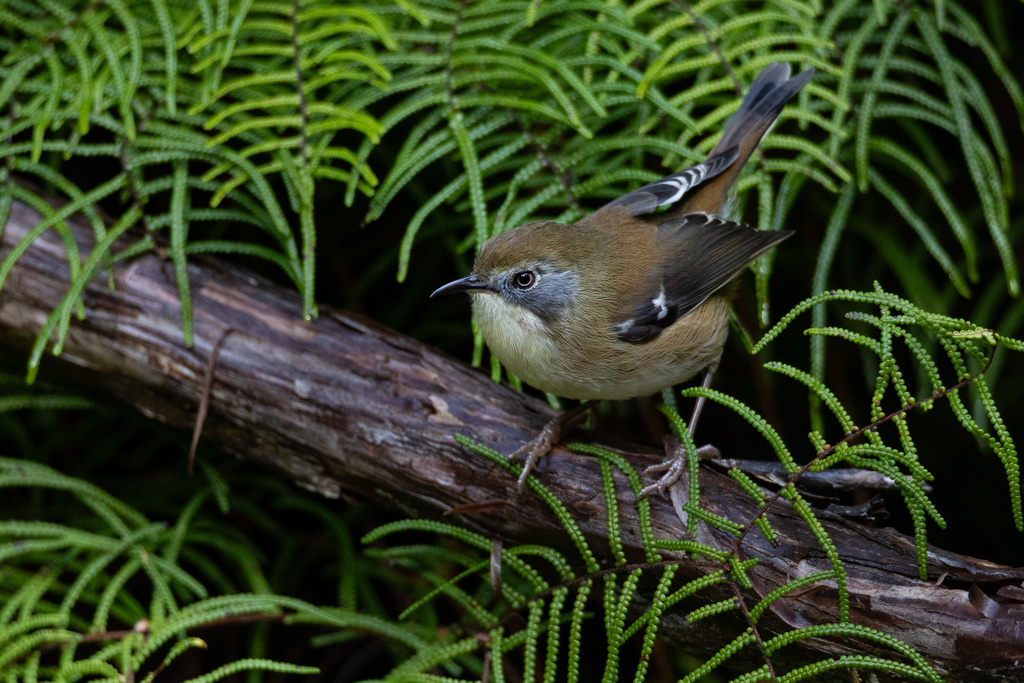
The scrubtit (Acanthornis magna) is a species of bird in the thornbill family Acanthizidae. It is endemic to Tasmania and King Island in Australia. Its natural habitat is the temperate rainforest, Nothofagus beech forest and eucalypt woodland. It is a small species that resembles the Sericornis scrubwrens (with which it was once placed).
From the article Scrubtit on Wikipedia (CC BY-SA), quoted section by section
Description
The scrubtit is 11 to 12 centimetres (4.33 to 4.72 in) long and weighs around 10 grams (0.35 oz). The plumage consists of a white throat and belly, a brown back, crown, flank and tail, black wings and grey on the face. The eye is pale and the bill is short, black and slightly curved. The species is often silent, but makes quite loud contact calls and has a song described as "sweet [and] musical".
What it does
The scrubtit forages individually, in pairs or in small family groups near the ground in dense cover. It feeds on small invertebrates, particularly insects and their eggs. The species will associate with mixed-species feeding flocks. The species is territorial and monogamous, with the breeding season lasting from September to January. The nest is a woven globe with a side entrance, lined with feathers and fur, camouflaged and usually found between 1–3 m off the ground. The clutch size is usually three eggs but sometimes four. The eggs measure 18 by 15 millimetres (0.71 by 0.59 in) and are pearly white, with fine reddish spots, mostly around the larger end. No information exists about incubation or nestling times. Both parents feed the chicks in the nest, but unlike many Australian passerines helpers have never been reported. The species is victim to brood parasitism by fan-tailed cuckoos (Cacomantis flabelliformis) and shining bronze-cuckoos (Chrysococcyx lucidus), and quolls (Dasyurus) also take eggs and nestlings. The species is shy and unobtrusive and is seldom observed by people.
Wikipedia: “Behaviour”
Listen
Looking for field recordings…
Where it lives
Recorded sightings
—
geo-referenced records in GBIF, from museums, herbaria and field observers.
Drag the globe to turn it. Dots are where records exist, not a range map; darker means more records.
In the stacks
Searching the stacks…
Every page naming Acanthornis magna in the Biodiversity Heritage Library →
This page is assembled live from iNaturalist, GBIF, Wikipedia, the Source Library and the Internet Archive. It is not yet part of the hand-edited codex. iNaturalist taxon 72440.