- Plants
- ›Vascular Plants
- ›flowering plants
- ›Dicots
- ›Sunflowers, Bellflowers, Fanflowers, and Allies
- ›Sunflowers, Daisies, Asters, and Allies
- ›chicories, dandelions, and allies
- ›Lettuce, Chicory, Dandelion and Salsify Tribe
- ›Chondrillinae
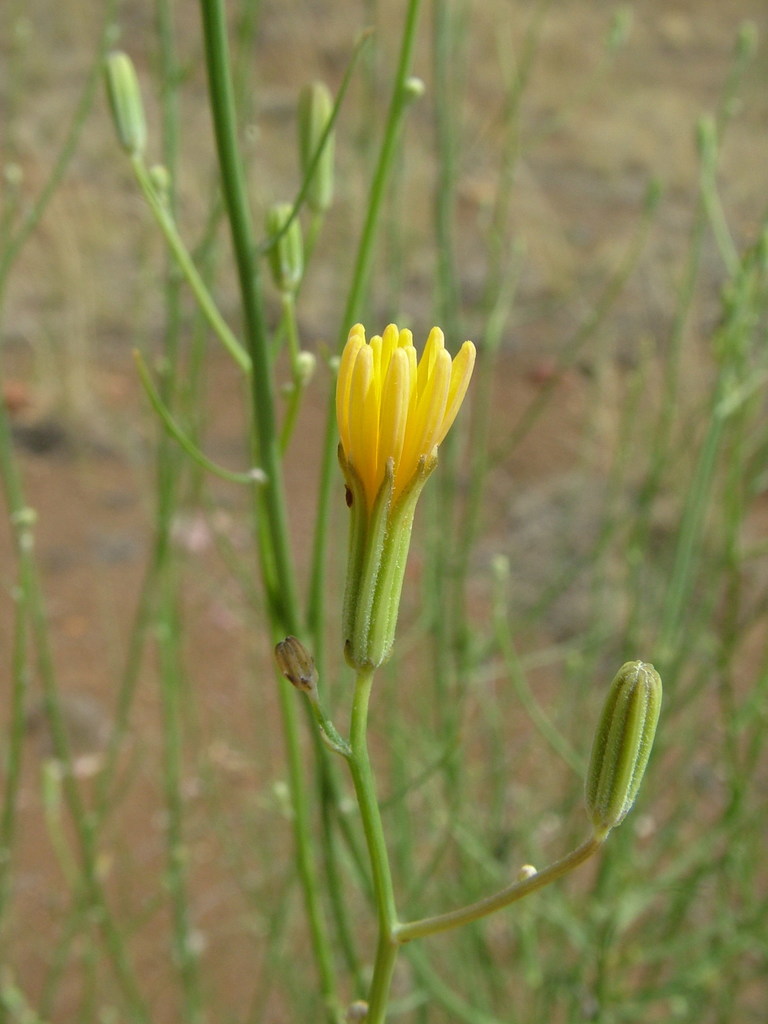
Chondrilla
Chondrilla is a genus of flowering plants in the family Asteraceae. They are native to Eurasia, and certain taxa are known as introduced species outside their native range. The best known of these is rush skeletonweed (Chondrilla juncea), a noxious weed established in Africa, Australia, and the Americas.
Chondrilla species produce one or more stems up to 1.5 meters tall from a taproot which can be very deep and highly branched. The basal and lower stem leaves are divided and toothed, and are borne on winged petioles. The upper leaf blades are smaller and simple. The cylindrical flower heads are often solitary but may grow in clusters, and are located along the branches and at the ends. They contain several yellow florets that soon wither. The fruit is a cylindrical, beaked, ribbed cypsela with a pappus of many white bristles.
15 branches of this genus, most-observed first

Rush Skeletonweed
speciesChondrilla juncea

Chondrilla chondrilloides
speciesChondrilla chondrilloides
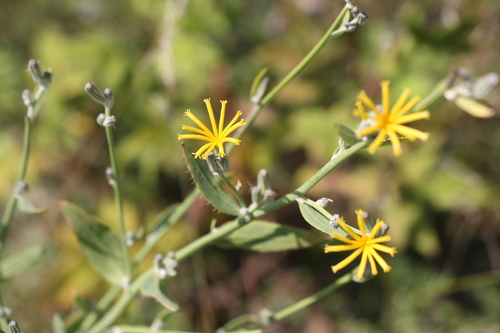
Chondrilla latifolia
speciesChondrilla latifolia
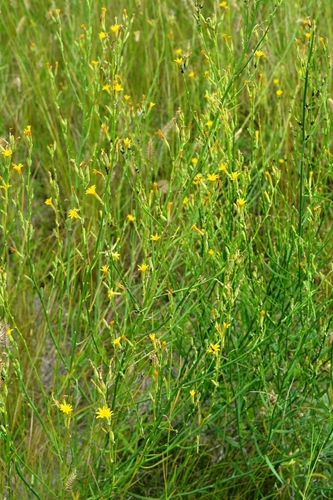
Chondrilla graminea
speciesChondrilla graminea
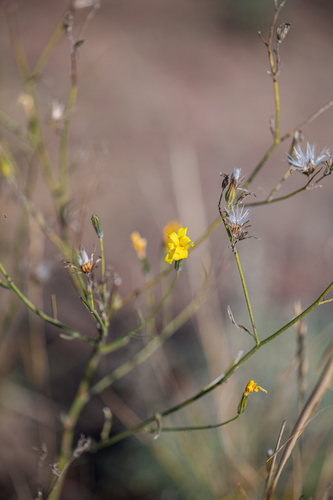
Chondrilla brevirostris
speciesChondrilla brevirostris

Chondrilla ramosissima
speciesChondrilla ramosissima
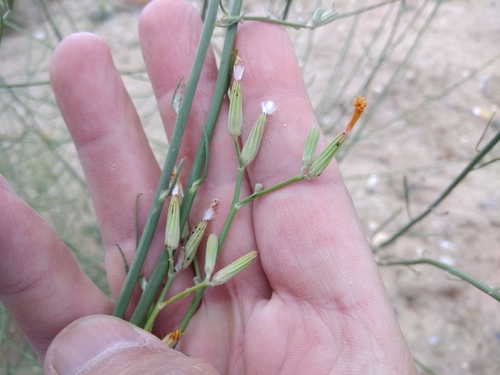
Chondrilla canescens
speciesChondrilla canescens

Chondrilla piptocoma
speciesChondrilla piptocoma
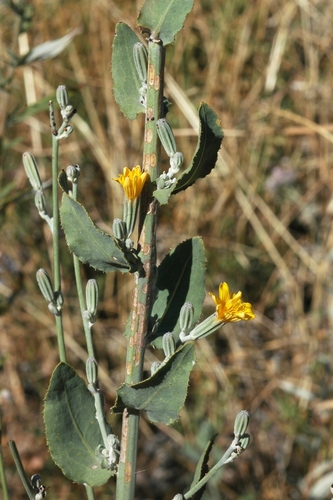
Chondrilla lejosperma
speciesChondrilla lejosperma
Chondrilla laticoronata
speciesChondrilla laticoronata
Chondrilla rouillieri
speciesChondrilla rouillieri
Chondrilla bosseana
speciesChondrilla bosseana
Chondrilla pauciflora
speciesChondrilla pauciflora
Chondrilla phaeocephala
speciesChondrilla phaeocephala
Chondrilla kusnezovii
speciesChondrilla kusnezovii
Where it lives
Recorded sightings
—
geo-referenced records in GBIF, from museums, herbaria and field observers.
Drag the globe to turn it. Dots are where records exist, not a range map; darker means more records.
In the old herbals & bestiaries

Hortus Eystettensis
Basilius Besler · 1640 · p.225

Six Groups of the History of Plants
Rembert Dodoens · 1583 · p.647

Commentaries on the Six Books of Dioscorides
Pietro Andrea Mattioli · 1560 · p.409

Commentaries on the Six Books of Dioscorides
Pietro Andrea Mattioli · 1560 · p.409

Commentaries on the Six Books of Dioscorides on Medical Matter
Pietro Andrea Mattioli · 1563 · p.394

Commentaries on the Six Books of Pedanius Dioscorides on Medical Matter
Pietro Andrea Mattioli · 1565 · p.679

Plant Touchstone (Phytobasanos)
Fabio Colonna · 1592 · p.34

Plant Touchstone (Phytobasanos)
Fabio Colonna · 1592 · p.30

Rariorum Plantarum Historia (with Fungorum Historia)
Carolus Clusius · 1601 · p.525

Rariorum Plantarum Historia (with Fungorum Historia)
Carolus Clusius · 1601 · p.527

Rariorum Plantarum Historia (with Fungorum Historia)
Carolus Clusius · 1601 · p.527

History of Rare Plants
Carolus Clusius · 1601 · p.521
In the stacks
Searching the stacks…
Every page naming Chondrilla in the Biodiversity Heritage Library →
This page is assembled live from iNaturalist, GBIF, Wikipedia, the Source Library and the Internet Archive. It is not yet part of the hand-edited codex. iNaturalist taxon 72049.