On eBird ↗
Smew
Live sightings near you, the range map, bar charts of when it is seen, and Macaulay Library photos and recordings.
Smew
Mergellus albellus
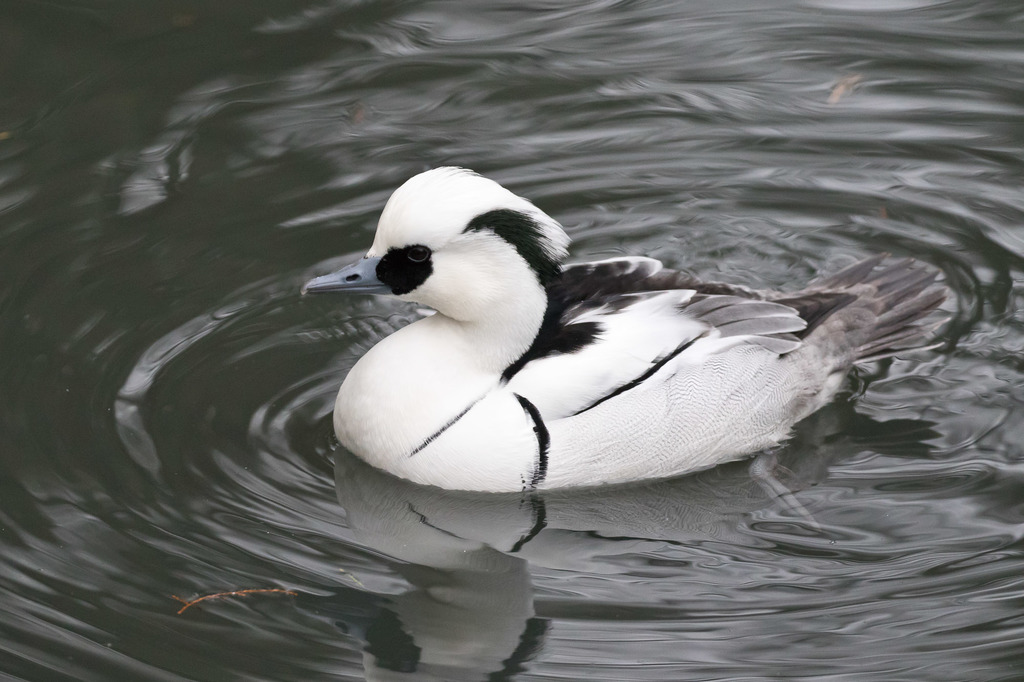
The smew (Mergellus albellus) is a species of duck, and is the only living member of the genus Mergellus. Mergellus is a diminutive of Mergus and albellus is from Latin albus "white". This genus is closely related to Mergus and is sometimes included in it, though it might be closer to the goldeneyes (Bucephala). The smew has hybridized with the common goldeneye (B. clangula).
From the article Smew on Wikipedia (CC BY-SA), quoted section by section
Description
The smew is 38–44 cm (15–17 in) long, with a wingspan of 56–69 cm (22–27 in), and a weight of 450–650 g (16–23 oz). Adult drake smew, with its 'cracked ice' or 'panda' appearance, is unmistakable, and looks very black-and-white in flight. The females and immature males are grey, with chestnut forehead and crown, white chin and cheeks, and black lores; they are often known as "redhead" smew. Young males moult into adult plumage late in their first winter, when about 8–10 months old; adult males have an eclipse plumage when they become similar to females, but retaining more white in the wing, in late summer and autumn. It has oval white wing-patches in flight. The smew's bill has a hooked tip and serrated edges, which help it catch fish when it dives for them.
Range & habitat
This species breeds in the Palearctic in the northern taiga from northern Scandinavia east to Chukotka. It needs trees for breeding. The smew lives on fish-rich lakes and slow rivers. As a migrant, it leaves its breeding areas and winters on sheltered coasts or inland lakes; in Europe in the Baltic Sea, the Black Sea, northern Germany, the Low Countries, and Great Britain (mainly in southeast England but some reaching Scotland); in Asia in the Caspian Sea, in eastern China, Korea, and Japan, and a small number reaching northern India. Vagrants have been recorded in northern Africa (Algeria, Egypt) and North America (Alaska, where regular in the Aleutian Islands, and Canada).
Wikipedia: “Distribution”
What it does
On lakes it prefers areas around the edges, often under small trees. The smew breeds in May and lays 7–11 cream-coloured eggs, incubated by the female for 26–28 days. Ducklings leave the nest soon after hatching and learn to fly within about 10 weeks. It nests in tree holes, such as old woodpecker nests. It is a shy bird and flushes easily when disturbed. The smew is one of the species to which the Agreement on the Conservation of African-Eurasian Migratory Waterbirds (AEWA) applies. It is not considered threatened on the IUCN Red List, though its population is decreasing.
Wikipedia: “Ecology”
In human culture
The genus name Mergellus is a diminutive of Mergus, a Latin word related to mergo, to dive or submerge, used by Pliny for an unspecified diving bird. The specific epithet albellus is a Latin diminutive of albus meaning "white". The term smew has been used since the 17th century and is of uncertain origin. It is believed to be related to the Dutch smient ("wigeon") and the German Schmeiente or Schmünte, "wild duck". It is probably derived from smee, a dialectal term for a wild duck.
Wikipedia: “Etymology”
Listen
Looking for field recordings…
Where it lives
Recorded sightings
—
geo-referenced records in GBIF, from museums, herbaria and field observers.
Drag the globe to turn it. Dots are where records exist, not a range map; darker means more records.
In the stacks
Searching the stacks…
Every page naming Mergellus albellus in the Biodiversity Heritage Library →
This page is assembled live from iNaturalist, GBIF, Wikipedia, the Source Library and the Internet Archive. It is not yet part of the hand-edited codex. iNaturalist taxon 7192.