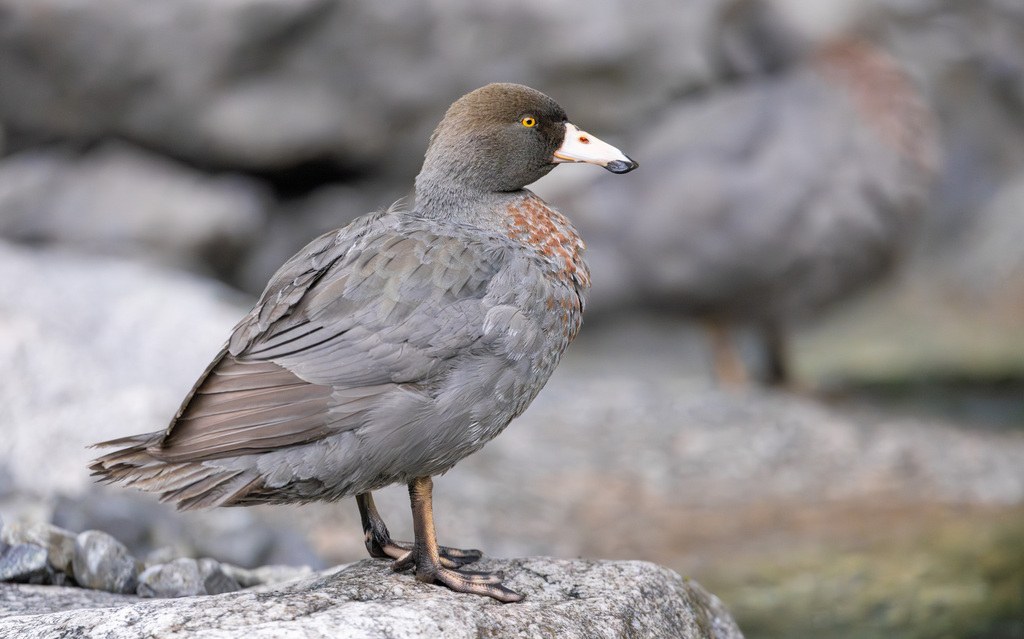
Hymenolaimus
The blue duck (Hymenolaimus malacorhynchos) or whio is a member of the duck, goose and swan family, Anatidae and is endemic to New Zealand. It is the only individual species belonging to the genus Hymenolaimus. Its closest relatives are the ducks in the genus Sarkidiornis.
First seen and recorded by the British explorer, James Cook in his second voyage to New Zealand, its scientific name was given by the German naturalist, Johann Friedrich Gmelin in 1789 and later George Robert Gray in 1843. There are two subspecies of the blue duck, one in North Island and the other in South Island. Common to both gender, its physical characteristics include yellow iris, a pale grey beak with semicircular flaps and lamellae, dark-slate grey plumage, chestnut flecked breast, dark grey webbed feet, and well developed claws. The male blue duck has a high-pitched whistle, which gave its Māori name Whio, while the female has a low-pitched rattle.
1 branches of this genus, most-observed first · about 1 known species
See this branch on the Wheel of Life →
Where it lives
Recorded sightings
—
geo-referenced records in GBIF, from museums, herbaria and field observers.
Drag the globe to turn it. Dots are where records exist, not a range map; darker means more records.
In the stacks
Searching the stacks…
Every page naming Hymenolaimus in the Biodiversity Heritage Library →
This page is assembled live from iNaturalist, GBIF, Wikipedia, the Source Library and the Internet Archive. It is not yet part of the hand-edited codex. iNaturalist taxon 7183.