- Animals
- ›Chordates
- ›Vertebrates
- ›Reptiles
- ›Snakes and Lizards
- ›Lizards
- ›Wall lizards, amphisbaenians, and allies
- ›Whiptails and Tegus
- ›Whiptails and Ameivas
- ›Aspidoscelis
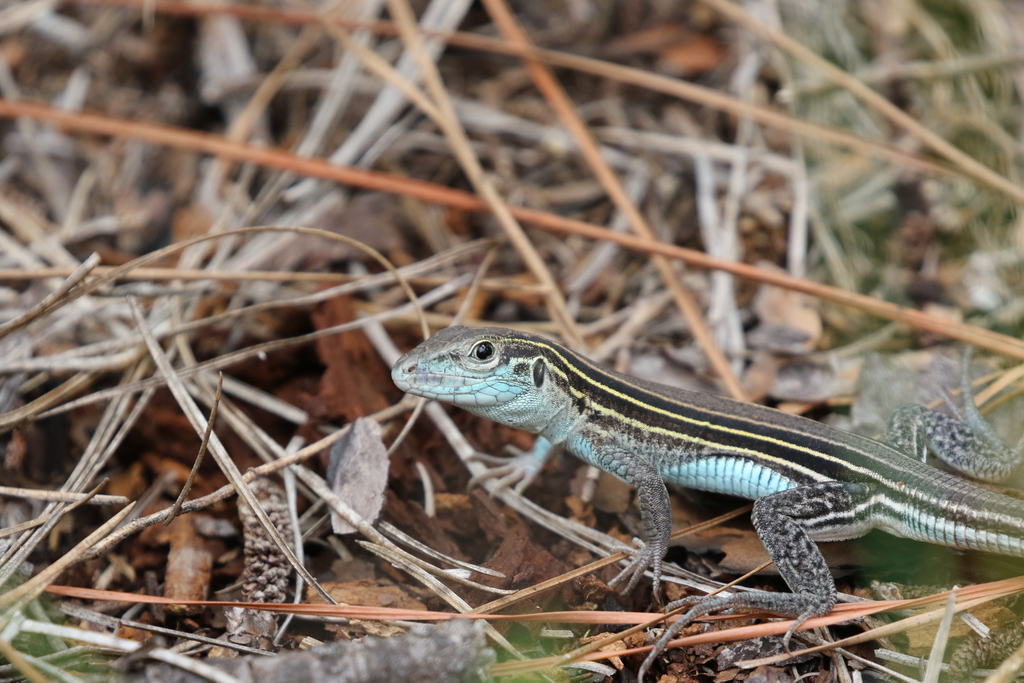
Six-lined Racerunner
Aspidoscelis sexlineatus
The six-lined racerunner (Aspidoscelis sexlineatus) is a species of lizard native to the United States and Mexico.
From the article Six-lined racerunner on Wikipedia (CC BY-SA), quoted section by section
Description
The six-lined racerunner is typically dark green, brown, or black in color, with six yellow or green-yellow stripes that extend down the body from head to tail. Between the stripes are dark-colored fields ranging from dark brown to black and pale-colored fields near ventral scales on each side. A distinct lemon-yellow coloration is on the sides of the head both above and below the lateral stripe. Also, white mental and gular stripes occur. The posterior gular fold is bordered by enlarged mesoptychial scales. The postantebrachial scales on the forearms are granular-like and only slightly enlarged. The underside is usually white in color on females, but they may have some pale blue as adults. Males have a brightly blue-hued chest and abdominal stripes. Males also sometimes have a pale green-colored throat. They are slender-bodied, with a tail nearly twice the body length. Its long tail may serve as a counterbalance, allowing it to turn to flee quickly from predators.
Range & habitat
The six-lined racerunner is found throughout much of the southeastern and south-central portion of the United States, from Maryland to Florida in the east, across the Great Plains to South Texas and northern Mexico. In a study conducted on A. sexlineata in Mexico, the majority of the individuals found were inhabiting areas near the seashore that were formed and influenced from maritime climate and hurricanes. The species' range also reaches north to Wisconsin and Minnesota. A small disjunct population is found in Tuscola County, Michigan.
Wikipedia: “Geographic range”
What it does
Like other species of whiptail lizards, the six-lined racerunner is diurnal and insectivorous. A. sexlineata is most active between 9:00 and 11:30 am on clear days between late spring and early summer when the temperature is closest to 90 °F. A different study found six-lined racerunners were most active between 11:00 am and 3:00 pm. They are wary, energetic, and fast moving, with speeds up to 18 mph (29 kmh), darting for cover if approached. The farther away they are from shelter, the faster they will flee. In addition, a "pecking order" exists within populations. Aggressive behavior is common, as the dominant chases the subordinate and often follows up with a bite to signify dominance.
Wikipedia: “Behavior”
Where it lives
Recorded sightings
—
geo-referenced records in GBIF, from museums, herbaria and field observers.
Drag the globe to turn it. Dots are where records exist, not a range map; darker means more records.
In the stacks
Searching the stacks…
Every page naming Aspidoscelis sexlineatus in the Biodiversity Heritage Library →
This page is assembled live from iNaturalist, GBIF, Wikipedia, the Source Library and the Internet Archive. It is not yet part of the hand-edited codex. iNaturalist taxon 717858.