On eBird ↗
Spur-winged Goose
Live sightings near you, the range map, bar charts of when it is seen, and Macaulay Library photos and recordings.
Spur-winged Goose
Plectropterus gambensis
The spur-winged goose (Plectropterus gambensis) is a large, Sub-Saharan African waterbird in the family Anatidae, which includes geese and shelducks. However, P. gambensis developed unique environmental adaptations, which resulted in the evolution of several anatomical features that are not shared with other anatids; thus, the species has been classified one step further into its own subfamily, the Plectropterinae.
From the article Spur-winged goose on Wikipedia (CC BY-SA), quoted section by section
Description
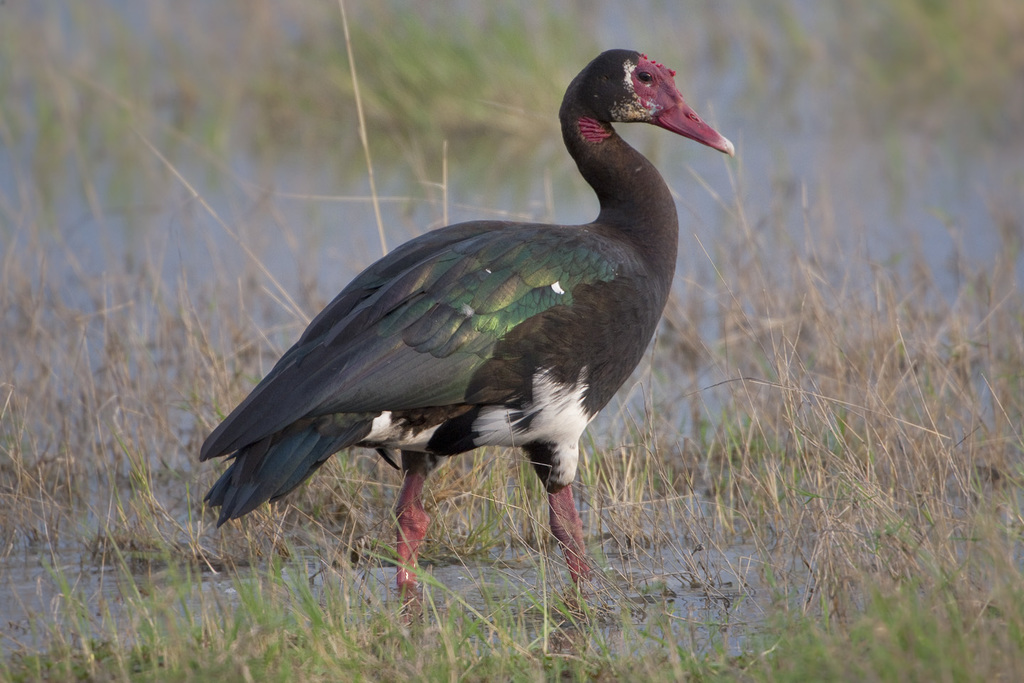
Adults are 75–115 cm (30–45 in) long, and weigh an average of 4–6.8 kg (8.8–15.0 lb) (rarely up to 10 kg (22 lb)), with ganders (males) being noticeably larger than the geese. The wingspan can range from 150 to 200 cm (59 to 79 in). One source claims the average weight of males is around 6 kg (13 lb) and the weight of females is around 4.7 kg (10 lb). However, 11 individuals that were banded in South Africa, were found to average only 3.87 kg (8.5 lb), with a range of 2.4 to 5.4 kg (5.3 to 11.9 lb). Another South African-based study found 58 males weighing an average of 5.52 kg (12.2 lb) and measuring 98.1 cm (38.6 in) in total length; meanwhile, 34 females averaged 3.35 kg (7.4 lb) in weight and 84.2 cm (33.1 in) in total length. Among standard measurements, the wing chord is 42.5 to 55 cm (16.7 to 21.7 in), the bill is 5.7 to 6.4 cm (2.2 to 2.5 in) and the tarsus is 5.7 to 12 cm (2.2 to 4.7 in). They are among the largest true African waterfowl (besides the wading Goliath heron) and are, on average, the world's largest "goose", although in average weight, their size is at least rivaled by the Cape Barren goose. Spur-winged geese appear to be more closely allied to shelducks than "true geese" such as those from the Branta and Anser genera. They are mainly black, with a white face and large white wing patches. The long legs are pinkish red in colour. …
Range & habitat
This species often occurs in open grasslands with lakes, seasonal pools, rivers, swamps and river deltas. Large inland rivers and lakes are perhaps most commonly inhabited, with saline lakes and upland areas generally being avoided, although the species can occur to an elevation of 3,000 m (9,800 ft) in eastern Africa. It is also absent from arid zones.
Wikipedia: “Habitat”
What it does
The spur-winged goose is gregarious, generally meeting in small flocks that contain up to 50 birds. They occur around various African rivers, lakes and swamps. Varied sites may be used for post-breeding moulting, in which case large numbers of the geese may congregate. This common species feeds by grazing, but spends the middle part of the day resting by water. Its diet consists predominantly of plant matter such as the vegetative parts and seeds of grasses, sedges and aquatic plants, agricultural grains, fruit (e.g. figs) and tuberous crops, although it may occasionally supplement its diet with small fish or insects. Dispersal may occur in pursuit of feeding opportunities outside of the breeding season. The breeding season for spur-winged geese is variable across the range. In the north, breeding generally occurs from August to December, in eastern Africa from January to June and in southern Africa from August to May. This species is highly aggressive to other waterfowl (including conspecifics) during the breeding season. At this time of the year, the geese may violently put the spur on the bend of the wings to use in conflicts with other birds. Adult male geese are especially prone to attacking other adult males. …
Wikipedia: “Ecology”
Toxicity
Some populations of the spur-winged goose are toxic. Populations that have a diet that includes significant quantities of blister beetles are poisonous. The poison, cantharidin, is held within the tissue of the bird resulting in poisoning of those that eat the cooked goose. A dose of 10 mg of cantharidin can kill a human.
Listen
Looking for field recordings…
Where it lives
Recorded sightings
—
geo-referenced records in GBIF, from museums, herbaria and field observers.
Drag the globe to turn it. Dots are where records exist, not a range map; darker means more records.
In the stacks
Searching the stacks…
Every page naming Plectropterus gambensis in the Biodiversity Heritage Library →
This page is assembled live from iNaturalist, GBIF, Wikipedia, the Source Library and the Internet Archive. It is not yet part of the hand-edited codex. iNaturalist taxon 7146.