On eBird ↗
African Pygmy-Goose
Live sightings near you, the range map, bar charts of when it is seen, and Macaulay Library photos and recordings.
African Pygmy-Goose
Nettapus auritus
The African pygmy goose (Nettapus auritus) is a perching duck from sub-Saharan Africa. It is the smallest of Africa's waterfowl, and one of the smallest in the world.
Though pygmy geese have beaks like those of geese, they are more related to the dabbling ducks and other species called 'ducks'.
From the article African pygmy goose on Wikipedia (CC BY-SA), quoted section by section
Description
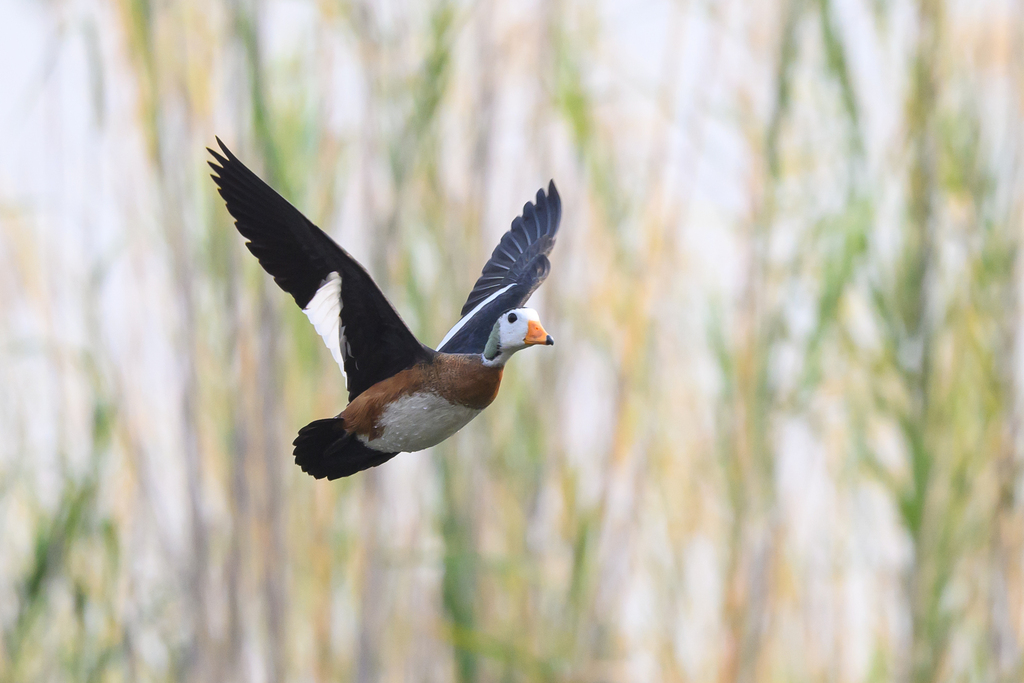
The African pygmy goose is one of the smallest of the perching ducks, and it has the average weight of about 285 grams (10.1 oz) for males and 260 grams (9.2 oz) for females. Length of individual wings is between 142 millimetres (5.6 in) and 165 millimetres (6.5 in) (not to be confused with wingspan). They have a short bill which extends up the forehead so they superficially resemble geese. The males have a white face with black eye patches. The iridescent black crown extends down the back of the neck. This structure fringes powder green ear patches. The upper half of the fore neck is white and forms an open collar around the neck whereas the base if the neck and breast are light chestnut colored. The flanks are more intensely chestnut colored and the back is metallic green. The sixteen tail feathers are black. The wing feathers are black with metallic green iridescence on the coverts, with the exemption of a white bar on the distal secondaries. The belly is white. The bill is yellow with a black tip and the feet are dark-gray to black. The iris of there is reddish brown. The females have a gray face with a dark brown eye stripe and smudged brown patches on the cheeks and nape. They have dark-brown a forehead, crown and back of the neck with a slight iridescence. The breast and flanks have a dark chestnut coloration. Their back is dark brown. …
Range & habitat
The African pygmy goose is known to be nomadic. It can be found across a wide area of sub-Saharan Africa and Madagascar. It lives in habitats of slow flowing or stagnant water with a cover of water lilies (mostly inland wetlands, but also open swamps, farm dens, river pools, and estuaries).
Wikipedia: “Distribution”
What it does
The African pygmy goose feeds mainly on the seeds of water lilies (Nymphaea spp.) but also on other floating seeds and small insects as well as other small invertebrates. They live in strong pair bonds that may last over several seasons and their breeding is triggered by rains. In captivity successful breeding is rare.
Wikipedia: “Behavior”
Listen
Looking for field recordings…
Where it lives
Recorded sightings
—
geo-referenced records in GBIF, from museums, herbaria and field observers.
Drag the globe to turn it. Dots are where records exist, not a range map; darker means more records.
In the stacks
Searching the stacks…
Every page naming Nettapus auritus in the Biodiversity Heritage Library →
This page is assembled live from iNaturalist, GBIF, Wikipedia, the Source Library and the Internet Archive. It is not yet part of the hand-edited codex. iNaturalist taxon 7127.