- Animals
- ›Arthropods
- ›Hexapods
- ›Insects
- ›Winged and Once-winged Insects
- ›Grasshoppers, Crickets, and Katydids
- ›Katydids, Crickets, and Allies
- ›Crickets
- ›True Crickets and Allies
- ›True Crickets
- ›Field Crickets
- ›Gryllini
- ›Gryllina
- ›Gryllus
- ›Gryllus
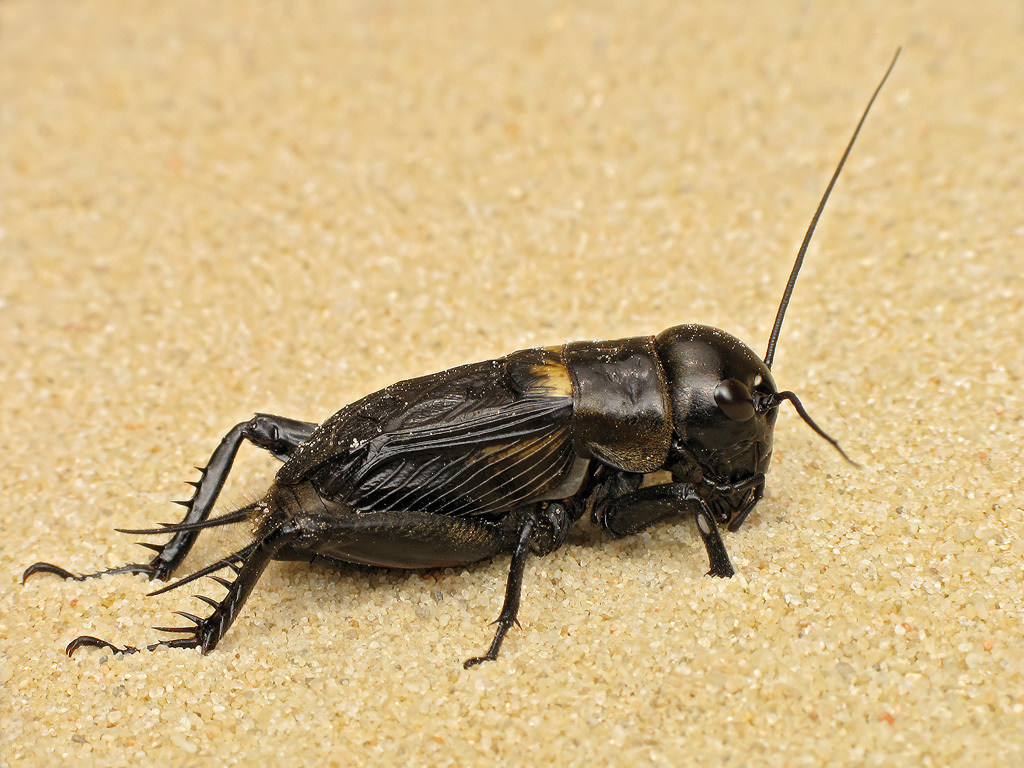
European Field Cricket
Gryllus campestris
Gryllus campestris, the European field cricket or simply the field cricket in the British Isles, is the type species of crickets in its genus and tribe Gryllini. These flightless dark colored insects are comparatively large; the males range from 19 to 23 mm and the females from 17 to 22 mm.
From the article Gryllus campestris on Wikipedia (CC BY-SA), quoted section by section
Range & habitat
Gryllus campestris used to be common over most of Western Europe. It prefers dry, sunny locations with short vegetation, like dry grasslands. At the northern edge of its range, it is restricted to heathlands and oligotrophic grasslands. The species is flightless and unable to migrate long distances, and it therefore does not commonly recover on its own from local extinction.
Wikipedia: “Habitat”
What it does
The reproductive season of the univoltine species lasts from May to July. The males make a burrow with a platform at the entrance from which they attract females with their courtship stridulation. They chirp during daytime as well as the first part of the night, only when the temperature is well above 13 °C (55 °F). Nymphs hatch in June till mid July and hibernate during their tenth or eleventh instar. The final moult takes place at the end of April or at the beginning of May. Males are territorial and defend their burrows fiercely, while females are vagrant and are attracted by singing males. They lay their eggs in bare ground either close to a burrow or inside the burrow. Populations of G. campestris are known to undergo extreme fluctuations and are strongly affected by weather conditions.
Wikipedia: “Reproduction”
Listen
Looking for field recordings…
Where it lives
Recorded sightings
—
geo-referenced records in GBIF, from museums, herbaria and field observers.
Drag the globe to turn it. Dots are where records exist, not a range map; darker means more records.
In the stacks
Searching the stacks…
Every page naming Gryllus campestris in the Biodiversity Heritage Library →
This page is assembled live from iNaturalist, GBIF, Wikipedia, the Source Library and the Internet Archive. It is not yet part of the hand-edited codex. iNaturalist taxon 71248.