- Animals
- ›Arthropods
- ›Hexapods
- ›Insects
- ›Winged and Once-winged Insects
- ›Grasshoppers, Crickets, and Katydids
- ›Katydids, Crickets, and Allies
- ›Crickets
- ›Mole and Ant Crickets
- ›Mole Crickets
- ›Gryllotalpinae
- ›Gryllotalpini
- ›Gryllotalpa
- ›Gryllotalpa gryllotalpa
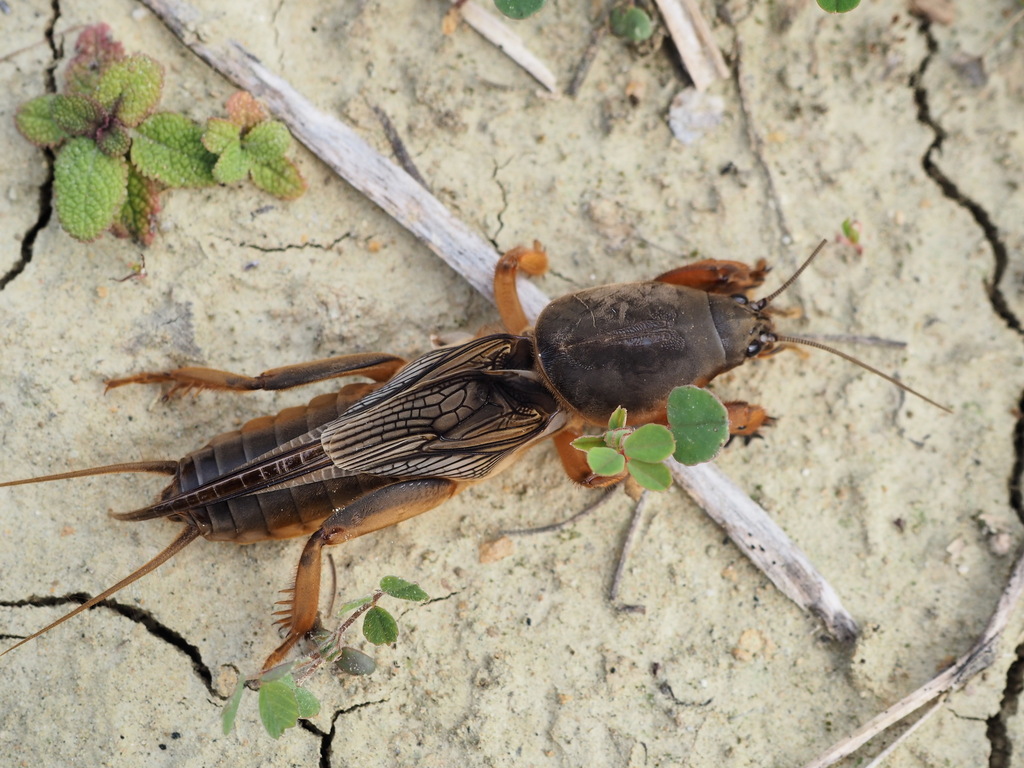
European Mole Cricket
Gryllotalpa gryllotalpa
Gryllotalpa gryllotalpa, commonly known as the European mole cricket, is widespread in Europe and has been introduced to the eastern United States. The scientific name is derived from the Latin 'gryllus' meaning a cricket and 'talpa', a mole, and is descriptive because of the fine dense fur by which it is covered and its subterranean habits, and because of the mole-like forelegs adapted for digging, a good example of convergent evolution.
From the article Gryllotalpa gryllotalpa on Wikipedia (CC BY-SA), quoted section by section
Description
The body length is about 50 millimetres (2.0 in) in males and 70 millimetres (2.8 in) in females. The cricket is dark brown with a silky shimmer and yellowish underside and is covered with fine velvety hairs. The forelegs are powerful and modified for digging. The elytra are half the length of the abdomen and the wings are transparent and netted with veins. They are folded into pleats and seldom used as the cricket normally remains below the ground. The males can be distinguished from the females by the open vein area in the forewing known as the 'harp' while the females lack the external ovipositor that is possessed by other crickets.
Range & habitat
This mole cricket occurs throughout much of the Western Palaearctic, but is replaced by similar species in the south and east, and becomes rare or absent towards the north. It is thought to be possibly extirpated from Ireland, given only one record from 1920. Favoured habitats include damp rich soils, flood plains, reservoir edges, irrigated and well-fertilized fields and vegetable gardens. The family Gryllotalpidae includes several similar species.
Wikipedia: “Range and habitat”
Listen
Looking for field recordings…
Where it lives
Recorded sightings
—
geo-referenced records in GBIF, from museums, herbaria and field observers.
Drag the globe to turn it. Dots are where records exist, not a range map; darker means more records.
In the stacks
Searching the stacks…
Every page naming Gryllotalpa gryllotalpa in the Biodiversity Heritage Library →
This page is assembled live from iNaturalist, GBIF, Wikipedia, the Source Library and the Internet Archive. It is not yet part of the hand-edited codex. iNaturalist taxon 71219.