- Plants
- ›Vascular Plants
- ›flowering plants
- ›Dicots
- ›Legumes, Milkworts, and Allies
- ›Legumes
- ›Faboideae
- ›Trifolieae
- ›Trifolium
- ›Trifolium
- ›Involucrarium
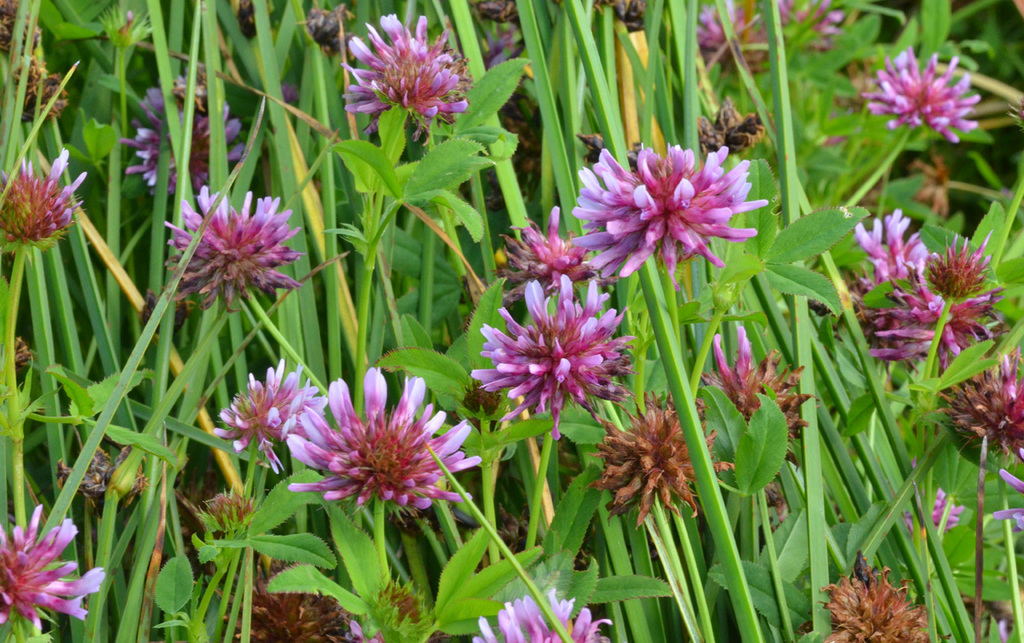
springbank clover
Trifolium wormskioldii
Trifolium wormskioldii is a species of clover native to the western half of North America. Its common names include cows clover, coast clover, sand clover, seaside clover, springbank clover, and Wormskjold's clover.
From the article Trifolium wormskioldii on Wikipedia (CC BY-SA), quoted section by section
Description
Trifolium wormskioldii, a legume, is a perennial herb sometimes taking a matlike form, with decumbent or upright stems. The leaves are made up of leaflets measuring 1 to 3 centimetres (1⁄2 to 1+1⁄4 inches) long. The lower stipules are tipped with bristles and the upper stipules may be toothed. The rounded inflorescences are 2 to 3 cm (3⁄4 to 1+1⁄4 in) wide. The sepals are bristle-tipped. The corollas are pinkish purple or magenta with white tips.
Range & habitat
This plant is native to the western half of North America from Alaska, through California, to Mexico. It is a perennial herb that grows in many locales, from beaches to mountain ridges, below about 3,200 metres (10,500 ft) in elevation. Habitats it grows in include chaparral, oak woodland, grassland, yellow pine forest, red fir forest, lodgepole forest, subalpine forest, and wetland−riparian.
Wikipedia: “Distribution and habitat”
At the table
Many Native American groups of western North America use this clover for food. The herbage and flowers are eaten raw, sometimes salted. The roots are commonly steamed or boiled and eaten with fish, fish eggs, and fish grease. This species is host to the caterpillar of the Western cloudywing butterfly (Thorybes diversus).
Wikipedia: “Uses”
How it is grown
The seeds germinate at 75F without the need for cold treatment or other dormancy breaking mechanism.
Wikipedia: “Propagation”
In human culture
The species was given its scientific name in honour of the Danish botanist Morten Wormskjold.
Wikipedia: “Etymology”
Where it lives
Recorded sightings
—
geo-referenced records in GBIF, from museums, herbaria and field observers.
Drag the globe to turn it. Dots are where records exist, not a range map; darker means more records.
In the stacks
Searching the stacks…
Every page naming Trifolium wormskioldii in the Biodiversity Heritage Library →
This page is assembled live from iNaturalist, GBIF, Wikipedia, the Source Library and the Internet Archive. It is not yet part of the hand-edited codex. iNaturalist taxon 71146.