- Animals
- ›Chordates
- ›Vertebrates
- ›Reptiles
- ›Snakes and Lizards
- ›Lizards
- ›Glass, alligator, monitor lizards and allies
- ›Monitor Lizards
- ›Varanus
- ›Polydaedalus
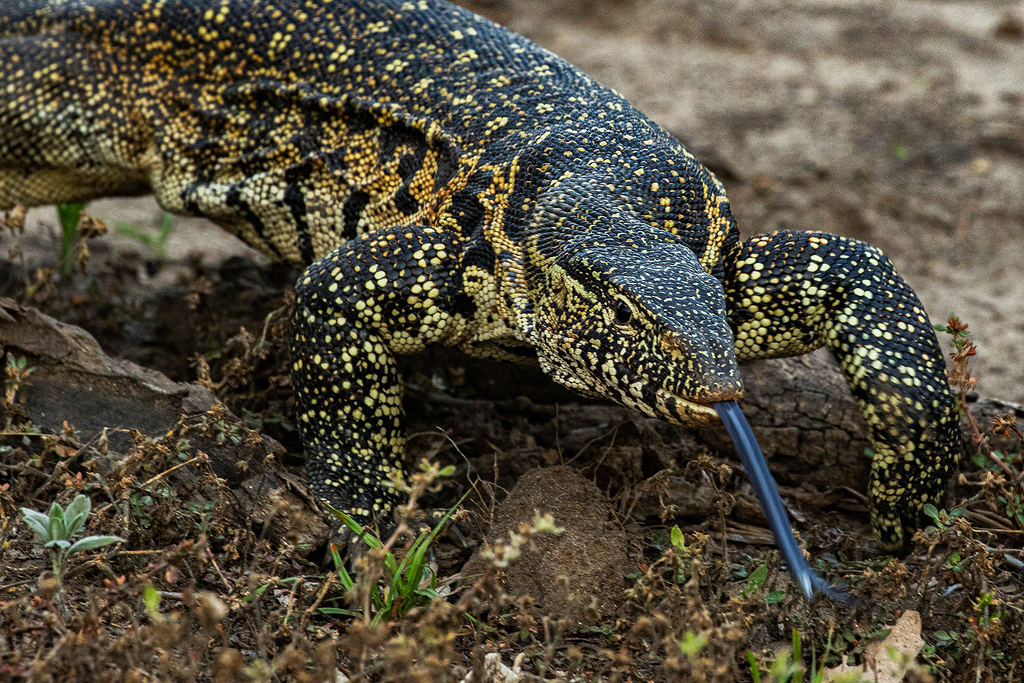
Nile Monitor
Varanus niloticus
The Nile monitor (Varanus niloticus) is a large member of the monitor family (Varanidae) found throughout most of Sub-Saharan Africa, particularly in drier regions, and along the Nile River and its tributaries in East Africa. Additionally, there are modern, invasive populations in North America. The population found in West African forests and savannahs is sometimes recognized as a separate species, the West African Nile monitor (V. niloticus stellatus) and Ornate monitor (V. niloticus ornatus). While it is dwarfed by its larger relatives, such as the Komodo dragon, the Asian water monitor or the crocodile monitor, it is still one of the largest lizards in the world, reaching (and even surpassing) Australia's perentie in size. Other common names include the African small-grain lizard, as well as iguana and various forms derived from it, such as guana, water leguaan or river leguaan (leguan, leguaan, and likkewaan mean monitor lizard in South African English, and can be used interchangeably).
A feral population of Nile monitors (descended from escaped or intentionally-released pets) has become established in several locations in South Florida. In addition to any illegally-released animals, it is speculated that during particularly intense hurricane seasons in Florida, many reptiles potentially escape when their enclosures are damaged or inadvertently unlocked; as Florida has a semi-tropical to tropical climate, many reptiles are housed outdoors, and poorly-secured enclosures may become damaged during bad storms.
From the article Nile monitor on Wikipedia (CC BY-SA), quoted section by section
Description
The Nile monitor is Africa's longest lizard. They grow from about 120 to 220 cm (3 ft 11 in to 7 ft 3 in) in length, with the largest specimens attaining 244 cm (8 ft). In an average-sized specimen, the snout-to-vent length will be around 50 cm (1 ft 8 in). In body mass, adults have been reported to vary widely, one study claiming only 0.8 to 1.7 kg (1.8 to 3.7 lb), others state weights ranging from 5.9 to 15 kg (13 to 33 lb) in big monitors. Variations may be due to age or environmental conditions. Exceptionally large specimens may scale as much as 20 kg (44 lb), but this species weighs somewhat less on average than the bulkier rock monitor. They have muscular bodies, strong legs, and powerful jaws. Their teeth are sharp and pointed in juvenile animals and become blunt and peg-like in adults. They also possess sharp claws used for climbing, digging, defense, or tearing at their prey. Like all monitors, they have forked tongues, with highly developed olfactory properties. The Nile monitor has quite striking, but variable, skin patterns, as they are greyish-brown above with greenish-yellow barring on the tail and large, greenish-yellow rosette-like spots on their backs with a blackish tiny spot in the middle. …
Range & habitat
Nile monitors are native to Sub-Saharan Africa and along the Nile. They are not found in any of the desert regions of Africa (notably Sahara, Kalahari and much of the Horn of Africa), however, they thrive around rivers. Nile monitors were reported to live in and around the Jordan River, Dead Sea, and wadis of the Judaean Desert in Israel until the late 19th century, though they are now extinct in the region.
Invasive species. In Florida in the United States, established breeding populations of Nile monitors have been known to exist in different parts of the state since at least 1990. Genetic studies have shown that these introduced animals are part of the subpopulation that originates from West Africa, and now often is recognized as its own species, the West African Nile monitor. The vast majority of the established breeding population is in Lee County, particularly in the Cape Coral and surrounding regions, including the nearby barrier islands (Sanibel, Captiva, and North Captiva), Pine Island, Fort Myers, and Punta Rassa. Established populations also exist in adjacent Charlotte County, especially on Gasparilla Island. Other areas in Florida with a sizeable number of Nile monitor sightings include Palm Beach County just southwest of West Palm Beach along State Road 80. In July 2008, a Nile monitor was spotted in Homestead, a small city southwest of Miami. …
Wikipedia: “Distribution and habitat”
Where it lives
Recorded sightings
—
geo-referenced records in GBIF, from museums, herbaria and field observers.
Drag the globe to turn it. Dots are where records exist, not a range map; darker means more records.
In the stacks
Searching the stacks…
Every page naming Varanus niloticus in the Biodiversity Heritage Library →
This page is assembled live from iNaturalist, GBIF, Wikipedia, the Source Library and the Internet Archive. It is not yet part of the hand-edited codex. iNaturalist taxon 71085.