On eBird ↗
Brown Mesite
Live sightings near you, the range map, bar charts of when it is seen, and Macaulay Library photos and recordings.
Brown Mesite
Mesitornis unicolor
The brown mesite (Mesitornis unicolor) is a ground-dwelling bird endemic to Madagascar. It is one of three species in the mesite family or the Mesitornithidae, and though classified as vulnerable by the International Union for Conservation of Nature (IUCN), it is the most widespread of the three.
From the article Brown mesite on Wikipedia (CC BY-SA), quoted section by section
Description
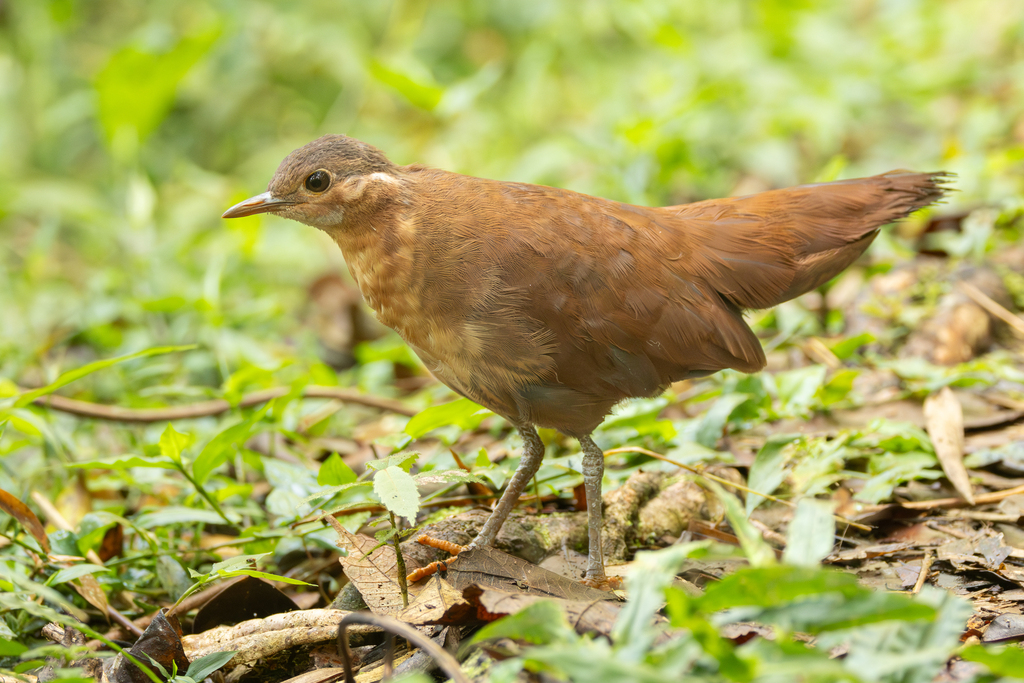
This species is a medium-sized terrestrial bird which is often described as rail-like. The species has a plain face, marked only by a slightly contrasting fleshy eye-ring around a rather large eye and a variable white streak behind the eye. It has a short straight bill. The upperparts of the bird are rufous brown, the underside tawny with no barring or spotting.
Range & habitat
The brown mesite has a patchy distribution in humid evergreen forest along the eastern coast of Madagascar, from Marojejy National Park in the north to Tôlanaro to the south.
Wikipedia: “Distribution”
What it does
The brown mesite is a humid forest species, it forages by walking through the forest floor flicking over leaf-litter in order to find invertebrates. Its rufous brown plumage provides reasonable camouflage on the shady forest floor. The preferred habitat is undisturbed deciduous forest from sea-level up to 1,200 meters (3,900 ft). One to three eggs are laid in a nest which consists of a loose platform made from twigs and lined with plant fibre and leaves. The eggs are dull white with brown markings on one end. Soon after hatching the chicks leave the nest. It is secretive and rarely seen. The brown mesite has never been observed flying; this may be simply due to its secretive habits, or it may be because it is in fact flightless.
Wikipedia: “Ecology”
Listen
Looking for field recordings…
Where it lives
Recorded sightings
—
geo-referenced records in GBIF, from museums, herbaria and field observers.
Drag the globe to turn it. Dots are where records exist, not a range map; darker means more records.
In the stacks
Searching the stacks…
Every page naming Mesitornis unicolor in the Biodiversity Heritage Library →
This page is assembled live from iNaturalist, GBIF, Wikipedia, the Source Library and the Internet Archive. It is not yet part of the hand-edited codex. iNaturalist taxon 71.