On eBird ↗
Canada Goose
Live sightings near you, the range map, bar charts of when it is seen, and Macaulay Library photos and recordings.
Canada Goose
Branta canadensis
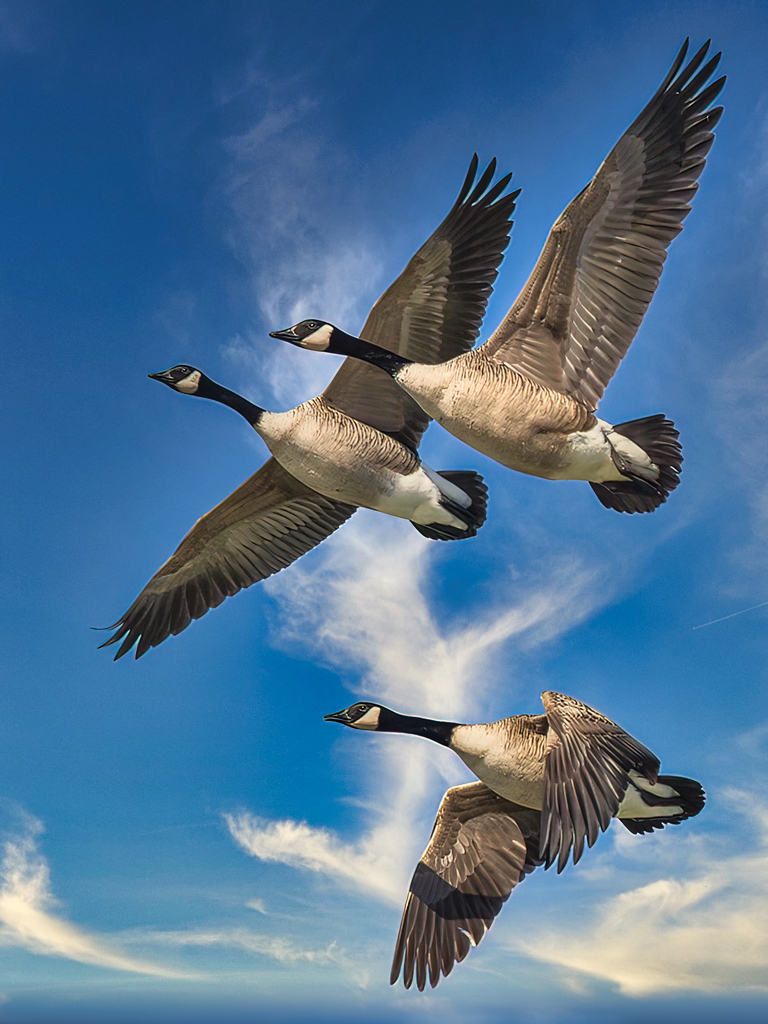
The Canada goose (Branta canadensis) is a large species of goose with a black head and neck, white cheeks, white under its chin, and a brown body. It is native to the Arctic and temperate regions of North America, and it is occasionally found during migration across the Atlantic in northern Europe. It has been introduced to France, the United Kingdom, Ireland, Scandinavia, New Zealand, Japan, Chile, Argentina, and the Falkland Islands. Like most geese, the Canada goose is primarily herbivorous and normally migratory; often found on or close to fresh water, the Canada goose is also common in brackish marshes, estuaries, and lagoons.
Adept at living in human-altered areas, Canada geese have established breeding colonies in urban and cultivated habitats, which provide food and have few natural predators. The success of this common park species has led to it often being considered a pest species. This is because of its excrement, its depredation of crops, its noise, its aggressive territorial behavior toward both humans and other animals, and its habit of stalking and begging for food. The last is a result of humans not following artificial feeding policies toward wild animals.
From the article Canada goose on Wikipedia (CC BY-SA), quoted section by section
Description
The black head and neck with a white "chinstrap" distinguish the Canada goose from all other goose species except the cackling goose and barnacle goose. (The latter, however, has a black breast and gray rather than brownish body plumage.) Some Canada geese come with a pepper-spotted or brown neck with brown plumage, and these are assumed to be a leucistic variety. On occasion, individuals with dark cheeks, white foreheads or white necks may be seen The seven subspecies of this bird vary widely in size and plumage details but all are recognizable as Canada geese. Some of the smaller subspecies can be hard to distinguish from the cackling goose, which slightly overlap in mass. However most subspecies of the cackling goose (exclusive of Richardson's cackling goose, B. h. hutchinsii) are considerably smaller. The smallest cackling goose, B. h. minima, is scarcely larger than a mallard. In addition to the size difference, cackling geese also have a shorter neck and smaller bill, which can be useful when small Canada geese comingle with relatively large cackling geese. Of the "true geese" (i.e. …
Range & habitat
This species is native to North America. It breeds in Canada and the northern United States in a wide range of habitats. The Great Lakes region maintains a large population of Canada geese. Canada geese live year-round in the southern part of their breeding range, including the northern half of the United States' eastern seaboard and Pacific Coast, and areas in between. Between California and South Carolina in the southern United States and in northern Mexico, Canada geese are mainly present as migrants from further north during the winter. By the early 20th century, overhunting and loss of habitat in the late 19th and early 20th centuries had resulted in a serious decline in the numbers of this bird in its native range. The giant Canada goose subspecies was believed to be extinct in the 1950s until, in 1962, a small flock was discovered wintering in Rochester, Minnesota, by Harold Hanson of the Illinois Natural History Survey.
In 1964, the Northern Prairie Wildlife Research Center was built near Jamestown, North Dakota. Its first director, Harvey K. Nelson, talked Forrest Lee into leaving Minnesota to head the center's Canada goose production and restoration program. Forrest soon had 64 pens with 64 breeding pairs of screened, high-quality birds. The project involved private, state, and federal resources and relied on the expertise and cooperation of many individuals. …
Wikipedia: “Distribution and habitat”
What it does
Like most geese, the Canada goose is naturally migratory with the wintering range being most of the United States. The calls overhead from large groups of Canada geese flying in a V-shaped formation signal the transitions into spring and autumn. In some areas, migration routes have changed due to changes in habitat and food sources. In mild climates from southwestern British Columbia to California to the Great Lakes, some of the population has become nonmigratory due to adequate winter food supply and a lack of former predators. Males exhibit agonistic behavior both on and off breeding and nesting grounds. This behavior rarely involves interspecific killing. One documented case involved a male defending his nest from a brant that wandered into the area; the following attack lasted for one hour until the death of the brant. The cause of death was suffocation or drowning in mud as a direct result of the Canada goose's pecking the head of the brant into the mud. Researchers attributed it to high hormone levels and the brant's inability to leave the nesting area.
Diet. Canada geese are primarily herbivores, although they sometimes eat small insects and fish. Their diet includes green vegetation and grains. The Canada goose eats a variety of grasses when on land. It feeds by grasping a blade of grass with the bill, then tearing it with a jerk of the head. …
Wikipedia: “Behavior”
At the table
As a large, common wild bird, the Canada goose is a common target of hunters, especially in its native range. Drake Larsen, a researcher in sustainable agriculture at Iowa State University, described their meat to The Atlantic magazine as "yummy ...good, lean, rich meat" and finds it "similar to a good cut of beef". The British Trust for Ornithology, however, has described them as "reputedly amongst the most inedible of birds". The U.S. goose harvest for 2013–14 reported over 1.3 million geese taken. Canada geese are rarely farmed, and sale of wild Canada goose meat is rare due to regulation and slaughterhouses' lack of experience with wild birds. Geese in New York City parks culled by the New York City Department of Environmental Protection have been donated to food banks in Pennsylvania.
Wikipedia: “Cuisine”
In human culture
Branta was a Latinized form of Old Norse Brandgás, "burnt (black) goose" and the specific epithet canadensis is a Neo-Latin word meaning "from Canada". According to the Oxford English Dictionary, the first citation for the 'Canada goose' dates back to 1772. The Canada goose is also colloquially referred to as the "Canadian goose".
Wikipedia: “Etymology”
Listen
Looking for field recordings…
Where it lives
Recorded sightings
—
geo-referenced records in GBIF, from museums, herbaria and field observers.
Drag the globe to turn it. Dots are where records exist, not a range map; darker means more records.
In the old herbals & bestiaries

In the stacks
Searching the stacks…
Every page naming Branta canadensis in the Biodiversity Heritage Library →
This page is assembled live from iNaturalist, GBIF, Wikipedia, the Source Library and the Internet Archive. It is not yet part of the hand-edited codex. iNaturalist taxon 7089.