On eBird ↗
Pink-headed Duck
Live sightings near you, the range map, bar charts of when it is seen, and Macaulay Library photos and recordings.
Pink-headed Duck
Rhodonessa caryophyllacea
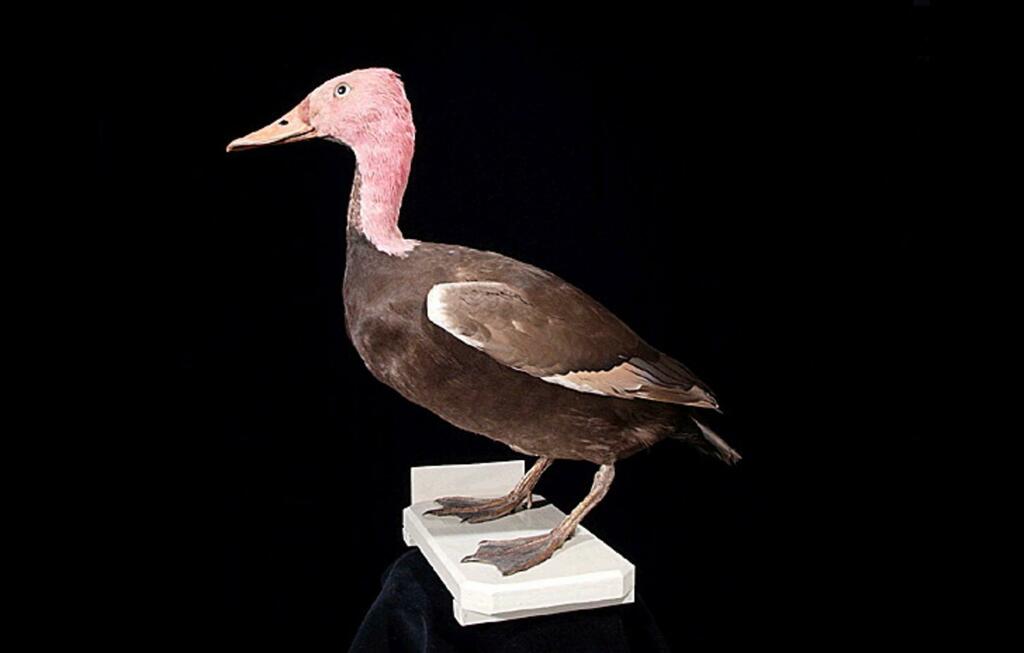
The pink-headed duck (Rhodonessa caryophyllacea) is a probable extinct species of large diving duck that was once found in parts of the Gangetic plains and parts of Maharashtra State of India, Nepal, Bangladesh and in the riverine swamps of Myanmar but has been feared extinct since the 1950s. Numerous searches have failed to provide any proof of continued existence. It has been suggested that it may exist in the inaccessible swamp regions of northern Myanmar and some sight reports from that region have led to its status being declared as "Critically Endangered" rather than extinct. The genus placement has been disputed and while some have suggested that it is close to the red-crested pochard (Netta rufina), others have placed it in a separate genus of its own. It is unique in the pink colouration of the head combined with a dark body. A prominent wing patch and the long slender neck are features shared with the common Indian spot-billed duck. The eggs have also been held as particularly peculiar in being nearly spherical.
From the article Pink-headed duck on Wikipedia (CC BY-SA), quoted section by section
Description
The male pink-headed duck is unmistakable in good view. Both sexes are 41–43 cm and long-billed with long necks and peaked heads. The male has a pink bill, head and neck while the female has a pale pinkish head and neck with a paler bill. The black of the body extends as a narrow strip on the front of the neck. Wings have a leading white edge. In flight it would not contrast as much as the syntopic white-winged duck. Wing does not have the dark trailing edge of the red-crested pochard. Confusion with male red-crested pochards stems mainly from observations of swimming birds, as the latter species also has a conspicuous red head (although the color is actually very different from the pink-headed duck). Indian spot-billed ducks, on the other hand, can look similar to female pink-headed ducks when in flight and seen from a distance, and if seen from behind, they could be mistaken for males too. The upper side of the wing is distinguishing, with dark green secondaries (speculum) and prominent white tertiaries in the spot-billed duck and a pinkish-beige speculum, much lighter than its surroundings, in the pink-headed duck. If the upper part of the wings cannot be reliably seen, they are all but indistinguishable except to expert observers in good visibility conditions. …
Range & habitat
Allan Octavian Hume and Stuart Baker noted that the stronghold of the species was north of the Ganges and west of the Brahmaputra, mainly in Maldah, Purnea, Madhubani and Purulia districts of present-day Bihar. It was said to be commoner in Singhbum. Hume collected a specimen in Manipur which he noted was very rare, hiding among dense reeds in Loktak Lake. Edward Blyth claimed that it was found in the Rakhine state of Burma. Brian Houghton Hodgson obtained specimens from Nepal. A few records were also noted from Delhi, Sindh and Punjab. The populations (possibly) undertook local seasonal movements, resulting in scattered historic records as far as Punjab, Maharashtra and Andhra Pradesh. Thus, resulting in rare sightings of the species in Maharashtra. Birds were also reported from the Oudh region some from very close to Lucknow. Specimens were shot at Najafgarh lake in the Delhi district. Jerdon obtained specimens of the bird from further south although he did not personally observe any in the wild until he visited Bengal.
Wikipedia: “Distribution”
Listen
Looking for field recordings…
Where it lives
Recorded sightings
—
geo-referenced records in GBIF, from museums, herbaria and field observers.
Drag the globe to turn it. Dots are where records exist, not a range map; darker means more records.
In the stacks
Searching the stacks…
Every page naming Rhodonessa caryophyllacea in the Biodiversity Heritage Library →
This page is assembled live from iNaturalist, GBIF, Wikipedia, the Source Library and the Internet Archive. It is not yet part of the hand-edited codex. iNaturalist taxon 7085.