On eBird ↗
Common Shelduck
Live sightings near you, the range map, bar charts of when it is seen, and Macaulay Library photos and recordings.
Common Shelduck
Tadorna tadorna
The common shelduck (Tadorna tadorna) is a waterfowl species of the shelduck genus, Tadorna. It is widespread and common in the Euro-Siberian region of the Palearctic, mainly breeding in temperate and wintering in subtropical regions; in winter, it can also be found in the Maghreb. Its scientific name comes from the French name Tadorne for this species. It may originally derive from Celtic roots meaning "pied waterfowl", essentially the same as the English "shelduck".
From the article Common shelduck on Wikipedia (CC BY-SA), quoted section by section
Description
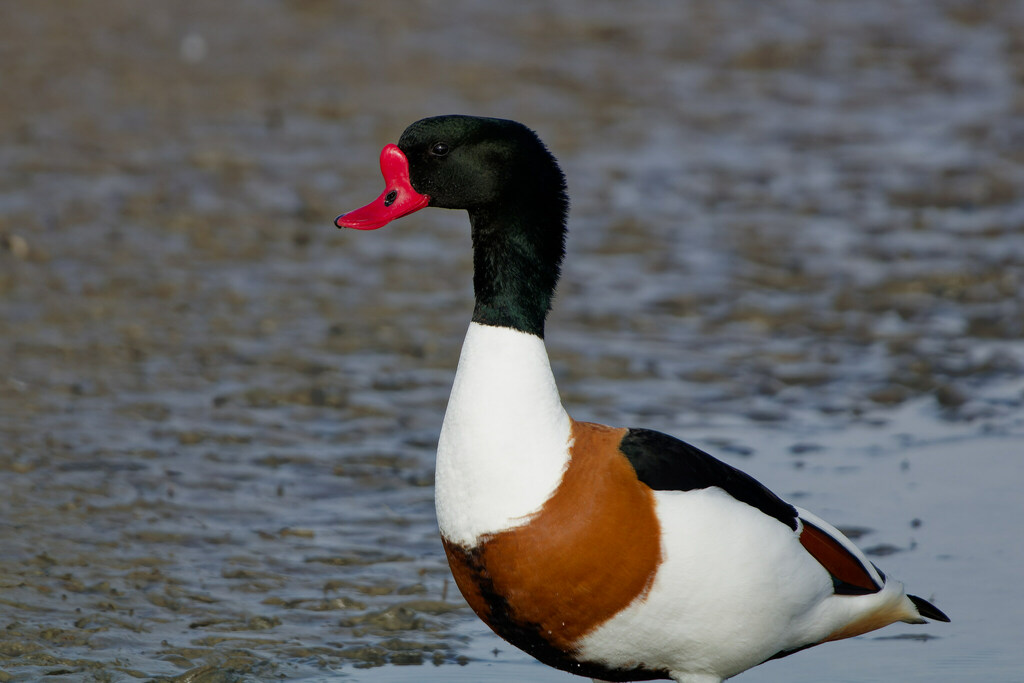
The common shelduck resembles a small short-necked goose in size and shape. It is 55–65 cm long and with a wingspan of 100–120 cm, with a reddish-pink bill, pink feet, a white body with chestnut patches and a black belly, and a dark green head and neck. The wing coverts are white, the primary remiges black, and the secondaries black with a strong green iridescent reflection in good light (only showing in flight). The outer tertial feather is orange-brown, with the inner tertials white. The underwings are white, except for the flight feathers, which are black. The sexes are similar, but the female is slightly smaller, usually with some white flecks on the green face, while the male is particularly crisply coloured in the breeding season, his bill bright red and bearing a prominent knob at the base of the bill. The ducklings are white, with blackish-brown cap, hindneck and wing and back patches. Juveniles are similarly coloured, greyish above and mostly white below, but already have the adult's wing pattern. The call is a loud honk.
Range & habitat
This is a bird which breeds in the temperate Palearctic region. It has increased and spread markedly since the mid 20th century; at that time in Europe it was strongly restricted to coasts, estuaries and other saline habitats, but is now widespread inland in open freshwater wetlands. It has also spread northwards; in the mid 20th century, it only reached north to 66°N latitude in Norway, but by 2020 had spread along the entire Norwegian coast and into northwestern Russia, including since 2000 in the Murmansk area and the White Sea. Breeding has also expanded south, with extensive colonisation of the Iberian Peninsula, where it formerly only wintered. Much of the increase is thought to be related to improved protection from hunting, but also increased eutrophication of estuaries and wetlands increasing the availability of food. In northwest Africa, breeding is restricted to Tunisia, but it is more widespread in winter west to Morocco. Asian populations migrate to subtropical areas in winter, south to northern India and southern China, but this species is largely resident in Europe, apart Scandinavian and some eastern European populations which migrate southwest, and from movements to favoured late summer moulting grounds, such as the Wadden Sea on the north German coast. The common shelduck is common around the coastline of Great Britain and Ireland (where it is known simply as …
Wikipedia: “Distribution and habitat”
What it does
Moulting flocks can be very large (100,000 on the Wadden Sea), since most pairs leave their partially grown young in a crèche with just one or two adults. This species is mainly associated with estuaries and tidal mudflats, but increasingly also in freshwater lakes and rivers in open country inland, breeding in rabbit burrows, tree holes, haystacks or similar. In winter it is more confined to estuaries and tidal mudflats. Like geese and swans but unlike most ducks, both parents protect the ducklings and lead them to good feeding areas, which can be up to 3 km from the nest site; only the female broods the young though. The young will dive under water to avoid predators and the adults will fly away from them to act as a decoy. Shelduck typically breed for the first time when 2 years old; the maximum recorded age is just short of 20 years. This bird is one of the species to which the Agreement on the Conservation of African-Eurasian Migratory Waterbirds (AEWA) applies.
Wikipedia: “Behaviour”
Listen
Looking for field recordings…
Where it lives
Recorded sightings
—
geo-referenced records in GBIF, from museums, herbaria and field observers.
Drag the globe to turn it. Dots are where records exist, not a range map; darker means more records.
In the stacks
Searching the stacks…
Every page naming Tadorna tadorna in the Biodiversity Heritage Library →
This page is assembled live from iNaturalist, GBIF, Wikipedia, the Source Library and the Internet Archive. It is not yet part of the hand-edited codex. iNaturalist taxon 7067.