On eBird ↗
Lesser Scaup
Live sightings near you, the range map, bar charts of when it is seen, and Macaulay Library photos and recordings.
Lesser Scaup
Aythya affinis
The lesser scaup (Aythya affinis) is a small North American diving duck that migrates south as far as Central America in winter. It is colloquially known as the little bluebill or broadbill because of its distinctive blue bill. The origin of the name scaup may stem from the bird's preference for feeding on scalp—the Scottish word for clams, oysters, and mussels; however, some credit it to the female's discordant scaup call as the name's source. It is apparently a very close relative of the Holarctic greater scaup or "bluebill" (A. marila), with which it forms a superspecies. The scientific name is derived from Ancient Greek and Latin, with aithuia being an Ancient Greek term for an unidentified seabird, used by Hesychius and Aristotle, among other authors, and affinis, Latin for "related to", from the lesser scaup's resemblance to the greater scaup.
From the article Lesser scaup on Wikipedia (CC BY-SA), quoted section by section
Description
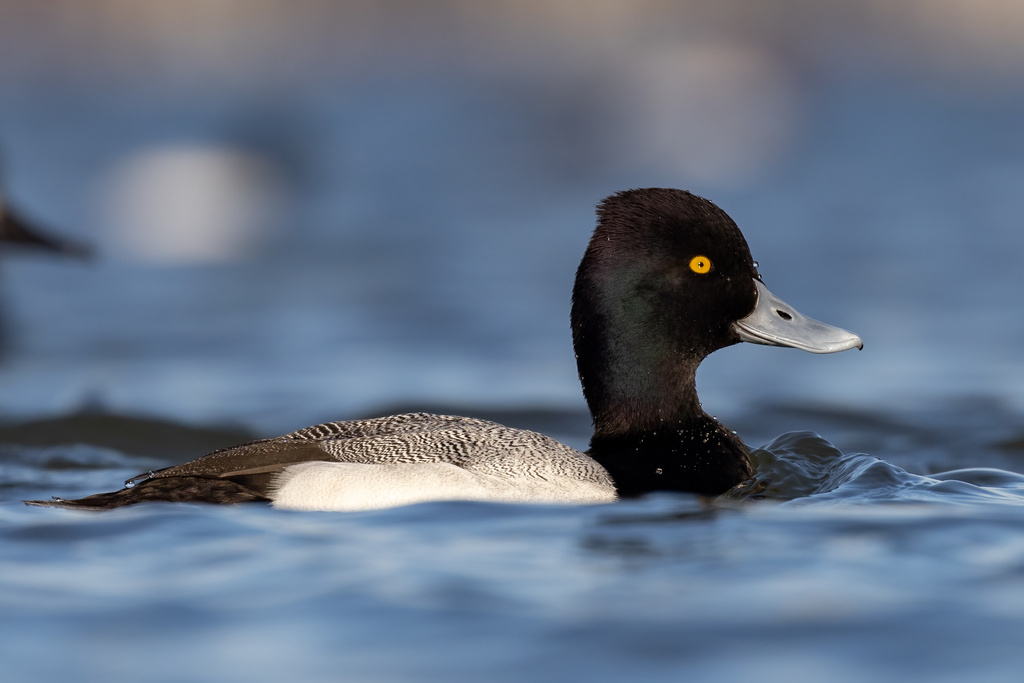
Adults are 38–48 cm (15–19 in) long, 41.7–43 cm (16.4–16.9 in) on average. The species can weigh 454–1,089 g (1.001–2.401 lb); males weigh 820 g (1.81 lb) on average while females weigh noticeably less, at 730 g (1.61 lb) on average. Wing lengths (not wingspans) are about 7.5–7.9 in (19–20 cm) in males and 7.3–7.8 in (19–20 cm) in females. The tarsus is about 1.4–1.5 in (3.6–3.8 cm) long, and the bill is 1.4–1.7 in (3.6–4.3 cm). The wingspan is 68–78 cm (27–31 in). The adult males (drakes) in definitive basic (breeding) plumage have a black, iridescent head and a small tuft at the hindcrown, a black breast, a whitish-grey back, wings with darker vermiculations and black outer and greyish-brown inner primary remiges. The underparts are white with some olive vermiculations on the flanks, and the rectrices and tail coverts are black. Adult females (hens) have a white band at the base of the bill and often a lighter ear region, and are otherwise dark brown all over, shading to white on the mid-belly. Drakes in eclipse plumage look similar, but with a very dark head and breast, little or no white on the head and usually some greyish vermiculations on the wings. Immature birds resemble the adult females, but are duller and have hardly any white at the bill base. …
Range & habitat
Their breeding habitats are inland lakes and arctic marsh ponds from Alaska through western Canada to western Montana; few breed east of James Bay and the Great Lakes. Notable breeding concentrations, with more than half a million birds at the height of the season, can be found in Alaska, in the woodlands of the McKenzie River valley and on the Old Crow Flats. These birds migrate south (mostly via the Central and Mississippi Flyways) when the young are fledged and return early spring, usually arriving on the breeding ground in May. Lesser scaup typically travel in flocks of 25–50 birds and winter mainly on lakes, rivers and sheltered coastal lagoons and bays between the US–Canada border and northern Colombia, including Central America, the West Indies and Bermuda. Wintering lesser scaup are typically found in freshwater or slightly brackish habitat and unlike greater scaup rarely are seen offshore when unfrozen freshwater habitat is available. They may even spend the winter on lakes in parks, as long as they are not harassed, and will occur even on smallish Caribbean islands such as Grand Cayman. Thousands winter each year on the Topolobampo lagoons in Mexico, and even in the southernmost major wintering location—Ciénaga Grande de Santa Marta in Colombia—hundreds of birds can be seen. In Central America, flocks are present from July on, but only really numerous after September. …
Wikipedia: “Distribution and migration”
What it does
Lesser scaup forage mainly by sifting through the bottom mud, usually after diving and swimming underwater, occasionally by dabbling without diving. They mainly eat mollusks such as mussels and clams, as well as seeds and other parts of aquatic plants like sedges and bulrushes (Cyperaceae), "pondweeds", widgeon-grass (Ruppia cirrhosa), wild celery (Vallisneria americana) or wild rice (Zizania). In winter, but less so in summer, other aquatic animals—crustacean, insect and their larvae and small fishes—form an important part of their diet. It has been reported that both the lesser and the greater scaup have shifted their traditional migration routes to take advantage of the presence of the zebra mussel (Dreissena polymorpha) in Lake Erie, which was accidentally introduced in the 1980s and has multiplied enormously. This may pose a risk to these birds because zebra mussels are efficient filter feeders and so accumulate environmental contaminants rapidly. They nest in a sheltered location on the ground near water, usually among thick vegetation such as sedges and bulrushes, sometimes in small loose groups and not rarely next to colonies of gulls or terns; several females may deposit eggs in a single nest. The drakes court the hens in the winter quarters; pairs form shortly before and during the spring migration. …
Wikipedia: “Ecology”
Listen
Looking for field recordings…
Where it lives
Recorded sightings
—
geo-referenced records in GBIF, from museums, herbaria and field observers.
Drag the globe to turn it. Dots are where records exist, not a range map; darker means more records.
In the stacks
Searching the stacks…
Every page naming Aythya affinis in the Biodiversity Heritage Library →
This page is assembled live from iNaturalist, GBIF, Wikipedia, the Source Library and the Internet Archive. It is not yet part of the hand-edited codex. iNaturalist taxon 7054.