On eBird ↗
Surf Scoter
Live sightings near you, the range map, bar charts of when it is seen, and Macaulay Library photos and recordings.
Surf Scoter
Melanitta perspicillata
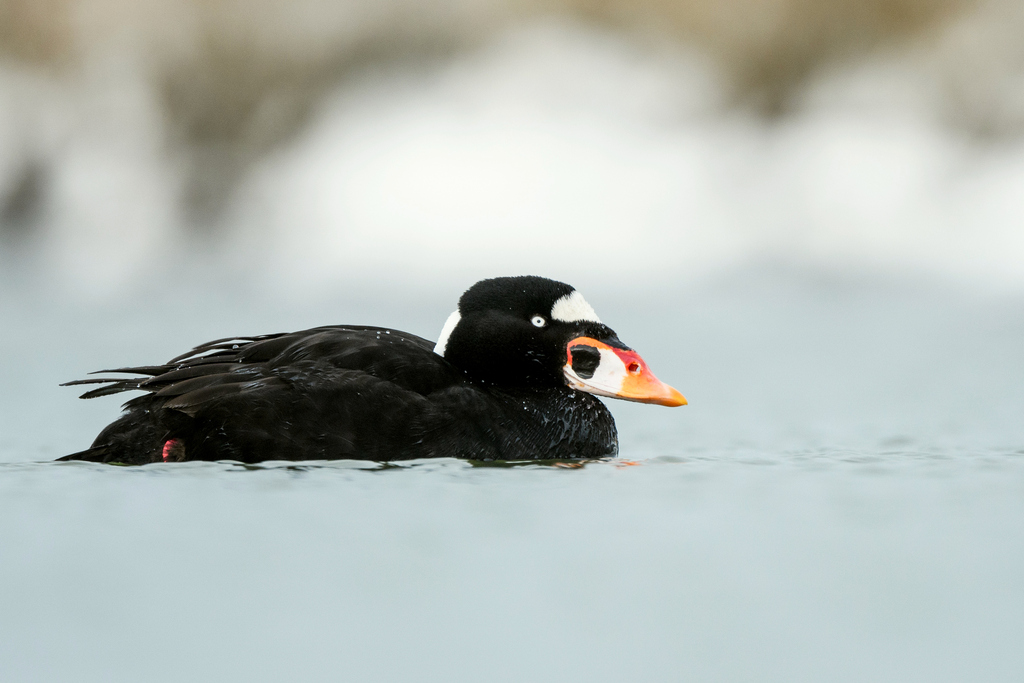
The surf scoter (Melanitta perspicillata) is a large sea duck native to North America. Adult males are almost entirely black with characteristic white patches on the forehead and the nape and adult females are slightly smaller and browner. Surf scoters breed in Northern Canada and Alaska and winter along the Pacific and Atlantic coasts of North America. They are diving ducks and mainly feed on benthic invertebrates, mussels representing an important part of their diet.
From the article Surf scoter on Wikipedia (CC BY-SA), quoted section by section
Description
The surf scoter reaches sexual maturity after 3 years. The adult male is on average 1,050 g (2.31 lb) and 48 cm (19 in) in length while the adult female averages about 900 g (2.0 lb) and 44 cm (17 in) in length, making this the smallest species of scoter on average. The surf scoter has a wingspan of 29.9–30.3 in (76–77 cm). The male is completely velvety black except for white patches on the forehead and the nape. It has a swollen bill, appearing orange at a distance but patterned with white, red and yellow, and a black spot near the base. The female is browner than the male, with a fairly uniform plumage, slightly darker above than below. Indistinct paler patches are present on the cheeks below the eye and sometimes a whitish patch is on the nape, a unique trait among scoters. The bill is black with green or blue colorations The juvenile has a plumage similar to the female, but mainly paler and browner, and the breast and belly are whitish. The surf scoter is easily distinguishable from other scoters by the white patch on the head of the adult male and its unique bill pattern. Females and immatures have a bulkier bill with a squarish base and a more flattened head profile than other scoters. …
Range & habitat
Compared to most Northern American sea ducks, the surf scoter breeds exclusively in North America, mostly in Northern Canada and Alaska. Then, they take different migration routes to spend the winter in more temperate environments. While small numbers regularly winter in western Europe as far south as Ireland and Britain, the vast majority of surf scoters winter along the Pacific and Atlantic coasts of North America. The Pacific coast host the highest number of individuals and its large wintering range extends over 5,000 km (3,100 mi), from the Aleutian Islands in Alaska to the Baja Peninsula in Mexico. This migratory species breeds in the boreal forests near northern freshwater lakes. Very few nests have been observed but they tend to be near spruce cover, slightly upland to wetland areas. To complete its molt before migration, the surf scoter travels to a molting site, which differ from the wintering or the nesting site. Because of the vulnerable state of the ducks in those periods, molting sites are assumed to have profitable food and lower predation risks and they are located in bays, inlets or estuaries. The surf scoter winters in marine habitats near the shore.
Migration. Many migration routes have been observed, and the route choice of the surf scoter will depend on the latitude of its nesting site. …
Wikipedia: “Distribution and habitat”
What it does
The surf scoter mainly feeds on benthic invertebrates. During the breeding period, surf scoters forage in pairs or small groups on a diverse range of freshwater invertebrates. However, the sea ducks feed on marine organisms for the rest of the year, in flocks ranging from a few individuals to several thousands birds. Important foods include crustaceans, herring spawn, gastropods and small bivalves such as mussels. In late winter and spring, Surf scoters tend to shift their diet according to the relative profitability of the food, showing a level of opportunism. For example, they start feeding in seagrass beds, on epifaunal crustaceans that have increased in size over winter or on Pacific herring eggs (Clupea pallasi), during the fish spawning. As the prey landscape changes, surf scoters will adjust their foraging effort and habitat selection. Effort is lowest in December, due to high prey abundance, and it increases until mid-February, when prey declines. It increases again in March, probably due to the increasing daylight time for foraging. As the season progresses, surf scoters move to habitats with lower prey declines, instead of staying in habitats poor in prey and increasing their foraging effort. A surf scoter usually captures its food underwater and consumes it whole. …
Wikipedia: “Diet and foraging”
Listen
Looking for field recordings…
Where it lives
Recorded sightings
—
geo-referenced records in GBIF, from museums, herbaria and field observers.
Drag the globe to turn it. Dots are where records exist, not a range map; darker means more records.
In the stacks
Searching the stacks…
Every page naming Melanitta perspicillata in the Biodiversity Heritage Library →
This page is assembled live from iNaturalist, GBIF, Wikipedia, the Source Library and the Internet Archive. It is not yet part of the hand-edited codex. iNaturalist taxon 7036.