- Animals
- ›Arthropods
- ›Hexapods
- ›Insects
- ›Winged and Once-winged Insects
- ›Butterflies and Moths
- ›Hawk, Sphinx, Silk, Emperor, and Allied Moths
- ›Sphinx Moths
- ›Macroglossine Sphinx Moths
- ›Macroglossini
- ›Choerocampina
- ›Hyles
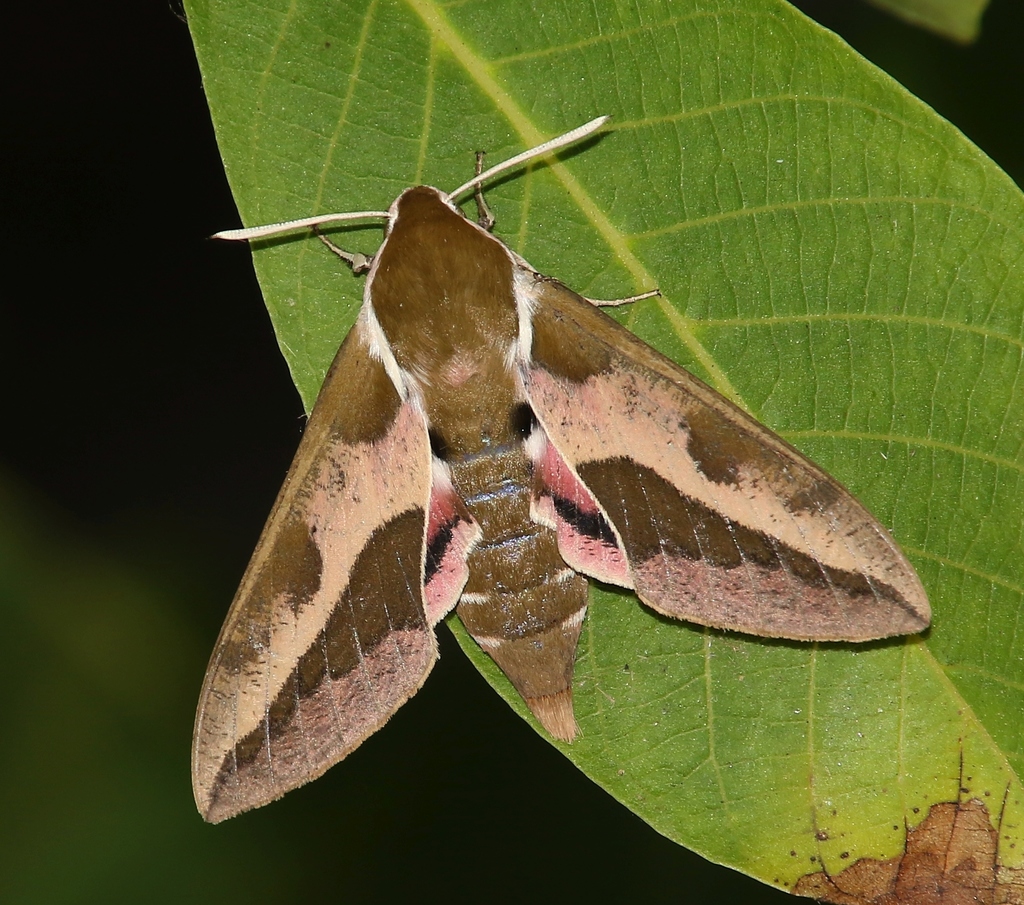
Leafy Spurge Hawkmoth
Hyles euphorbiae
Hyles euphorbiae, the spurge hawk-moth, is a European moth of the family Sphingidae. This hawk moth is used as an agent of biological pest control against the noxious weed leafy spurge (Euphorbia virgata), but usually only in conjunction with other agents. The larvae consume the leaves and bracts of the plant. The species was first described by Carl Linnaeus in his 1758 10th edition of Systema Naturae.
From the article Hyles euphorbiae on Wikipedia (CC BY-SA), quoted section by section
Description
The Spurge Hawk-Moth - Fore wings grey, with an almost square olive-brown blotch; at the base another olive-brown blotch near the middle, and a long oblique band of the same colour, commencing in a point at the extreme apex of the wing, and gradually growing wider until it reaches the margin, where it is very broad: hind wings pink, with a black blotch at the base, and a black band half-way between this black blotch and the margin, and a snowy-white blotch at the anal angle: thorax and body olive-brown, with a white line on each side of the thorax just at the base of the wings; this line runs on each side along the head just above the eye, and the two meet at the nose; the body has on each side at the base two square black spots and two square white spots, and beyond them, nearer the apex, and also on each side, are three white lines. The caterpillar is smooth and black, with innumerable whitish dots; there are also eleven large spots of the same colour arrayed in a row on each side of the back, and beneath these as many spots of the same size and of a bright coral-red colour; the head is of the same coral-red colour, and a line of the same colour runs all along the back, from the head to the horn; the horn is red at the base and black at the tip. …
Listen
Looking for field recordings…
Where it lives
Recorded sightings
—
geo-referenced records in GBIF, from museums, herbaria and field observers.
Drag the globe to turn it. Dots are where records exist, not a range map; darker means more records.
In the stacks
Searching the stacks…
Every page naming Hyles euphorbiae in the Biodiversity Heritage Library →
This page is assembled live from iNaturalist, GBIF, Wikipedia, the Source Library and the Internet Archive. It is not yet part of the hand-edited codex. iNaturalist taxon 70071.