- Plants
- ›Vascular Plants
- ›conifers
- ›conifers
- ›pine family
- ›pines, spruces, larches, and allies
- ›Pinus
- ›Pinus
- ›Trifoliae
- ›Australes
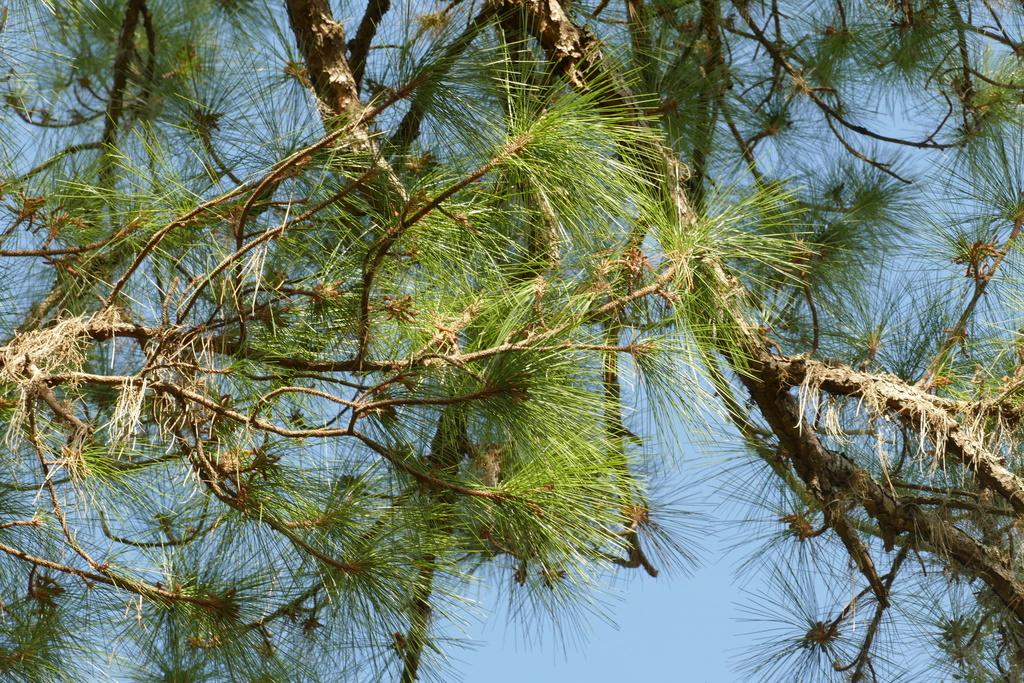
slash pine
Pinus elliottii
Pinus elliottii, commonly known as slash pine, is a species of conifer in the family Pinaceae, a pine native to the coastal plain of the Southeastern United States. Slash pine is named after the "slashes" – swampy ground overgrown with trees and bushes – that constitute its habitat. Other common names include swamp pine, yellow slash pine, and southern Florida pine. Slash pine has two different varieties: P. e. var. elliottii and P. e. var. densa. Historically, slash pine has been an important economic timber for naval stores, turpentine, and resin. The wood of slash pine is known for its unusually high strength, especially for a pine. It exceeds many hardwoods and is even comparable to very dense woods such as black ironwood.
From the article Pinus elliottii on Wikipedia (CC BY-SA), quoted section by section
Description
This tree is fast-growing, but not very long-lived by pine standards (to 200 years). It reaches heights of 18–30 m (59–98 ft) with a trunk diameter of 0.6–0.8 m (2.0–2.6 ft). The leaves are needle-like, very slender, in clusters of two or three, and 18–24 cm (7.1–9.4 in) long. The cones are glossy red-brown, 5–15 cm (2.0–5.9 in) in length, with a short (2–3 mm or 0.079–0.118 in), thick prickle on each scale. It is known for its conical shape and unusually high strength, especially for a pine. Its wood has an average crush strength of 8,140 lb/in2 (56.1 MPa), which exceeds many hardwoods such as white ash (7,410 lb/in2) and black maple (6,680 lb/in2). It is not as strong as black ironwood (9,940 lb/in2), but because its average density is less than half that of ironwood, slash pine has a far greater strength-to-weight ratio. It may be distinguished from the related loblolly pine (P. taeda) by the somewhat longer, glossier needles and larger red-brown cones, and from longleaf pine (P. palustris) by the shorter, more slender needles and smaller cones with less broad scales. Two varieties of P. elliotii are described, but recent genetic studies have indicated that the varieties may not be more closely related to each other than they are to other pines in the Southeast. If this is the case, reclassifying these varieties as separate species would be warranted. P. …
Wikipedia: “Description and taxonomy”
Range & habitat
Communities dominated by slash pine are termed "slash pine forests". Slash pine is predominately found in Florida and Georgia, and extends from South Carolina west to southeastern Louisiana, and south to the Florida Keys. It is common in East Texas, where it was first planted at the E.O. Siecke State Forest in 1926. The natural habitat is sandy subtropical maritime forests and wet flatwoods. Slash pine generally grows better in warm, humid areas where the average annual temperature is above 17 °C (63 °F), with extreme ranges from −18 to 41 °C (0 to 106 °F). Factors such as competition, fire, and precipitation may limit the natural distribution of these trees. Slash pines are able to grow in an array of soils, but pine stands that are close to bodies of water such as swamps and ponds grow better because of higher soil moisture and seedling protection from wildfire. These forests have been managed through controlled fires since the beginning of the 20th century. Within the first year, P. elliottii is particularly susceptible to seedling mortality caused by fire. P. e. var. densa is more fire resistant than P. e. var. elliottii because it has thicker bark.
Wikipedia: “Range and habitat”
At the table
Without regular fire intervals in slash pine forests, the ecosystem can change over time. For example, in the northern range for slash pine, forests can convert from mesic flatwoods to denser mixed-hardwood canopies with trees such as oaks, hickory, and southern magnolia. In South Florida, the pine rocklands can convert to a rockland hammock dominated by woody shrubs and invasive plants. Invasive species are a major management issue in the South. Many pine trees and native plants are adapted to fire, meaning they require fire disturbance to open their pine cones, germinate seeds, and cue other metabolic processes. Fire can be a good management strategy for invasive species because many invasive plants are not adapted to fire. Therefore, fire can eliminate the parental plant or reduce seed viability. Controlled burning is also used to help reduce pathogen load in an ecosystem. For example, fire can eliminate pest populations or resting fungal spores that could infect new seedlings. Low-intensity burns can also clear space in the understory and provide nutrient pulses that benefit the understory vegetation. Fire is also used to prevent "fuel" buildup, the highly flammable plants such as grasses and scrub under the canopy that could burn easily in a wildfire. Most prescribed burn intervals are about every 2–5 years, which allows the ecosystem to regenerate after the burn. …
Wikipedia: “Uses”
In human culture
Fire has long been an important element in Southeastern forests. Native Americans burned land to improve grass growth for grazing and visibility for hunting. When European settlers arrived in the New World, they brought new diseases that severely diminished the Native American populations. Over time, with the lack of consistent burning, much of the open land of the South reverted to forest land. Logging began to increase in the Southeast, which created some tension between the loggers and local farmers. The loggers wanted to continue to burn the forest, but the local farmers were concerned about how burning would affect cattle grazing and turpentine production. Fire maintenance has long been a controversial issue. In the 1940s, the Smokey Bear campaign to prevent wildfires promoted a shift toward fire suppression. Subsequently, many of these fire-dependent ecosystems became increasingly dominated by more shade-tolerant tree species (hardwoods). Despite many reports from the U.S. Forest Service about the benefits fire has on forage production, pine regeneration, control of tree pathogens, and reducing risks of wildfires, controlled burning did not begin to regain traction until the 1950s and 1960s.
Wikipedia: “History”
Where it lives
Recorded sightings
—
geo-referenced records in GBIF, from museums, herbaria and field observers.
Drag the globe to turn it. Dots are where records exist, not a range map; darker means more records.
In the stacks
Searching the stacks…
Every page naming Pinus elliottii in the Biodiversity Heritage Library →
This page is assembled live from iNaturalist, GBIF, Wikipedia, the Source Library and the Internet Archive. It is not yet part of the hand-edited codex. iNaturalist taxon 69985.