On eBird ↗
Cape Teal
Live sightings near you, the range map, bar charts of when it is seen, and Macaulay Library photos and recordings.
Cape Teal
Anas capensis
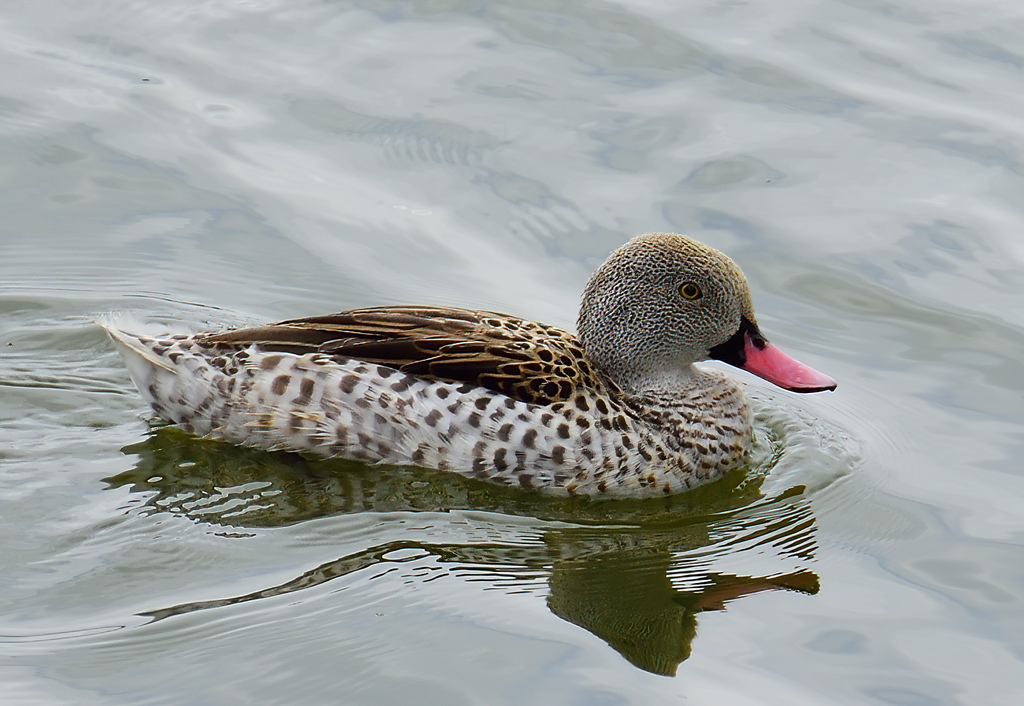
The Cape teal (Anas capensis) also Cape wigeon or Cape widgeon is a 44–46 cm long dabbling duck of open wetlands in sub-Saharan Africa.
From the article Cape teal on Wikipedia (CC BY-SA), quoted section by section
Description
Like many southern ducks, the sexes are similar. It is very pale and mainly grey, with a browner back and pink on the bill (young birds lack the pink). This is a generally quiet species, except during mating displays. The breeding male has a clear whistle, whereas the female has a feeble "quack". The Cape teal cannot be confused with any other duck in its range. This species is essentially non-migratory, although it moves opportunistically with the rains. It is a thinly distributed but widespread duck, rarely seen in large groups except the moulting flocks, which may number up to 2000. The Cape teal feeds on aquatic plants and small creatures (invertebrates, crustaceans and amphibians) obtained by dabbling. The nest is on the ground under vegetation and near water. The Cape teal is one of the species to which the Agreement on the Conservation of African-Eurasian Migratory Waterbirds (AEWA) applies.
Listen
Looking for field recordings…
Where it lives
Recorded sightings
—
geo-referenced records in GBIF, from museums, herbaria and field observers.
Drag the globe to turn it. Dots are where records exist, not a range map; darker means more records.
In the stacks
Searching the stacks…
Every page naming Anas capensis in the Biodiversity Heritage Library →
This page is assembled live from iNaturalist, GBIF, Wikipedia, the Source Library and the Internet Archive. It is not yet part of the hand-edited codex. iNaturalist taxon 6986.