- Animals
- ›Chordates
- ›Vertebrates
- ›Ray-finned Fishes
- ›Spiny-rayed fishes
- ›Pipefishes and Allies
- ›Syngnathoidei
- ›Pipefishes, Seahorses, and Seadragons
- ›Tail-brooding Pipefishes
- ›Hippocampus
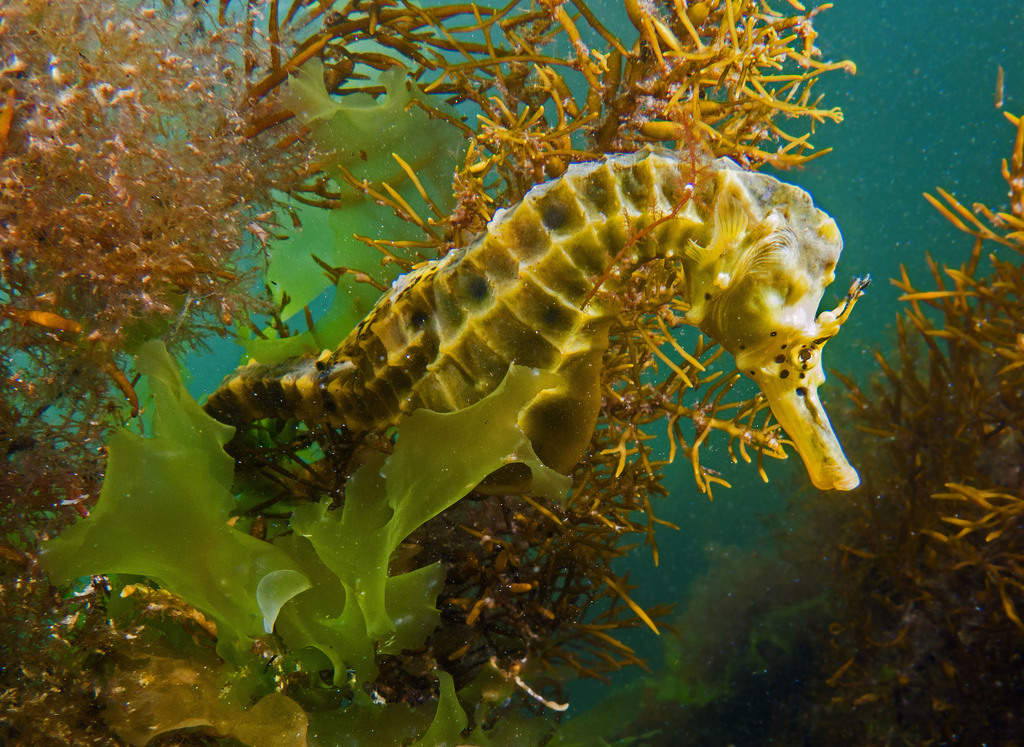
Bigbelly Seahorse
Hippocampus abdominalis
The big-belly seahorse (Hippocampus abdominalis) or pot-bellied seahorse is one of the largest seahorse species in the world, with a length of up to 35 cm (14 in), and is the largest in Australia. Seahorses are members of the family Syngnathidae, and are teleost fishes. They are found in south-eastern Australia and New Zealand, and are listed on Appendix II of CITES. They are the only species of seahorse found in New Zealand, with a habitat range spanning from the Three Kings Island in the north all the way to the Snares Islands in the south.
From the article Big-belly seahorse on Wikipedia (CC BY-SA), quoted section by section
Description
The big-belly seahorse has a forward-tilted, a long-snouted head, a distended but narrow pot belly, and a long, coiled tail. They can be yellow, brown or sometimes white in colouration. It swims using its dorsal fin with a vertical stance; when not swimming, it coils its prehensile tail around any suitable growth, such as seaweed, waiting for planktonic animals to drift by, when they are sucked up by the small mouth set at the tip of the snout much like a vacuum cleaner. Seahorses are voracious feeders, eating mainly crustaceans, such as shrimp, and other small animals living among the seaweed, such as copepods and amphipods. They do not chew, so they can eat to excess because of their small gut tract. Each eye moves separately, making it easier for them to see food and predators. Distinguishing males from females is simple: The male has a smooth, soft, pouch-like area at the base of its abdomen where the stomach meets the tail on the front side. Males also have a fin there, but it is less obvious. The female has more of a pointed stomach with a very obvious fin at the base of it.
Range & habitat
Big-belly Seahorses (Hippocampus abdominalis) are found in both South-East Australian and New Zealand waters, typically inhabiting shallow environments such as large rock pools at low tide. They are able to remain motionless amidst seaweed which can be useful to avoid predation. These types of habitats are preferred as they are the most productive for the seahorse's ambush predation strategy Juveniles are pelagic or attached to drifting seaweed, and adults feed on minute crustaceans like copepods and amphipods. They are nocturnal and ovoviviparous, with the male carrying eggs in a brood pouch located under the tail. These seahorses are often observed in groups at night and can attach to sponges, colonial hydroids, or man-made structures such as jetty piles in deeper water. Typically found in waters less than 50 m (160 ft) deep, they have been observed at depths as great as 104 m (340 ft) Notably, this is the largest seahorse species in southeastern Australia, with more dorsal fin rays and tail rings than any other seahorse.
Wikipedia: “Habitat”
What it does
Adult seahorses eat 30 to 50 times a day if food is available; due to their slow consumption they must feed constantly to survive. Big-belly seahorses do not have a stomach or teeth, so they feed by sucking small invertebrates in through their bony tubular snouts with a flick of their head. Their snouts can expand if the prey is larger than their snout, allowing them to consume a variety of organisms. They are not able to chew so eat prey whole and then disintegrate their food to eat it. Adult big-belly seahorses have fully developed bony plates, which makes it difficult for many marine predators to ingest them. Big-bellied seahorses also have cryptic colouration and can alter their colour to better camouflage with their surroundings which is beneficial when sneaking up on prey. Their head morphology provides a hydrodynamic advantage, which enables them to approach closely to hydrodynamically sensitive prey, without startling them. They use a pivot-feeding mechanism which is composed of two processes. First, the preparatory phase, where the seahorse slowly approaches prey and flexes its head, this is followed by the expansive phase, during which the seahorse now elevates its head and uses suction to capture the prey. Finally, during the recovery phase, their head and jaws return to their original position.
Visual feeding behaviour. …
Wikipedia: “Feeding behaviour”
In human culture
The big-belly seahorse is a popular aquarium species and dried specimens are sold as traditional medicine in Asia. Stocks come from the wild or are aquarium-reared. They are easy to keep in aquariums and feed on small shrimp and crustaceans.
Wikipedia: “Aquaculture”
Where it lives
Recorded sightings
—
geo-referenced records in GBIF, from museums, herbaria and field observers.
Drag the globe to turn it. Dots are where records exist, not a range map; darker means more records.
In the stacks
Searching the stacks…
Every page naming Hippocampus abdominalis in the Biodiversity Heritage Library →
This page is assembled live from iNaturalist, GBIF, Wikipedia, the Source Library and the Internet Archive. It is not yet part of the hand-edited codex. iNaturalist taxon 69837.