On eBird ↗
Yellow-hooded Blackbird
Live sightings near you, the range map, bar charts of when it is seen, and Macaulay Library photos and recordings.
Yellow-hooded Blackbird
Chrysomus icterocephalus
The yellow-hooded blackbird (Chrysomus icterocephalus) is a species of bird in the family Icteridae, the oropendolas, New World orioles, and New World blackbirds. It is found in Brazil, Colombia, French Guiana, Guyana, Peru, Suriname, Trinidad, and Venezuela. It has been recorded as a vagrant on Aruba, Bonaire, and Curaçao. In addition, there is a small population in extreme eastern Panama and a previously misidentified specimen from Barbados.
From the article Yellow-hooded blackbird on Wikipedia (CC BY-SA), quoted section by section
Description
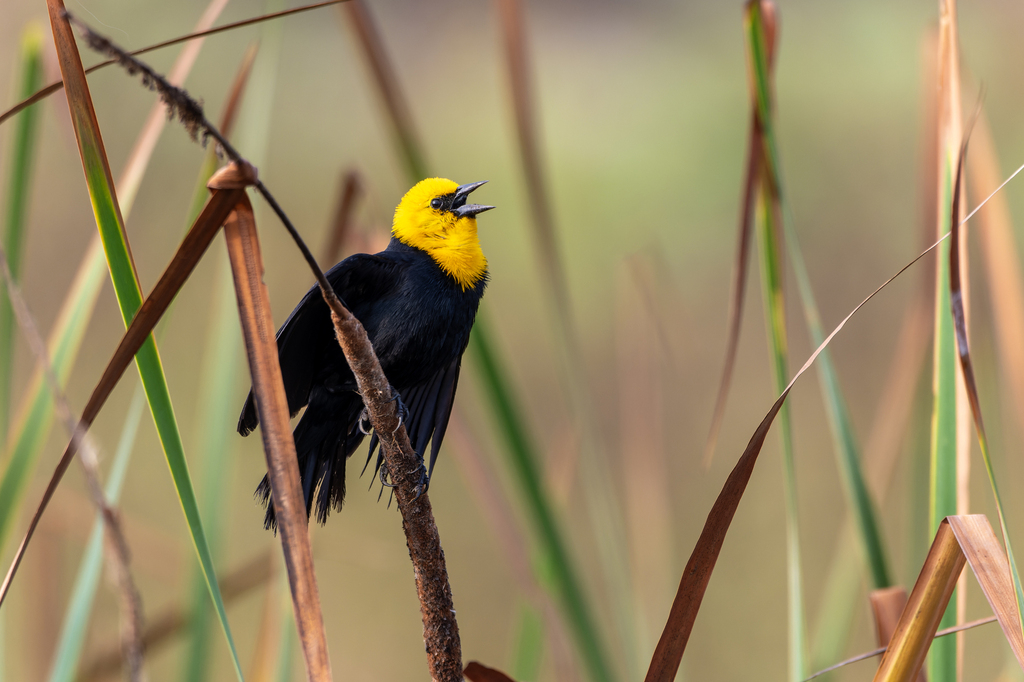
The yellow-hooded blackbird is about 17 to 19 cm (6.7 to 7.5 in) long. Males weigh an average of 35.9 g (1.3 oz) and females average 26.8 g (0.95 oz). The species is sexually dimorphic. Adult males of the nominate subspecies have a bright yellow head, throat, neck, and upper breast except for black lores. Ther rest of their plumage is glossy black. Adult females of the nominate subspecies have a yellow supercilium, throat, and upper breast. Their crown and the rest of their face are citrine. Their upperparts are dull grayish olive with dusky streaks. Their wings and tail are a darker brownish olive. Their underparts are mostly olive with a somewhat olive-streaked brownish belly. Adult males of subspecies C. i. bogotensis are like the nominate. Adult females are darker than the nominate. Their head is less yellowish overall. They have a blackish mask from the lores to the ear coverts and a brighter yellow supercillium that wraps around behind the ear coverts to meet a yellow upper breast. Juveniles are similar to adult females but are duller, have less yellow on the head, paler upperparts, and faintly streaked buffish underparts. Both sexes of both subspecies have a dark brown iris and black legs and feet. Males have a black bill; females' bills often have a pale base to the mandible.
Range & habitat
The nominate subspecies of the yellow-hooded blackbird has by far the larger range of the two. It is found in eastern Panama's Darién Province, in northern and northeastern Colombia into Venezuela west of the Andes, across northern Venezuela east of the Andes and mostly north of the Orinoco River, on Trinidad, across the Guianas, in far northern Brazil's Roraima state, and along the Amazon River from its mouth to northeastern Peru's Loreto Department. From there its range continues south along the Ucayali River. It also is found some distance up the Negro River from the Amazon in Brazil. Subspecies C. i. bogotensis is found only on the Bogotá, Colombia plateau. The nominate subspecies has been recorded once from a nineteenth century specimen on Barbados in the Lesser Antilles and several times as a vagrant on Aruba, Bonaire, and Curaçao. A small population of the nominate became established in Lima, Peru after it was introduced there. Along the Amazon and its tributaries the yellow-hooded blackbird primarily inhabits marshes and várzea grasslands. Elsewhere it primarily inhabits marshes and also savanna, mangroves, and agricultural lands (especially rice fields). Subspecies C. i. bogotensis is found at about 2,600 m (8,500 ft). …
Wikipedia: “Distribution and habitat”
What it does
The yellow-hooded blackbird feeds on seeds and insects. Cultivated rice is an important part of its diet. It forages mostly in grass and low vegetation and occasionally on the ground. In the breeding season small groups are common; in the non-breeding season flocks of 600 have been noted.
Wikipedia: “Feeding”
Listen
Looking for field recordings…
Where it lives
Recorded sightings
—
geo-referenced records in GBIF, from museums, herbaria and field observers.
Drag the globe to turn it. Dots are where records exist, not a range map; darker means more records.
In the stacks
Searching the stacks…
Every page naming Chrysomus icterocephalus in the Biodiversity Heritage Library →
This page is assembled live from iNaturalist, GBIF, Wikipedia, the Source Library and the Internet Archive. It is not yet part of the hand-edited codex. iNaturalist taxon 69688.