- Animals
- ›Arthropods
- ›Hexapods
- ›Insects
- ›Winged and Once-winged Insects
- ›Ants, Bees, Wasps, and Sawflies
- ›Narrow-waisted Wasps, Ants, and Bees
- ›Ants, Bees, and Stinging Wasps
- ›Formicoidea
- ›Ants
- ›Myrmicine Ants
- ›Pogonomyrmecini
- ›Pogonomyrmex
- ›Pogonomyrmex occidentalis
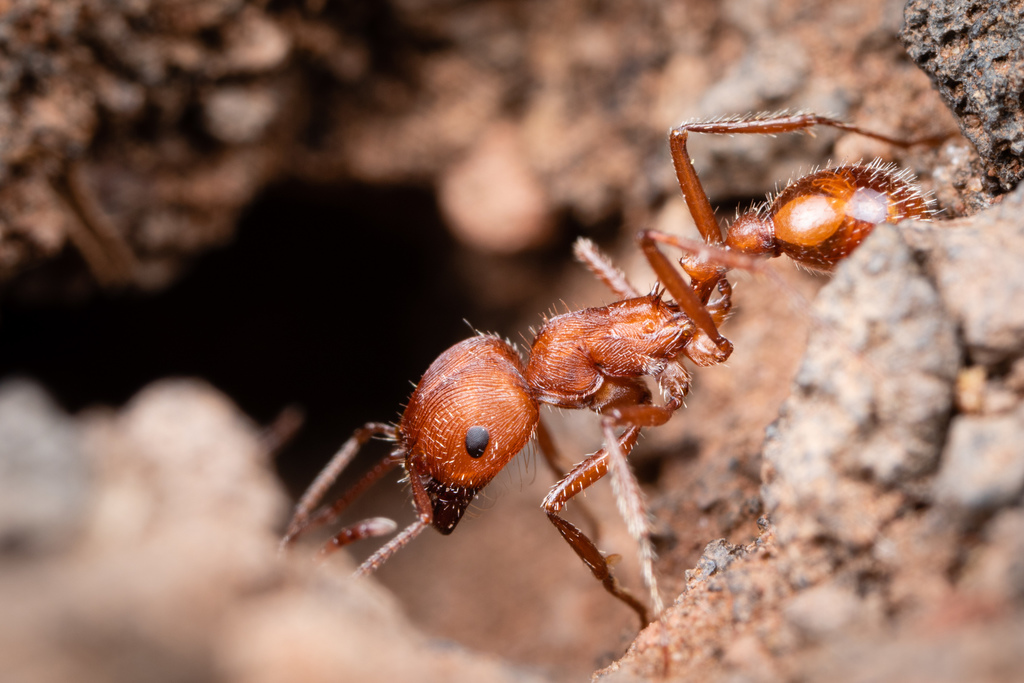
Western Harvester Ant
Pogonomyrmex occidentalis
Pogonomyrmex occidentalis, or the western harvester ant, is a species of ant that inhabits the deserts and arid grasslands of the American West and Canada at or below 6,300 feet (1,900 m). Like other harvester ants in the genus Pogonomyrmex, it is so called because of its habit of collecting edible seeds and other food items. The specific epithet "occidentalis", meaning "of the west", refers to the fact that it is characteristic of the interior of the Western United States; its mounds of gravel, surrounded by areas denuded of plant life, are a conspicuous feature of rangeland. When numerous, they may cause such loss of grazing plants and seeds, as to constitute both a severe ecological and economic burden. They have a painful and venomous sting.
From the article Pogonomyrmex occidentalis on Wikipedia (CC BY-SA), quoted section by section
At the table
Workers harvest seeds and pollen directly from plants and gather fallen seeds. Some seeds are sometimes stored in chambers within the nest and are depleted during winter. Workers also gather newly dead insects. Workers generally forage April–September. Workers generally forage throughout the day during cooler months and only 5–11 am and 3–9 pm during the summer. Genetically diverse colonies forage for more hours daily. Foraging times within a day and foraging temperature range vary consistently among colonies. Given a choice, workers select seeds containing more energy. Given a choice, workers select a diversity of seeds or seeds that are new to the colony. Workers usually forage one kind of item each day, but change their specialty daily. Workers usually forage in one direction over and over, even across days. Colonies recruit more workers (from the total worker pool) to forage at a good food source. Colonies lose foragers in encounters with neighboring colonies. Workers defend foraging territories against neighboring colonies. Different plant environments support different densities of colonies. Foragers produce more period mRNA during darkness, the timing of which varies seasonally.
Wikipedia: “Nutrition”
Listen
Looking for field recordings…
Where it lives
Recorded sightings
—
geo-referenced records in GBIF, from museums, herbaria and field observers.
Drag the globe to turn it. Dots are where records exist, not a range map; darker means more records.
In the stacks
Searching the stacks…
Every page naming Pogonomyrmex occidentalis in the Biodiversity Heritage Library →
This page is assembled live from iNaturalist, GBIF, Wikipedia, the Source Library and the Internet Archive. It is not yet part of the hand-edited codex. iNaturalist taxon 69514.