- Plants
- ›Vascular Plants
- ›flowering plants
- ›Dicots
- ›Sunflowers, Bellflowers, Fanflowers, and Allies
- ›Sunflowers, Daisies, Asters, and Allies
- ›Asteroideae
- ›groundsels and allies
- ›Senecioninae
- ›Senecio
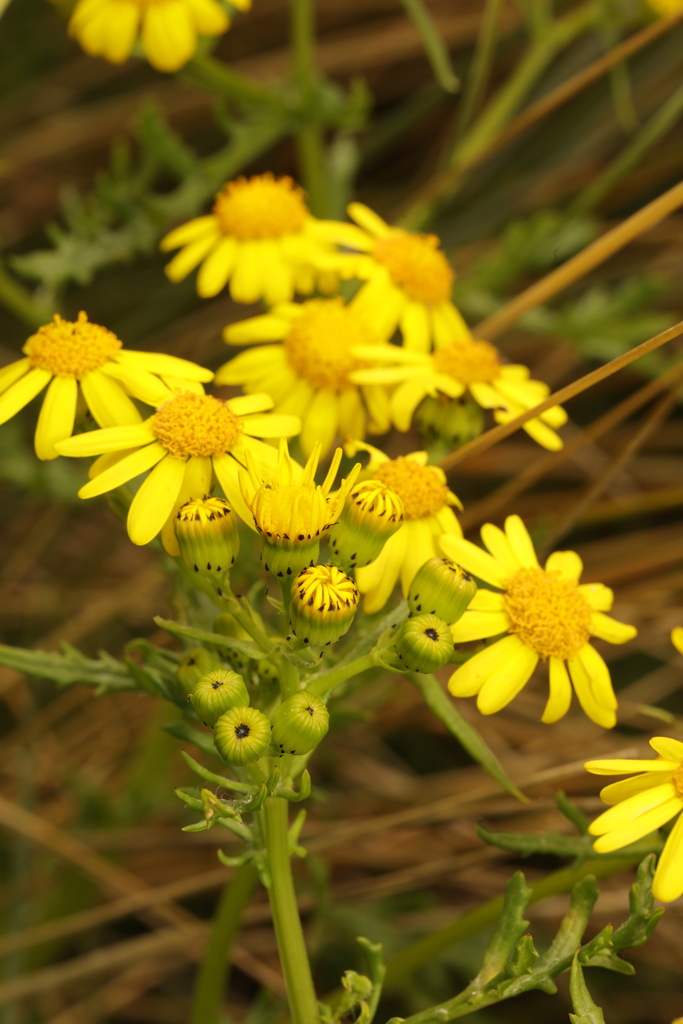
Oxford Ragwort
Senecio squalidus
Senecio squalidus, known as Oxford ragwort, is a flowering plant in the daisy family Asteraceae. It is a yellow-flowered herbaceous plant, native to mountainous, rocky or volcanic areas, that has managed to find other homes on man-made and natural piles of rocks, war-ruined neighborhoods and dry-stone walls. These habitats resemble its well drained natural rocky homeland. The plants have spread via the wind, rail and the activities of botanists. The travels of this short-lived perennial, biennial, or winter annual make it a good subject for studies of the evolution and ecology of flowering plants.
From the article Senecio squalidus on Wikipedia (CC BY-SA), quoted section by section
Description
Like all members of the family Asteraceae, Senecio squalidus has a composite flower head known as a capitulum. What look like single flowers are actually a cluster of florets, each petal or ligule being a flower, or floret, possessing its own stamen and capable of producing the specialized seed of the family Asteraceae, the parachute-like achene. Oxford ragwort is a short-lived perennial, a biennial, or a winter annual and grows in a branched straggling form to between 1.5 feet (0.5 m) and 3.3 feet (1 m) depending on conditions. S. squalidus prefers dry, disturbed places, cultivated and waste ground, walls and railway banks. It flowers from March to December and reproduces from seed.
Leaves and stems S. squalidus leaves are alternate, glossy, almost hairless and variable in form from deeply pinnately lobed to undivided with only the lower leaves being stalked. Stems and leaves resemble those of the common groundsel (Senecio vulgaris) with the exception that their lobes are more widely spaced. Inflorescence S. squalidus has larger capitula than Senecio jacobaea and a more spreading habit. Yellow capitula of 10-14 petals in loose clusters. They are pollinated by insects. …
Range & habitat
Senecio squalidus grows on scree in mountainous regions of native range, and earned its common name Oxford ragwort for its willingness and ability to grow in similar habitat elsewhere in the world.
Native
Senecio squalidus is considered to be a native of New Brunswick and Nova Scotia, Canada by the USDA Natural Resources Conservation Service while the same USDA other resource Germplasm Resources Information Network considers it to be native to Austria, Czech Republic, Slovakia, Germany, Switzerland, Albania, Bulgaria, Greece, Crete, Italy, Sardinia, Sicily, Romania, Bosnia and Herzegovina, Croatia, Montenegro, North Macedonia, Serbia, Slovenia. Current
Africa Northern Africa: Morocco America North America: New Brunswick, Nova Scotia, British Columbia, California Europe Northern Europe: Denmark, Germany, Republic of Ireland, Netherlands, Norway, Sweden, United Kingdom Middle Europe: Austria, Czech Republic, Hungary, Slovakia, Switzerland East Europe: Poland, Southeastern Europe: Albania, Bosnia and Herzegovina, Bulgaria Southwestern Europe: France, Spain South Europe: Croatia, Crete, Greece, Italy, North Macedonia, Romania, Sardinia, Serbia, Sicily, Slovenia Range Maps
Wikipedia: “Distribution”
In human culture
This Senecio was introduced into Britain via Francesco Cupani and William Sherard in the years of their visit 1700, 1701 and 1702 from Sicily where it lives as a native on volcanic ash to the Duchess of Beaufort's garden at Badminton House. Later a transfer of the plant material to the Oxford Botanic Garden by the "Horti Praefectus" Jacob Bobart the Younger took place before his death in 1719, providing perhaps a good indication of when this species of ragwort and other invasive species might have "escaped" and started to make their home in the greater British Isles. The Sicilian ragwort escaped into the wild and grew in the stonework of Oxford colleges (with the specific mention of the Bodleian Library) and many of the stone walls around the city of Oxford. This gave the plant its common name, "Oxford Ragwort". Carl Linnaeus first described Senecio squalidus in 1753, although there is a dispute as to whether the material came from the Botanic Garden or from walls in the city; the taxonomy for this species is further complicated by the existence of species with a similar morphology in continental Europe. James Edward Smith officially identified the escaped Oxford ragwort with its formal name Senecio squalidus in 1800.
During the Industrial Revolution, Oxford became connected to the railway system and the plant gained a new habitat in the railway lines clinker beds, gradually …
Wikipedia: “History”
Where it lives
Recorded sightings
—
geo-referenced records in GBIF, from museums, herbaria and field observers.
Drag the globe to turn it. Dots are where records exist, not a range map; darker means more records.
In the stacks
Searching the stacks…
Every page naming Senecio squalidus in the Biodiversity Heritage Library →
This page is assembled live from iNaturalist, GBIF, Wikipedia, the Source Library and the Internet Archive. It is not yet part of the hand-edited codex. iNaturalist taxon 69438.