- Animals
- ›Arthropods
- ›Hexapods
- ›Insects
- ›Winged and Once-winged Insects
- ›Ants, Bees, Wasps, and Sawflies
- ›Narrow-waisted Wasps, Ants, and Bees
- ›Ants, Bees, and Stinging Wasps
- ›Formicoidea
- ›Ants
- ›Formicine Ants
- ›Lasiine Ants
- ›Paratrechina
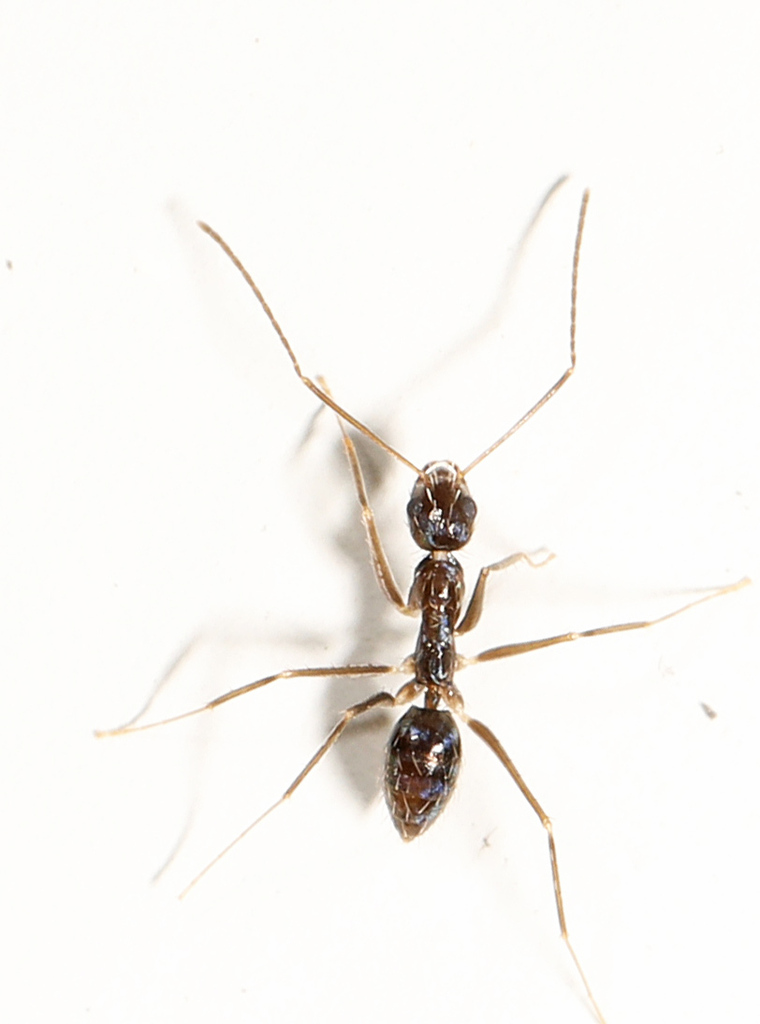
Longhorn Crazy Ant
Paratrechina longicornis
The longhorn crazy ant (Paratrechina longicornis), also known as the black crazy ant, is a species of small Formicine ant. These ants are commonly called "crazy ants" because instead of following straight lines, they dash around erratically. They have a broad distribution, including much of the tropics and subtropics, and are also found in buildings in more temperate regions, making them one of the most widespread ant species in the world. This species, as well as all others in the ant subfamily Formicinae, cannot sting. However, this species can fire/shoot a formic acid spray from its abdomen when under attack by other insects or attacking other insects. When the longhorn crazy ant (Paratrechina longicornis) bends its abdomen while aiming at an enemy insect, it is typically shooting its hard-to-see acid.
These ants can be touched safely, similar to the ghost ants.
From the article Longhorn crazy ant on Wikipedia (CC BY-SA), quoted section by section
Description
The worker longhorn crazy ant is about 2.3 to 3.0 mm (0.09 to 0.12 in) long with a brownish-black head, thorax, petiole, and gaster, often with a faint blue iridescence. The body has a few short, whitish bristles and the antennae and limbs are pale brown. Distinguishing this ant from other members of its genus, Paratrechina, is easy because its antennae and legs are so long. The first segment of each antenna is more than twice as long as the length between its base and the back edge of the head. The eyes are elliptical and set far back on the head. It has no sting, but the ant can bite and then curve its abdomen forwards and secrete formic acid onto its prey. They are too feeble to harm humans. A characteristic of this ant is the way that the workers move around jerkily in apparently random directions, whence their common name.
Range & habitat
The genus Paratrechina probably originated in the tropics of Africa. It has spread to temperate regions around the world, and due to human interference, is now present in North and South America, Africa, Europe, Asia, and Oceania. It is a tropical species, but because of its ability to live in disturbed and artificial habitats, inside buildings, and in urban areas, it has been able to spread northwards to Estonia and Sweden and southwards to New Zealand. In the United States, it is present outdoors in much of the southeast of the country and also indoors in buildings and warehouses in California, Arizona, and the eastern seaboard. In tropical and subtropical areas, as well as being found in buildings, it is found in gardens, coastal scrub, lowland rainforest, dry forest, and savannah shrubland, and by the roadside at elevations of up to 1,765 m (5,791 ft), but at an average elevation of 175 m (574 ft). It is considered a pest, both agricultural and domestic, in most parts of the tropics and subtropics, and an indoor pest in temperate areas. It is said to be the most widespread species of ant in the world, although the pharaoh ant (Monomorium pharaonis) is another challenger for this position.
Wikipedia: “Distribution and habitat”
What it does
Colonies of longhorn crazy ants make their nests in a wide range of either dry or damp sites. These include inside hollow trees, under loose bark, in rotten wood, under logs or stones, among rubbish, and under undisturbed debris inside buildings. They thrive in convenience stores, gas stations, apartment blocks, schools, and cafés. The workers emerge to forage and the location of the nest can be identified by watching ants carrying food back to the colony. The ants are omnivorous and feed on seeds, dead invertebrates, honeydew, plant secretions, fruit, and a range of household scraps. Large food items may be moved by several ants working together. They consume honeydew predominantly in spring and autumn, and may tend aphids, mealybugs, and scale insects so as to maximise the secretions they produce. During the summer, they preferentially seek a high-protein diet. In buildings, they collect crumbs and the insect corpses found under lights. The longhorn crazy ant is able to invade new habitats and outcompete other species of ants. In 1991, in the large closed dome of the research station Biosphere 2 in the Arizona Desert, no particular ant species was dominant. By 1996, the longhorn crazy ant had virtually replaced all the other ant species. …
Wikipedia: “Behaviour and ecology”
Listen
Looking for field recordings…
Where it lives
Recorded sightings
—
geo-referenced records in GBIF, from museums, herbaria and field observers.
Drag the globe to turn it. Dots are where records exist, not a range map; darker means more records.
In the stacks
Searching the stacks…
Every page naming Paratrechina longicornis in the Biodiversity Heritage Library →
This page is assembled live from iNaturalist, GBIF, Wikipedia, the Source Library and the Internet Archive. It is not yet part of the hand-edited codex. iNaturalist taxon 69388.