On eBird ↗
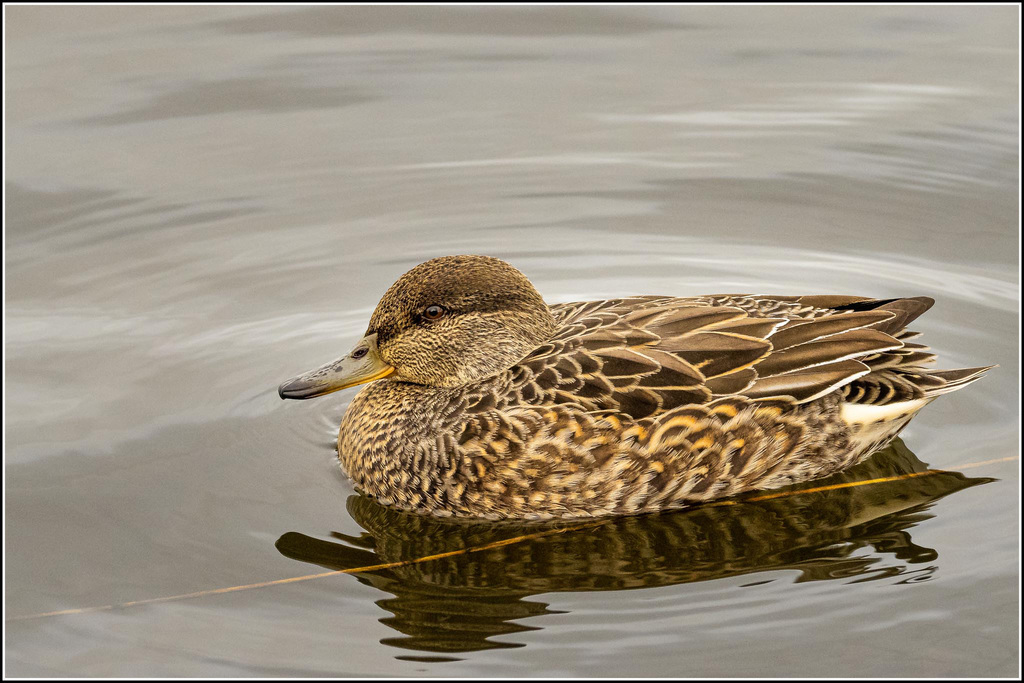
Green-winged Teal
Live sightings near you, the range map, bar charts of when it is seen, and Macaulay Library photos and recordings.
Green-winged Teal
Anas crecca
The Eurasian teal (Anas crecca), common teal, or Eurasian green-winged teal is a common and widespread duck that breeds in temperate Eurosiberia and migrates south in winter. The Eurasian teal is often called simply the teal due to being the only one of these small dabbling ducks in much of its range. The bird gives its name to the blue-green colour teal.
It is a highly gregarious duck outside the breeding season and can form large flocks. It is commonly found in sheltered wetlands and feeds on seeds and aquatic invertebrates. The North American green-winged teal (A. carolinensis) was formerly (and sometimes is still) considered a subspecies of A. crecca.
From the article Eurasian teal on Wikipedia (CC BY-SA), quoted section by section
Description
The Eurasian teal is one of the smallest extant dabbling ducks at 34–43 cm (13–17 in) length and with an average weight of 360 g (13 oz) in drake (males) and 340 g (12 oz) in hens (females). The wings are 17.5–20.4 cm (6.9–8.0 in) long, yielding a wingspan of 53–59 cm (21–23 in). The bill measures 3.2–4 cm (1.3–1.6 in) in length, and the tarsus 2.8–3.4 cm (1.1–1.3 in). From a distance, the drakes in breeding plumage appear grey, with a dark head, a yellowish behind, and a white stripe running along the flanks. Their head and upper neck is chestnut, with a wide and iridescent dark green patch of half-moon or teardrop-shape that starts immediately before the eye and arcs to the upper hindneck. The patch is bordered with thin yellowish-white lines, and a single line of that colour extends from the patch's forward end, curving along the base of the bill. The breast is buff with small round brown spots. The centre of the belly is white, and the rest of the body plumage is mostly white with thin and dense blackish vermiculations, appearing medium grey even at a short distance. The outer scapular feathers are white, with a black border to the outer vanes, and form the white side-stripe when the bird is in resting position. …
Range & habitat
The Eurasian teal breeds across the Palearctic and mostly winters well south of its breeding range. However, in the milder climate of temperate Europe, the summer and winter ranges overlap. For example, in the United Kingdom and Ireland a small summer population breeds, but far greater numbers of Siberian birds arrive in winter. In the Caucasus region, western Asia Minor, along the northern shores of the Black Sea, and even on the south coast of Iceland and on the Vestmannaeyjar, the species can be encountered all year, too. In winter, there are high densities around the Mediterranean, including the entire Iberian Peninsula, and extending west to Mauretania; on Japan and Taiwan; as well as in South Asia. Other important wintering locations include almost the entire length of the Nile Valley, the Near East and Persian Gulf region, the mountain ranges of northern Iran and South Korea, and continental East and Southeast Asia. More isolated wintering grounds are Lake Victoria, the Senegal River estuary, the swamps of the upper Congo River, the inland and sea deltas of the Niger River, and the central Indus River valley. …
Wikipedia: “Distribution and habitat”
What it does
This dabbling duck is highly gregarious outside of the breeding season and will form large flocks. In flight, the fast, twisting flocks resemble waders; despite its short legs, it is also rather nimble on the ground by ducks' standards. In the breeding season, it is a common inhabitant of sheltered freshwater wetlands with some tall vegetation, such as taiga bogs or small lakes and ponds with extensive reedbeds. In winter, it is often seen in brackish waters and even in sheltered inlets and lagoons along the seashore. The Eurasian teal usually feeds by dabbling, upending or grazing; it may submerge its head and on occasion even dive to reach food. In the breeding season it eats mainly aquatic invertebrates, such as crustaceans, insects and their larvae, molluscs and worms. In winter, it shifts to a largely granivorous diet, feeding on seeds of aquatic plants and grasses, including sedges and grains. Diurnal throughout the breeding season, in winter they are often crepuscular or even nocturnal feeders. It nests on the ground, near water and under cover. The pairs form in the winter quarters and arrive on the breeding grounds together, starting about March. The breeding starts some weeks thereafter, not until May in the most northernly locations. The nest is a deep hollow lined with dry leaves and down feathers, built in dense vegetation near water. …
Wikipedia: “Behaviour”
Listen
Looking for field recordings…
Where it lives
Recorded sightings
—
geo-referenced records in GBIF, from museums, herbaria and field observers.
Drag the globe to turn it. Dots are where records exist, not a range map; darker means more records.
In the stacks
Searching the stacks…
Every page naming Anas crecca in the Biodiversity Heritage Library →
This page is assembled live from iNaturalist, GBIF, Wikipedia, the Source Library and the Internet Archive. It is not yet part of the hand-edited codex. iNaturalist taxon 6937.