On eBird ↗
Northern Pintail
Live sightings near you, the range map, bar charts of when it is seen, and Macaulay Library photos and recordings.
Northern Pintail
Anas acuta
The pintail or northern pintail (Anas acuta) is a duck species with wide geographic distribution that breeds in the northern areas of Europe and across the Palearctic and North America. It is migratory and winters south of its breeding range as far as the equator. Unusually for a bird with such a large range, it has no geographical subspecies, although the possibly conspecific duck Eaton's pintail is considered to be a separate species.
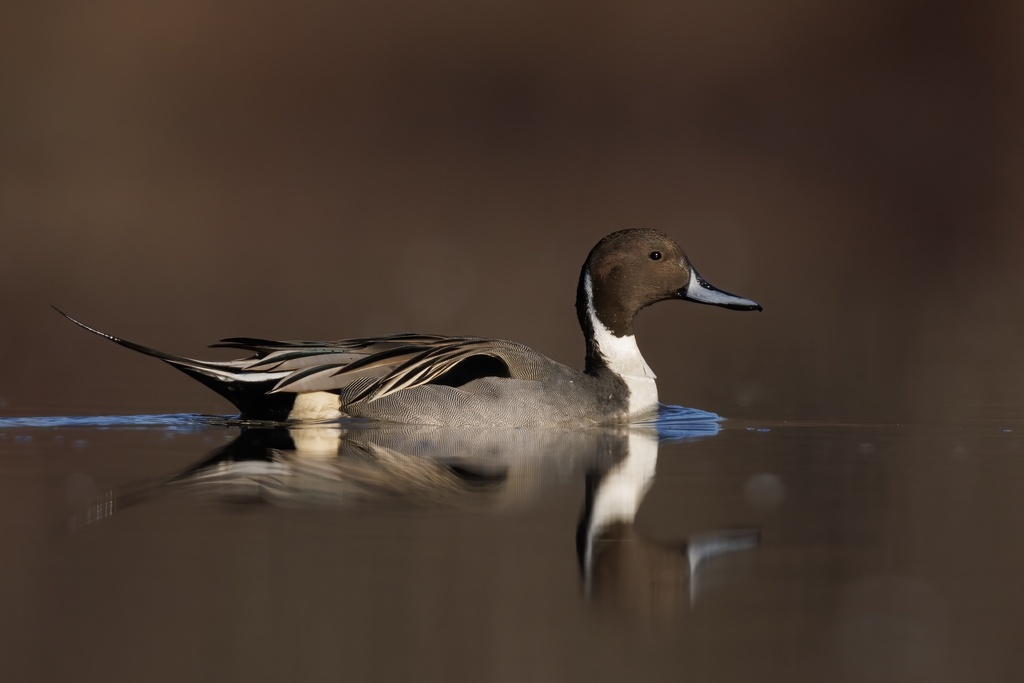
The Northern Pintail is a large duck, and the long central tail feathers of the male give the species its English and scientific names. Both sexes have blue-grey bills and grey legs and feet. The drake is more striking, with a thin white stripe running from the back of its chocolate-coloured head down its neck to its mostly white underparts. The drake also has attractive grey, brown, and black markings on its back and sides. The hen's plumage is more subtle and subdued, with drab brown feathers similar to those of other female dabbling ducks. Hens make a rough quacking sound and the drakes a flute-like whistle.
From the article Northern pintail on Wikipedia (CC BY-SA), quoted section by section
Description
The northern pintail is a fairly large duck with a wing chord of 23.6–28.2 cm (9.3–11.1 in) and wingspan of 80–95 cm (31–37 in). The male is 59–76 cm (23–30 in) in length and weighs 450–1,360 g (0.99–3.00 lb), and therefore is considerably larger than the female, which is 51–64 cm (20–25 in) long and weighs 454–1,135 g (1.001–2.502 lb). The northern pintail broadly overlaps in size with the similarly widespread mallard, but is more slender, elongated and gracile, with a relatively longer neck and (in males) a longer tail. The unmistakable breeding plumaged male has a chocolate-brown head and white breast with a white stripe extending up the side of the neck. Its upperparts and sides are grey, but elongated grey feathers with black central stripes are draped across the back from the shoulder area. The vent area is yellow, contrasting with the black underside of the tail, which has the central feathers elongated to as much as 10 cm (3.9 in). The bill is bluish and the legs are blue-grey. The adult female is mainly scalloped and mottled in light brown with a more uniform grey-brown head, and its pointed tail is shorter than that of the male; it is still easily identified by its shape, long neck, and long grey bill. In non-breeding (eclipse) plumage, the drake pintail looks similar to the female, but retains the male upper wing pattern and long grey shoulder feathers. …
Range & habitat
This dabbling duck breeds in northern areas of the Palearctic as far south as about Poland and Mongolia, and in Canada, Alaska and the Midwestern United States. It winters mainly south of its breeding range, reaching almost to the equator in Panama, northern sub-Saharan Africa and tropical South Asia. Small numbers migrate to Pacific islands, particularly Hawaii, where a few hundred birds winter on the main islands in shallow wetlands and flooded agricultural habitats. Transoceanic journeys also occur: a bird that was caught and ringed in Labrador, Canada, was shot by a hunter in England nine days later, and Japanese-ringed birds have been recovered from six US states east to Utah and Mississippi. In parts of the range, such as Great Britain and the northwestern United States, the pintail may be present year-round. The northern pintail's breeding habitat is open unwooded wetlands, such as wet grasslands, lake shores or tundra. In winter, it uses a wider range of open habitats, such as sheltered estuaries, brackish marshes and coastal lagoons. It is highly gregarious outside the breeding season, forming very large mixed flocks with other ducks.
Wikipedia: “Distribution and habitat”
What it does
The pintail feeds by dabbling and upending in shallow water for plant food mainly in the evening or at night, and therefore spends much of the day resting. Its long neck enables it to take food items from the bottom of water bodies up to 30 cm (12 in) deep, which are beyond the reach of other dabbling ducks like the mallard. The winter diet consists mainly of plant material including seeds and rhizomes of aquatic plants, but the pintail sometimes feeds on roots, grain and other seeds in fields, although less frequently than other Anas ducks. During the breeding season, this bird eats mainly invertebrate animals, including aquatic insects, molluscs and crustaceans.
Wikipedia: “Feeding”
Listen
Looking for field recordings…
Where it lives
Recorded sightings
—
geo-referenced records in GBIF, from museums, herbaria and field observers.
Drag the globe to turn it. Dots are where records exist, not a range map; darker means more records.
In the stacks
Searching the stacks…
Every page naming Anas acuta in the Biodiversity Heritage Library →
This page is assembled live from iNaturalist, GBIF, Wikipedia, the Source Library and the Internet Archive. It is not yet part of the hand-edited codex. iNaturalist taxon 6933.