On eBird ↗
Whooper Swan
Live sightings near you, the range map, bar charts of when it is seen, and Macaulay Library photos and recordings.
Whooper Swan
Cygnus cygnus
The whooper swan (Cygnus cygnus), pronounced hooper swan, is a large Northern Hemisphere swan. It is the Eurasian counterpart of the North American trumpeter swan, and the type species for the Cygnus genus. Francis Willughby and John Ray’s Ornithology of 1676 referred to this swan as “the Elk, Hooper, or wild Swan”.:23 The scientific name is from cygnus, the Latin for “swan”.
From the article Whooper swan on Wikipedia (CC BY-SA), quoted section by section
Description
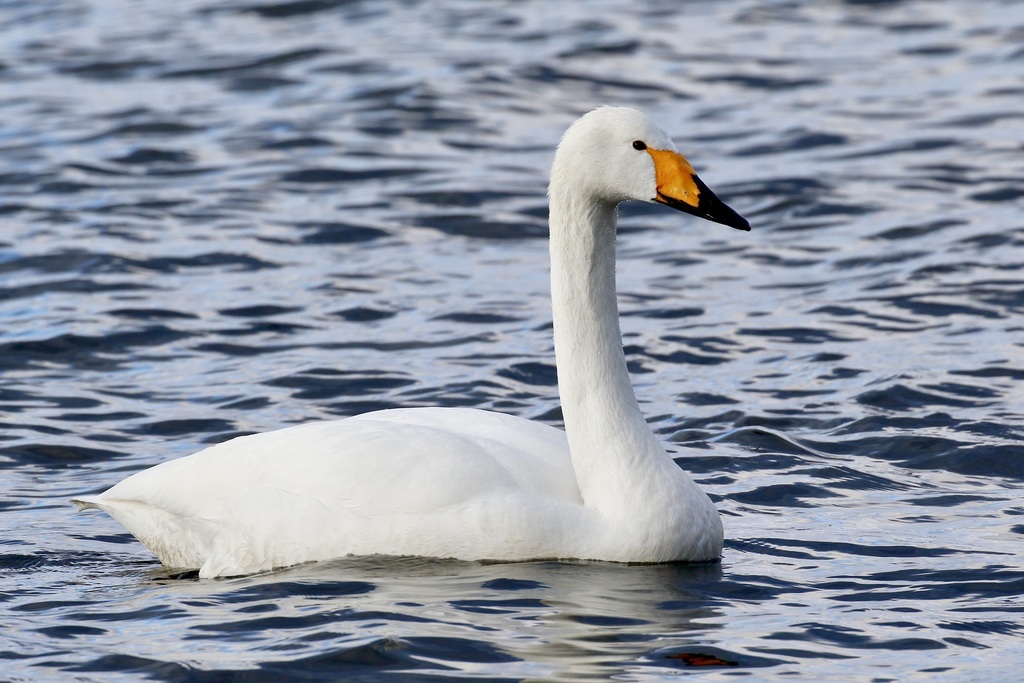
The whooper swan is similar in appearance to Bewick's swan. It is larger, however, at a length of 140–165 centimetres (55–65 inches) and a wingspan of 205–275 cm (81–108 in), similar in size to the mute swan. The weight is typically in the range of 7.4–14.0 kilograms (16+1⁄4–30+3⁄4 pounds), with an average of 9.8–11.4 kg (21+1⁄2–25+1⁄4 lb) for males and 8.2–9.2 kg (18–20+1⁄4 lb) for females. The verified record mass was 15.5 kg (34+1⁄4 lb) for a wintering male from Denmark. It is considered to be amongst the heaviest flying birds. Among standard measurements, the wing chord is 56.2–63.5 cm (22+1⁄8–25 in), the tarsus is 10.4–13.0 cm (4+3⁄32–5+1⁄8 in) and the bill is 9.2–11.6 cm (3.6–4.6 in). It has a more angular head shape, and a bill pattern that always shows more yellow than black (Bewick's swans have more black than yellow). Like their close relatives, whooper swans are vocal birds with a call similar to the trumpeter swan. The adults are pure white, but the head and neck are often stained rusty-yellow when feeding in water rich in tannins or iron compounds. Juveniles, up to about a year old, are uniform pale grey to greyish-brown, with the same bill pattern as adults but with the yellow replaced by pink, and the black replaced by blackish-grey; they differ from mute swans in being paler and more uniform, lacking the mute swan juvenile's brown-and-white pattern. …
Range & habitat
Whooper swans have a deep honking call that resembles geese and, despite their size, are powerful fliers. Whooper swans can migrate hundreds or even thousands of miles to their wintering sites in southern Europe and eastern Asia. They breed in the subarctic Eurosiberia, further south than Bewicks in the taiga zone. They are rare breeders in northern Scotland, particularly in Orkney, and no more than five pairs have bred there in recent years; a handful of pairs have also bred in Ireland in recent years. This bird is an occasional vagrant to the Indian subcontinent and western North America. Icelandic breeders overwinter in the United Kingdom and Ireland, especially in the wildfowl nature reserves of the Royal Society for the Protection of Birds and the Wildfowl and Wetlands Trust.
Wikipedia: “Distribution and habitat”
Listen
Looking for field recordings…
Where it lives
Recorded sightings
—
geo-referenced records in GBIF, from museums, herbaria and field observers.
Drag the globe to turn it. Dots are where records exist, not a range map; darker means more records.
In the stacks
Searching the stacks…
Every page naming Cygnus cygnus in the Biodiversity Heritage Library →
This page is assembled live from iNaturalist, GBIF, Wikipedia, the Source Library and the Internet Archive. It is not yet part of the hand-edited codex. iNaturalist taxon 6916.