On eBird ↗
Horned Screamer
Live sightings near you, the range map, bar charts of when it is seen, and Macaulay Library photos and recordings.
Horned Screamer
Anhima cornuta
The horned screamer (Anhima cornuta) is a species of waterfowl that belongs to a relatively small family, the Anhimidae, which occurs in wetlands of tropical South America. There are three screamer species, the other two being the southern screamer and the northern screamer in the genus Chauna. They are related to ducks, geese and swans, which are in the family Anatidae, but have bills looking more like those of Galliformes.
From the article Horned screamer on Wikipedia (CC BY-SA), quoted section by section
Description
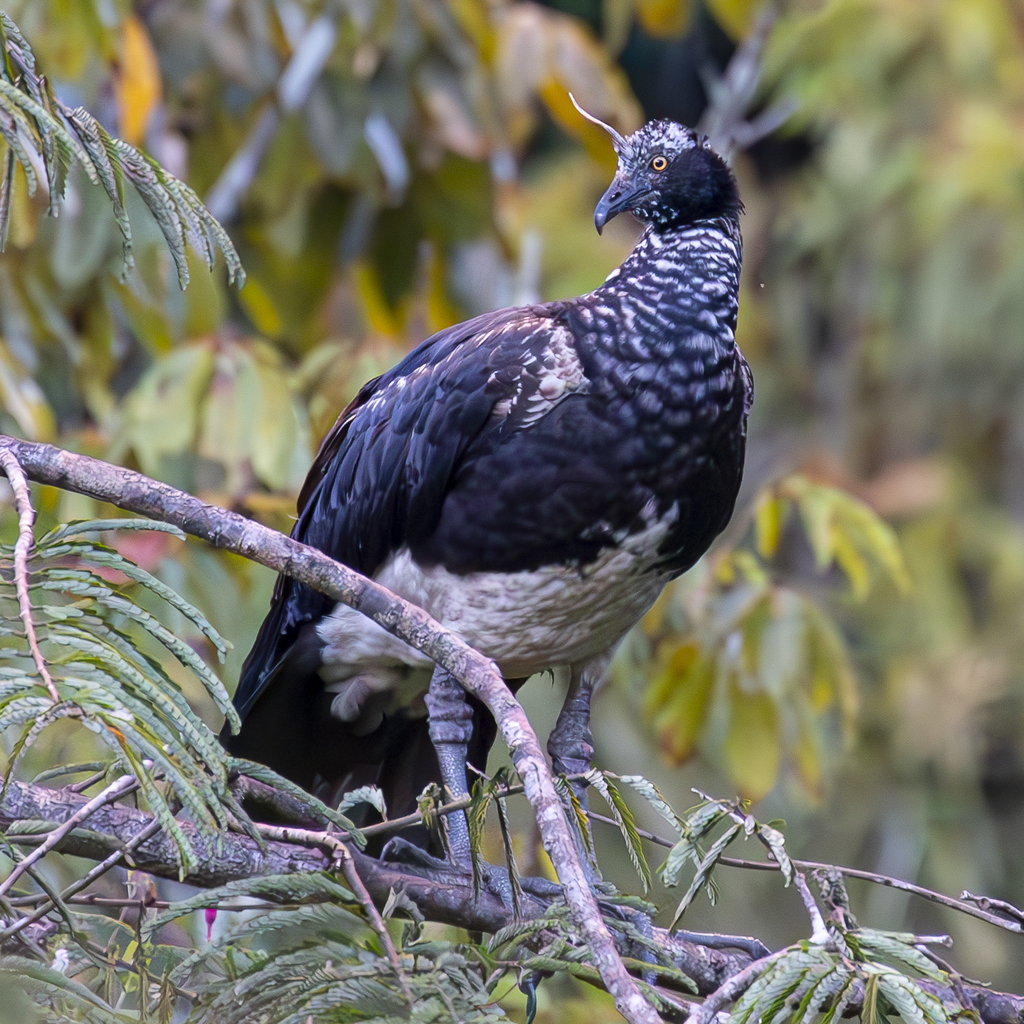
The horned screamer is a massive 84–95 cm (33–37.5 in) long, 3–3.5 kg (6.6–7.7 lb) bird, with a small chicken-like bill. The upperparts, head, and breast are black, with white speckles on the crown, throat and wing coverts. There is a long spiny structure projecting forward from the crown. This structure is unique among birds and is not derived from a feather but is a cornified structure that is loosely attached to the skull and grows continuously while often breaking at its tip. This gives this species its name. It has very long and lanky legs and three large toes in each. The belly and under wing coverts are white. It has two sharp spurs on its wings and feet which are only partially webbed.
Range & habitat
The horned screamer is found in lowlands from Colombia, Venezuela, Brazil, Bolivia, Peru, Ecuador, French Guiana, Suriname, and Guyana. It has been possibly extirpated from Trinidad. Despite having declined locally, it remains widespread and is fairly common overall. Its range in Brazil appears to have expanded in recent years.
Wikipedia: “Distribution and habitat”
What it does
Screamers, like most birds, tend to group together, but are for the most part semi-social. The existence of the screamer is rather sedentary. It lives in swamps, marshes, and meadows near rivers and lakes. The bird is herbivorous and feeds on water plants. It rarely flies, typically only for five seconds at a time. They are frequently observed alone or in pairs of up to six birds.
Wikipedia: “Behavior”
Listen
Looking for field recordings…
Where it lives
Recorded sightings
—
geo-referenced records in GBIF, from museums, herbaria and field observers.
Drag the globe to turn it. Dots are where records exist, not a range map; darker means more records.
In the old herbals & bestiaries

In the stacks
Searching the stacks…
Every page naming Anhima cornuta in the Biodiversity Heritage Library →
This page is assembled live from iNaturalist, GBIF, Wikipedia, the Source Library and the Internet Archive. It is not yet part of the hand-edited codex. iNaturalist taxon 6908.