- Animals
- ›Arthropods
- ›Hexapods
- ›Insects
- ›Winged and Once-winged Insects
- ›Ants, Bees, Wasps, and Sawflies
- ›Narrow-waisted Wasps, Ants, and Bees
- ›Ants, Bees, and Stinging Wasps
- ›Formicoidea
- ›Ants
- ›Odorous Ants
- ›Leptomyrmecini
- ›Dorymyrmex
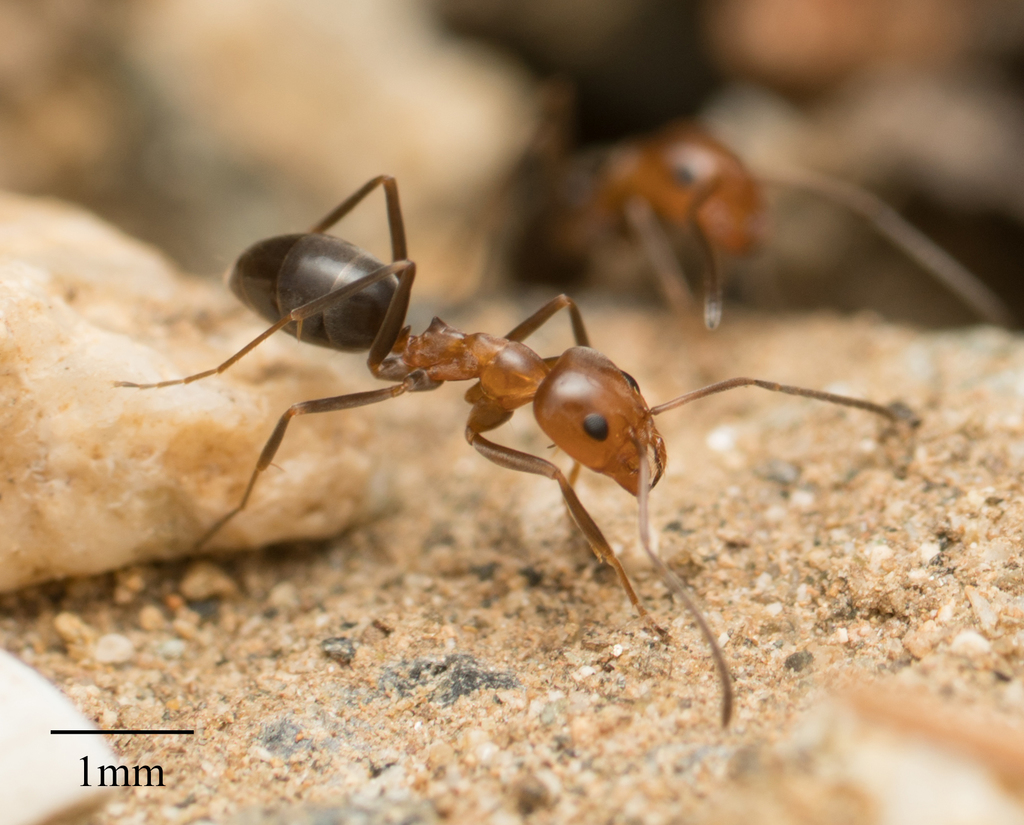
Bicolored Pyramid Ant
Dorymyrmex bicolor
Dorymyrmex bicolor is a species of ant in the Dolichoderinae subfamily, known as the bicolored pyramid ant due to the two-toned body color and the shape of their mounds. Dorymyrmex bicolor was recently known as Conomyrma bicolor but has been renamed to Dorymyrmex bicolor. It has a single petiole and a slit-like orifice which releases chemical compounds. This ant does not have the capability to sting. It is primarily found in arid desert regions in Central and South America and the southwestern United States.
From the article Dorymyrmex bicolor on Wikipedia (CC BY-SA), quoted section by section
Range & habitat
The known range of Dorymyrmex bicolor stretches from the Southwestern United States (California, Texas, Arizona, New Mexico, and Oklahoma), northern and southern Mexico (including Baja California), El Salvador, Guatemala, Belize, Peru, Honduras, and a few Caribbean island nations (i.e. Jamaica).
Wikipedia: “Distribution”
What it does
Dorymyrmex bicolor has a primarily foraging focused behavior, because of this they are known to influence rates of seed germination and distribution in plants. They move quickly and are active from early to late afternoon. They build crater-shaped nests made of fine sand, as they primarily live in desert-like areas though they can live in areas with higher humidity levels.
Wikipedia: “Behavior”
Listen
Looking for field recordings…
Where it lives
Recorded sightings
—
geo-referenced records in GBIF, from museums, herbaria and field observers.
Drag the globe to turn it. Dots are where records exist, not a range map; darker means more records.
In the stacks
Searching the stacks…
Every page naming Dorymyrmex bicolor in the Biodiversity Heritage Library →
This page is assembled live from iNaturalist, GBIF, Wikipedia, the Source Library and the Internet Archive. It is not yet part of the hand-edited codex. iNaturalist taxon 69057.