On eBird ↗
White-faced Whistling-Duck
Live sightings near you, the range map, bar charts of when it is seen, and Macaulay Library photos and recordings.
White-faced Whistling-Duck
Dendrocygna viduata
The white-faced whistling duck (Dendrocygna viduata) is a whistling duck that breeds in sub-Saharan Africa and much of South America.
This species is gregarious, and the flocks of a thousand or more arrive at dawn at favored sites. As the name implies, these are noisy birds with a clear three-note whistling call.
From the article White-faced whistling duck on Wikipedia (CC BY-SA), quoted section by section
Description
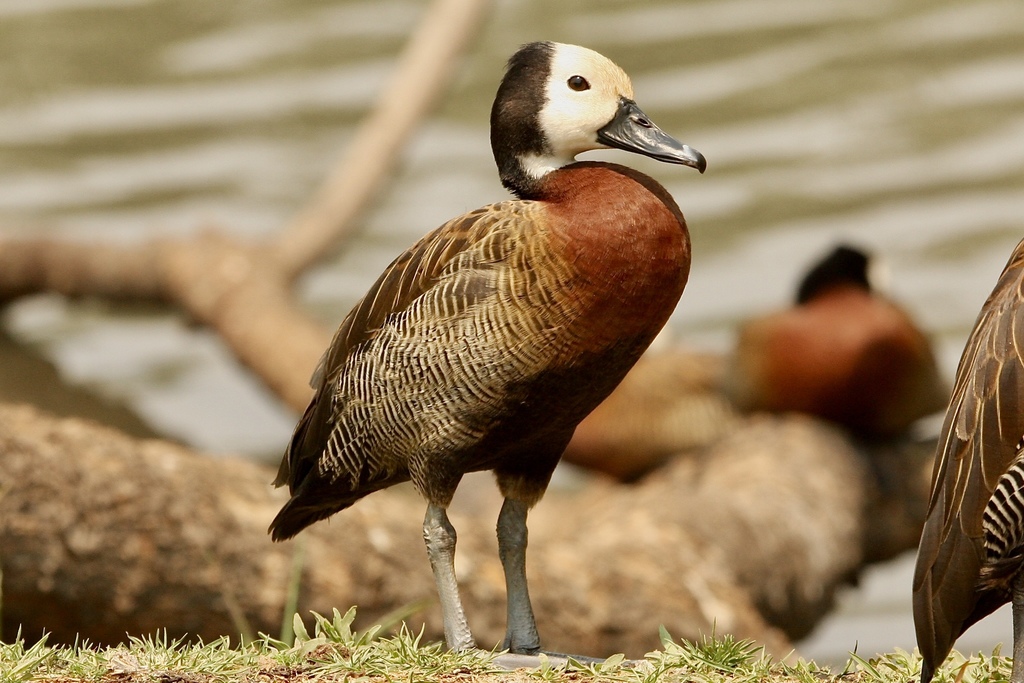
The white-faced whistling duck has a long grey bill, a long head, and longish legs. It has a black neck and head, and a distinctive white face that gives it its name, though the amount of white color visible has regional variations among the species. For example, the white-faced whistling ducks with more black coloration are commonly found in western Africa where rainfall supersedes the dry season. The back and wings are dark brown to black, and the underparts are black with a fine white barring on the flanks. The neck is chestnut. Males and females have similar plumage. Juveniles are similar in color to adults but have a much less contrasted head pattern.
Range & habitat
The white-faced whistling duck has a peculiar disjunctive distribution, occurring in Africa and South America. It has been suggested that they may have been transported to new locations worldwide by humans. The habitat is still freshwater lakes or reservoirs, with plentiful vegetation, where this duck feeds on seeds and other plant food. Because of its large range, there are many common names for the white-faced whistling duck, including "irere" and "guiriri".
Wikipedia: “Distribution and habitat”
What it does
This is an abundant species. It is largely resident, apart from local movements which can be 100 km or more.
Breeding. The nest site is a depression in the ground or in reed beds. The clutch is 6 to 12 eggs which are incubated by both sexes. The eggs hatch after 26 to 28 days. Both sexes attend the ducklings and usually keep them hidden in reeds. The chicks have dark down above and yellow down below. They fledge after two months.
Wikipedia: “Behaviour and ecology”
Listen
Looking for field recordings…
Where it lives
Recorded sightings
—
geo-referenced records in GBIF, from museums, herbaria and field observers.
Drag the globe to turn it. Dots are where records exist, not a range map; darker means more records.
In the stacks
Searching the stacks…
Every page naming Dendrocygna viduata in the Biodiversity Heritage Library →
This page is assembled live from iNaturalist, GBIF, Wikipedia, the Source Library and the Internet Archive. It is not yet part of the hand-edited codex. iNaturalist taxon 6898.