On eBird ↗
Plumed Whistling-Duck
Live sightings near you, the range map, bar charts of when it is seen, and Macaulay Library photos and recordings.
Plumed Whistling-Duck
Dendrocygna eytoni
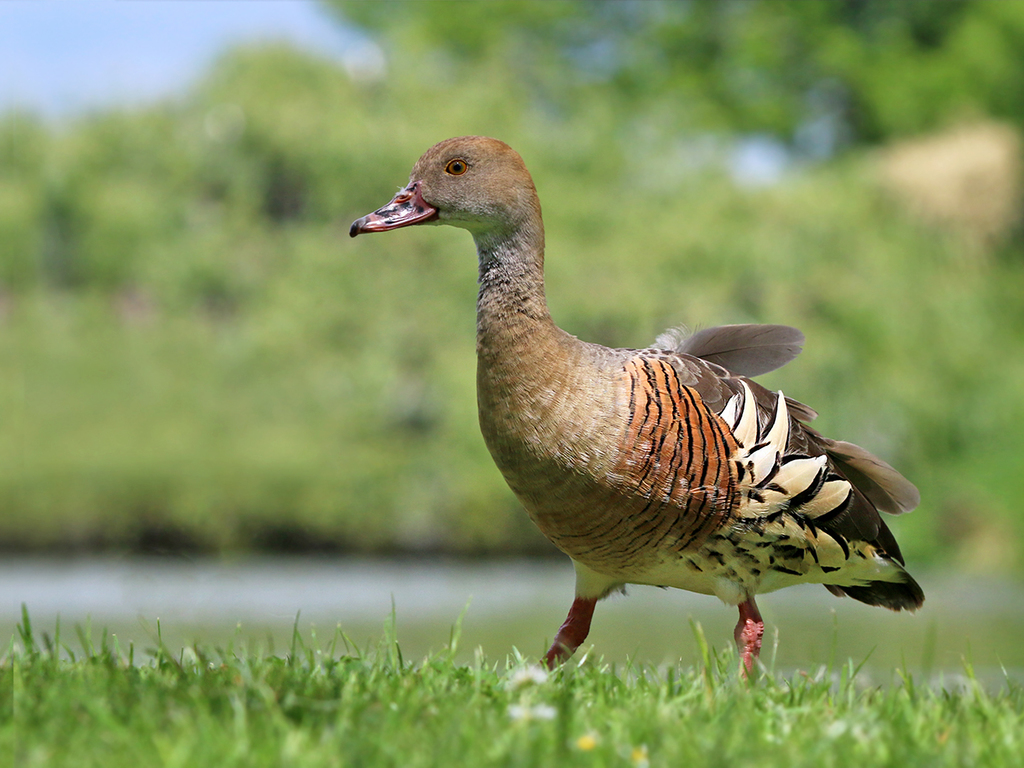
The plumed whistling duck (Dendrocygna eytoni), also called the grass whistling duck, is a species of bird in the whistling duck subfamily of the family Anatidae. It is resident and breeds in Australia, in a broad arc covering the northern half and most of the eastern third of the continent. There are also non-breeding and seasonally uncertain populations in New Zealand, the Solomon Islands, Indonesia and Papua New Guinea. It is a predominantly brown-coloured duck with a long neck and characteristic plumes arising from its flanks. The sexes are similar in appearance.
From the article Plumed whistling duck on Wikipedia (CC BY-SA), quoted section by section
Description
Measuring 42–60 cm (16.5–23.5 in) and weighing around one kilogram (2.2 lb), it is a long-necked duck with brown upperparts, paler underparts and a white rump. The chest is a chestnut colour with thin black bars, while long black-margined plumes arise from its flanks. Its bill and legs are a pinkish red, and the iris of the eyes are yellow. The male and female are similar in appearance. The species has a characteristic lowered neck and short, dark, rounded wings while flying. The call is a characteristic whistle, which gives the bird its common name.
Range & habitat
The plumed whistling duck has a range across the eastern, northern and central parts of Australia from the Kimberley across the Top End and Cape York, down to southern Queensland and northern New South Wales on the east coast, although may reach north-western Victoria inland, in the vicinity of the Murray River. It is also found in New Guinea. The preferred habitat is tall grassland and savanna, often near bodies of water.
Wikipedia: “Distribution and habitat”
What it does
Rather than diving for food in bodies of water like other ducks, the plumed whistling duck feeds by cropping grass on land.
Wikipedia: “Feeding”
Listen
Looking for field recordings…
Where it lives
Recorded sightings
—
geo-referenced records in GBIF, from museums, herbaria and field observers.
Drag the globe to turn it. Dots are where records exist, not a range map; darker means more records.
In the stacks
Searching the stacks…
Every page naming Dendrocygna eytoni in the Biodiversity Heritage Library →
This page is assembled live from iNaturalist, GBIF, Wikipedia, the Source Library and the Internet Archive. It is not yet part of the hand-edited codex. iNaturalist taxon 6895.