On eBird ↗
West Indian Whistling-Duck
Live sightings near you, the range map, bar charts of when it is seen, and Macaulay Library photos and recordings.
West Indian Whistling-Duck
Dendrocygna arborea
The West Indian whistling duck (Dendrocygna arborea) is a whistling duck that breeds in the Caribbean. Alternative names are black-billed whistling duck and Cuban whistling duck.
From the article West Indian whistling duck on Wikipedia (CC BY-SA), quoted section by section
Description
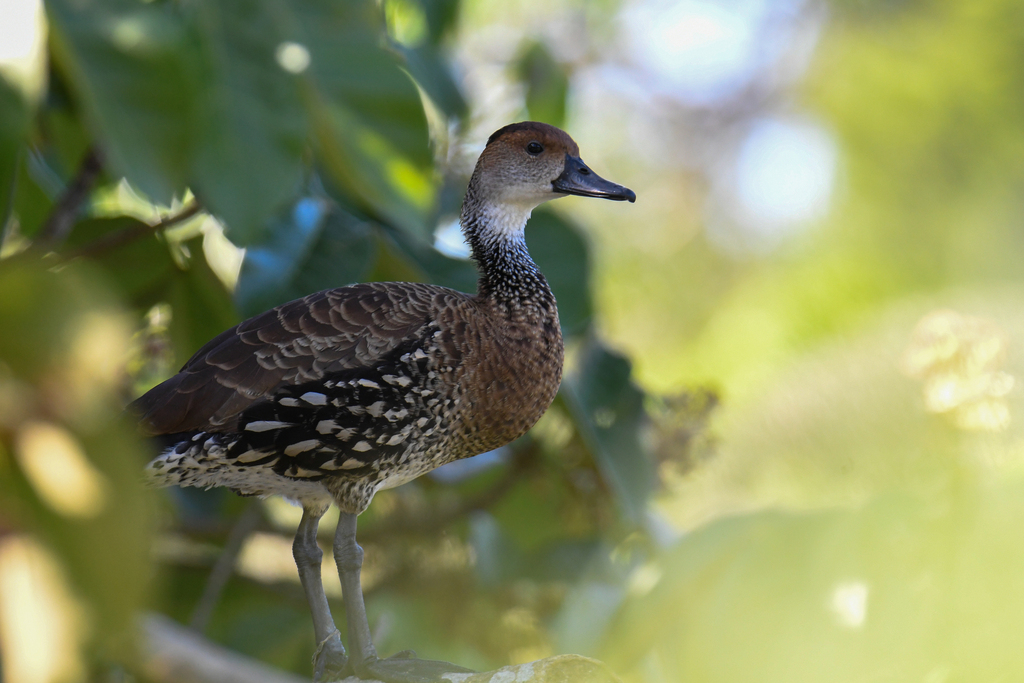
The West Indian whistling duck is the largest and darkest of the whistling ducks with a length of 48 to 58 cm (19 to 23 in). The female weighs from 800 to 1,320 g (1.76 to 2.91 lb) and the male weighs from 760 to 1,240 g (1.68 to 2.73 lb); this species is about the size of a mallard. It has a long black bill, long head and longish legs. It has a pale foreneck and light brown face. The crown, back, breast and wings are dark brown to black, and the rest of the underparts are white with heavy black markings. All plumages are similar, except that juveniles are duller and have a less contrasting belly pattern.
Range & habitat
The West Indian whistling duck is widely scattered throughout the West Indies, including a large breeding population in the Bahamas, and smaller numbers in Cuba, the Cayman Islands, Antigua and Barbuda, Jamaica, Hispaniola (both the Dominican Republic and Haiti), and Puerto Rico. It is largely sedentary, apart from local movements, which can be 100 km (62 mi) or more.
Wikipedia: “Distribution”
What it does
The birds are mostly nocturnal and secretive, inhabiting wooded swamps and mangroves, where this duck roosts and feeds on plant food including the fruit of the royal palm.
Wikipedia: “Food and feeding”
Listen
Looking for field recordings…
Where it lives
Recorded sightings
—
geo-referenced records in GBIF, from museums, herbaria and field observers.
Drag the globe to turn it. Dots are where records exist, not a range map; darker means more records.
In the stacks
Searching the stacks…
Every page naming Dendrocygna arborea in the Biodiversity Heritage Library →
This page is assembled live from iNaturalist, GBIF, Wikipedia, the Source Library and the Internet Archive. It is not yet part of the hand-edited codex. iNaturalist taxon 6892.