- Plants
- ›Vascular Plants
- ›flowering plants
- ›Dicots
- ›Legumes, Milkworts, and Allies
- ›Legumes
- ›Peacock Flower Subfamily
- ›Cassieae
- ›Cassiinae
- ›Cassia
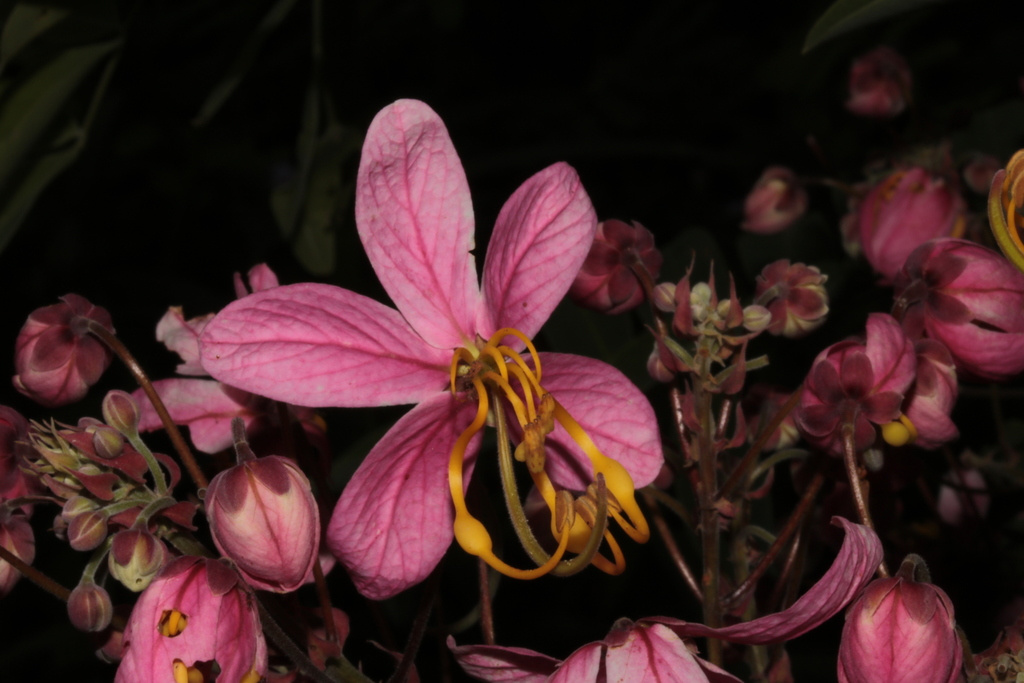
Java Cassia
Cassia javanica
Cassia javanica, also known as Java cassia, pink shower, apple blossom tree and rainbow shower tree (Thai: ชัยพฤกษ์), is a species of tree in the Fabaceae family. Its origin is in Southeast Asia, but it has been extensively grown in tropical areas worldwide as a garden tree owing to its beautiful crimson and pink flower bunches.
From the article Cassia javanica on Wikipedia (CC BY-SA), quoted section by section
Description
Cassia javanica is a fast growing, deciduous / semi-deciduous tree which flowers in spring and sheds its leaves in the winter months. It has a straight trunk that reaches heights of 25 - 40m. The leaves are paripinnate with 12 pairs of elliptical leaves. The flowers range in colour from pale pink to crimson with yellow coloured stamens and are found in open clusters. The ground under the tree is covered with a beautiful carpet of pink towards the end of the flowering season. The fruit are housed in long cylindrical dark brown pods. Because of its beauty and suitable size C. javanica is planted as a shade and ornamental tree on streets and in parks. C. javanica is polymorphic and several sub species such as those listed below exist.
Range & habitat
The natural range of this species is from Assam (far northeastern India), to southern China, south through Malesia and Papuasia, to Queensland (Australia). It has been introduced to other tropical countries and areas, including India, Hawaii, Sri Lanka, tropical America and tropical Africa.
Wikipedia: “Range”
At the table
It is used medicinally as a substitute to Cassia fistula for treating constipation, colic, chlorosis and urinary disorders. Its leaves are effective against herpes simplex and the bark of C. javanica is one of the ingredients in ayurvedic and other traditional medicine antidiabetic formulations. C. javanica yields a lightweight to heavy hardwood that is used for general construction, furniture and cabinet making. The bark of C. javanica is used for tanning in the leather processing industry.
Wikipedia: “Uses”
In human culture
Cassia javanica is one of Thailand's Nine Auspicious Trees and is said to bring good luck, ensure continued high rank and afford victory. Its flower is the provincial flower of Chainat Province, Thailand. The subspecies native to the Philippines is subspecies pubiflora, which is found only on Luzon in the provinces of Bataan, Bulacan, Ilocos Sur, Rizal, and Zambales; there also were historical records from Metro Manila. The so-called 'Palawan cherry blossom' is not a native of the Philippines and is composed of Cassia grandis, Cassia nodosa subsp. javanica, Cassia nodosa subsp. nodosa, and at least one hybrid of one of those. Though locally called balayong and honored through the Balayong Festival in Puerto Princesa, Palawan, it is most definitely not a true native of Palawan, having been introduced there as a timber tree. As an introduced tree without a local epithet, the locals needed a name for which to market it. Since the wood- pinkish when cut- is very similar to that of the true balayong or Afzelia rhomboidea, the name was given and has since stuck.
Wikipedia: “Cultural importance”
Where it lives
Recorded sightings
—
geo-referenced records in GBIF, from museums, herbaria and field observers.
Drag the globe to turn it. Dots are where records exist, not a range map; darker means more records.
In the stacks
Searching the stacks…
Every page naming Cassia javanica in the Biodiversity Heritage Library →
This page is assembled live from iNaturalist, GBIF, Wikipedia, the Source Library and the Internet Archive. It is not yet part of the hand-edited codex. iNaturalist taxon 68686.