On eBird ↗
Fork-tailed Palm Swift
Live sightings near you, the range map, bar charts of when it is seen, and Macaulay Library photos and recordings.
Fork-tailed Palm Swift
Tachornis squamata
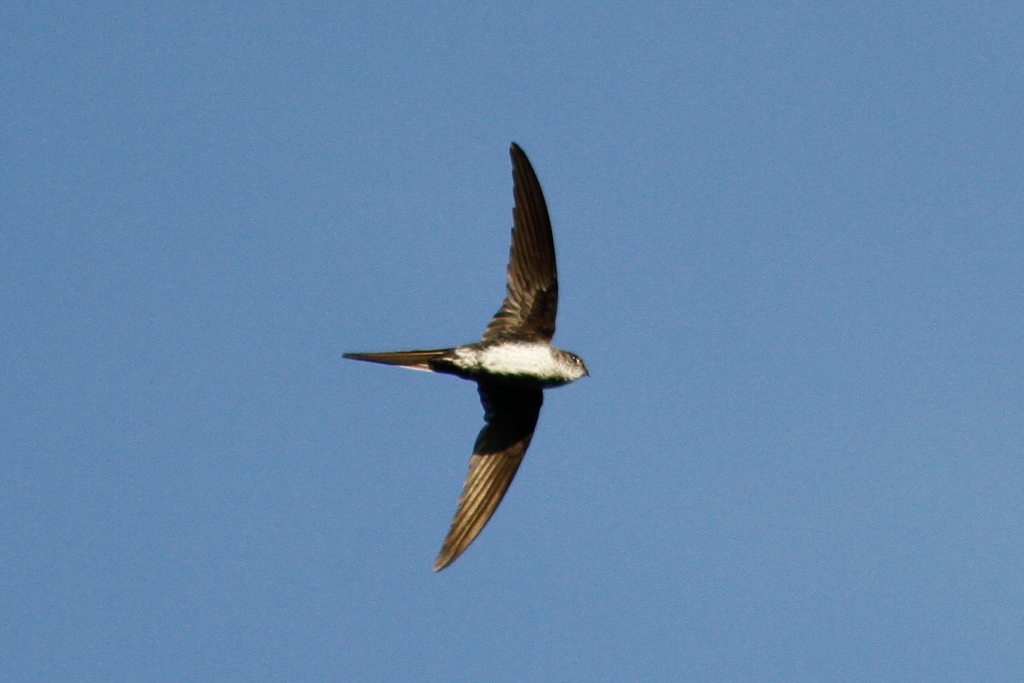
The fork-tailed palm swift or Neotropical palm swift (Tachornis squamata) is a species of bird in subfamily Apodinae of the swift family Apodidae. It is found across most of northern South America and on Trinidad and Tobago.
From the article Fork-tailed palm swift on Wikipedia (CC BY-SA), quoted section by section
Description
The fork-tailed palm swift is about 13 cm (5.1 in) long and weighs 9 to 13.6 g (0.32 to 0.48 oz). It has long narrow wings and a long deeply forked tail. The sexes are alike. Adults of the nominate subspecies T. s. squamata have blackish brown upperparts with a slight greenish gloss and pale gray edges on the feathers; the rump is slightly paler. Their cheeks are grayish brown and the throat very pale brownish white with dusky mottling. The rest of their underparts are pale with light brown mottling that is sparsest in the center of the belly. Their undertail coverts are blackish brown with pale edges. Juveniles are similar to adults but have a buff tinge to the head and buffy edges to their upperparts' feathers. Subspecies T. s. semota is darker overall than the nominate. It has blacker upperparts with less gray on the feathers' edges. Its underparts feathers are darker with very little pale edging and the undertail coverts are shining greenish black.
Range & habitat
The nominate subspecies of fork-tailed palm swift is found in the Amazon Basin from northern Bolivia, eastern Peru, and eastern Ecuador through eastern Colombia and northwestern Brazil into southern and eastern Venezuela. T. s. semota is found on Trinidad, Tobago and in the Guianas and north central, northeastern, and eastern Brazil. The fork-tailed palm swift is found in a variety of landscapes that have in common the presence of palm trees, especially moriche palms. They include moist and wet savannas, palm swamps, riparian forest, and urban areas. It is a lowland species, with maximum known elevation of about 1,000 m (3,300 ft).
Wikipedia: “Distribution and habitat”
What it does
Like all swifts, the fork-tailed palm swift is an aerial insectivore. It usually forages in small flocks of up to 10 of its species. Its diet is highly varied; it has been reported feeding on insects of at least nine orders. One study, however, found that in one area almost its entire diet was ants and termites, which hints that its diet varies geographically or seasonally.
Wikipedia: “Feeding”
Listen
Looking for field recordings…
Where it lives
Recorded sightings
—
geo-referenced records in GBIF, from museums, herbaria and field observers.
Drag the globe to turn it. Dots are where records exist, not a range map; darker means more records.
In the stacks
Searching the stacks…
Every page naming Tachornis squamata in the Biodiversity Heritage Library →
This page is assembled live from iNaturalist, GBIF, Wikipedia, the Source Library and the Internet Archive. It is not yet part of the hand-edited codex. iNaturalist taxon 6867.