- Animals
- ›Chordates
- ›Vertebrates
- ›Birds
- ›Perching Birds
- ›Old World Flycatchers, Robins, and Chats
- ›Myophonus
On eBird ↗
Blue Whistling-Thrush
Live sightings near you, the range map, bar charts of when it is seen, and Macaulay Library photos and recordings.
Blue Whistling-Thrush
Myophonus caeruleus
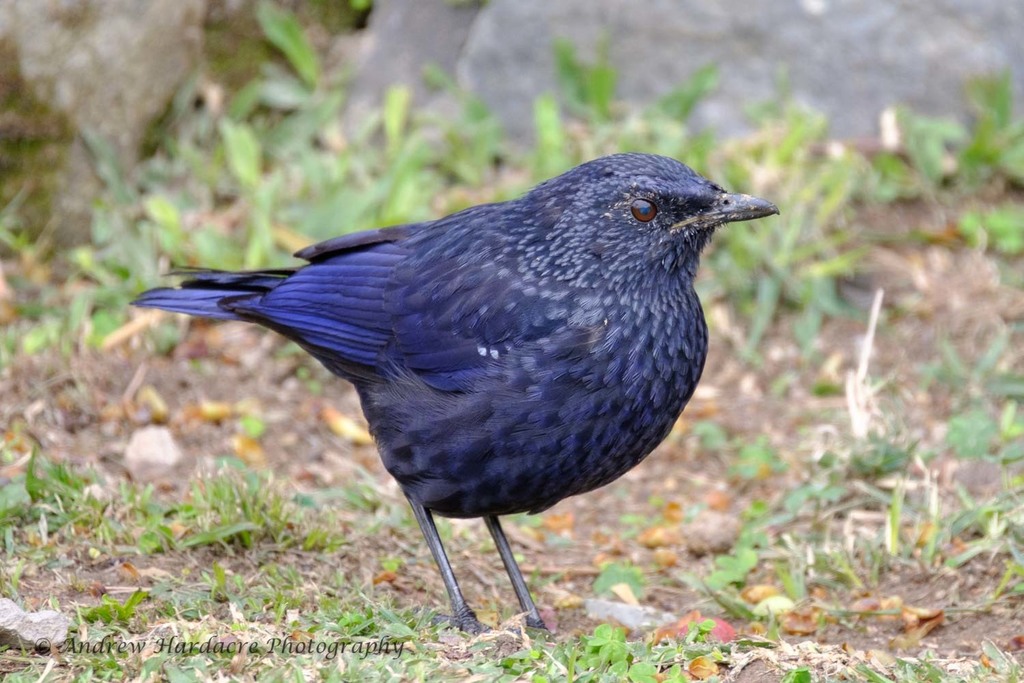
The blue whistling thrush (Myophonus caeruleus) is a bird in the Old World flycatchers family Muscicapidae that is found in the mountains of Central Asia, South Asia, China and Southeast Asia. It is known for its loud human-like whistling song at dawn and dusk. The widely distributed populations show variations in size and plumage, with six subspecies accepted. Like others in the genus, they feed on the ground, often along streams and in damp places, foraging for snails, crabs, insects, and fruit.
From the article Blue whistling thrush on Wikipedia (CC BY-SA), quoted section by section
Description
Blue whistling thrush is dark violet blue with shiny pale blue to white spangling on the tips of the body feathers other than on the lores, abdomen and under the tail. The wing coverts are a slightly different shade of blue and the median coverts have white spots at their tips. The bill is black in nominate M. c. caeruleus, but yellow and stands in contrast in the other five subspecies; the legs are black in all. The inner webs of the flight and tail feathers is black. The sexes are similar in plumage. It measures 29–35 cm (11–14 in) in length. It is the largest species in the old world flycatcher family Muscicapidae; weight across the subspecies can range from 136 to 231 g (4.8 to 8.1 oz). For comparison, this is around twice the weight of a common blackbird or an American robin. Among standard measurements, the wing chord measures 15.5–20 cm (6.1–7.9 in) long, the tarsus is 4.5–5.5 cm (1.8–2.2 in) and the bill is 2.9–4.6 cm (1.1–1.8 in). Size varies across the range with larger thrushes found to the north of the species range and slightly smaller ones to the south, corresponding with Bergmann's rule. In northern China, males and females average 188 g (6.6 oz) and 171 g (6.0 oz), whereas in India they average 167.5 g (5.91 oz) and 158.5 g (5.59 oz).
Several populations are given subspecies status. The nominate subspecies is found in central and eastern China. The widespread M. …
Range & habitat
It is found along the Tian Shan and Himalayas, in temperate forests and subtropical or tropical moist montane forests. The species ranges across Afghanistan, Bangladesh, Bhutan, Cambodia, China, Hong Kong, India, Indonesia, Kazakhstan, Laos, Macau, Malaysia, Myanmar, Nepal, Tajikistan, Thailand, Tibet, Turkmenistan, Pakistan and Vietnam. They make altitudinal movements in the Himalayas, descending in winter. In the Beijing area of northern China, it is a summer visitor, migrating away during the winter.
Wikipedia: “Habitat and distribution”
What it does
The blue whistling thrush is usually found singly or in pairs. They hop on rocks and move about in quick spurts. They turn over leaves and small stones, cocking their head and checking for movements of prey. When alarmed they spread and droop their tail. They are active well after dusk and during the breeding season (April to August) they tend to sing during the darkness of dawn and dusk when few other birds are calling. The call precedes sunrise the most during November. The alarm call is a shrill kree. The nest is a cup of moss and roots placed in a ledge or hollow beside a stream. The usual clutch consists of 3 to 4 eggs, the pair sometimes raising a second brood. They feed on fruits, earthworms, insects, crabs and snails. Snails and crabs are typically battered on a rock before feeding. In captivity, they have been known to kill and eat mice and in the wild have been recorded preying on small birds.
Wikipedia: “Behaviour and ecology”
Listen
Looking for field recordings…
Where it lives
Recorded sightings
—
geo-referenced records in GBIF, from museums, herbaria and field observers.
Drag the globe to turn it. Dots are where records exist, not a range map; darker means more records.
In the stacks
Searching the stacks…
Every page naming Myophonus caeruleus in the Biodiversity Heritage Library →
This page is assembled live from iNaturalist, GBIF, Wikipedia, the Source Library and the Internet Archive. It is not yet part of the hand-edited codex. iNaturalist taxon 68507.