On eBird ↗
Purple Needletail
Live sightings near you, the range map, bar charts of when it is seen, and Macaulay Library photos and recordings.
Purple Needletail
Hirundapus celebensis
The purple needletail, or hagibas in Tagalog, is the largest swift found in the Old World. This species is distributed from northeastern Sulawesi through the Philippine islands of Luzon, Mindoro, Marinduque, Catanduanes, Calayan, Panay, Negros, Cebu, Leyte, Biliran, Mindanao and Basilan.
From the article Purple needletail on Wikipedia (CC BY-SA), quoted section by section
Description
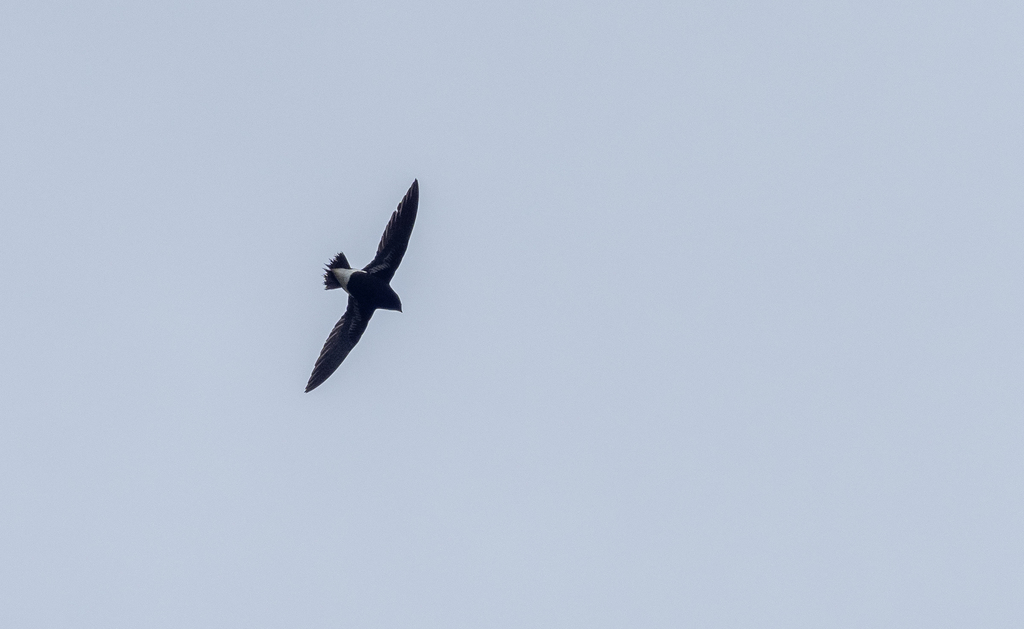
This bird is a huge swift, measuring on average about 25 cm (9.8 in) long and weighing from 170 to 203 g (6.0 to 7.2 oz), with an average of 180 g (6.3 oz) in one study of 22 unsexed adult birds. The wingspan can range up to 60 cm (24 in), with a wing chord length of 20.3 to 23.4 cm (8.0 to 9.2 in). Only the related brown-backed needletail of Southeast Asia and the white-naped swift of Central America rival this species for size and wingspan, with the latter averaging 5 g (0.18 oz) less than this needletail in weight. The overall plumage is mostly uniform blackish, with a whitish loral marking. This species has the large size, white horseshoe-shaped underside-marking, and the subtly-needled tail typical of the needletails. Compared to other needletails, it is extremely dark and lacks the pale throat patch of white-throated needletail and silver-backed needletail. Purple needletail has white-lores, like the nominate form of white-throated needletail and brown-backed needletail, but has distinctive diagonal white bars from the central to inner hind edge of the underwing and has an overall deep purple gloss, visible in strong light. Few detailed descriptions of the life history of the purple needletail are known. It is a gregarious species, probably never leaving a group of at least 20 birds. The large size of these swifts is said to be apparent even from a distance. …
Range & habitat
The abundance of this species is not well known. They are thought to be scarce to uncommon through most of their range, but not endangered and numerous in some parts of the Philippines. This bird lives in various forests and open country. They may be found in the lowlands or in hills, from 150–2,000 m (490–6,560 ft) high in elevation.
Wikipedia: “Distribution and habitat”
Listen
Looking for field recordings…
Where it lives
Recorded sightings
—
geo-referenced records in GBIF, from museums, herbaria and field observers.
Drag the globe to turn it. Dots are where records exist, not a range map; darker means more records.
In the stacks
Searching the stacks…
Every page naming Hirundapus celebensis in the Biodiversity Heritage Library →
This page is assembled live from iNaturalist, GBIF, Wikipedia, the Source Library and the Internet Archive. It is not yet part of the hand-edited codex. iNaturalist taxon 6850.