- Plants
- ›Vascular Plants
- ›flowering plants
- ›monocots
- ›Agaves, Orchids, Irises, and Allies
- ›agave and allies
- ›Hyacinth subfamily
- ›hyacinth tribe
- ›Muscari
- ›Pulchella
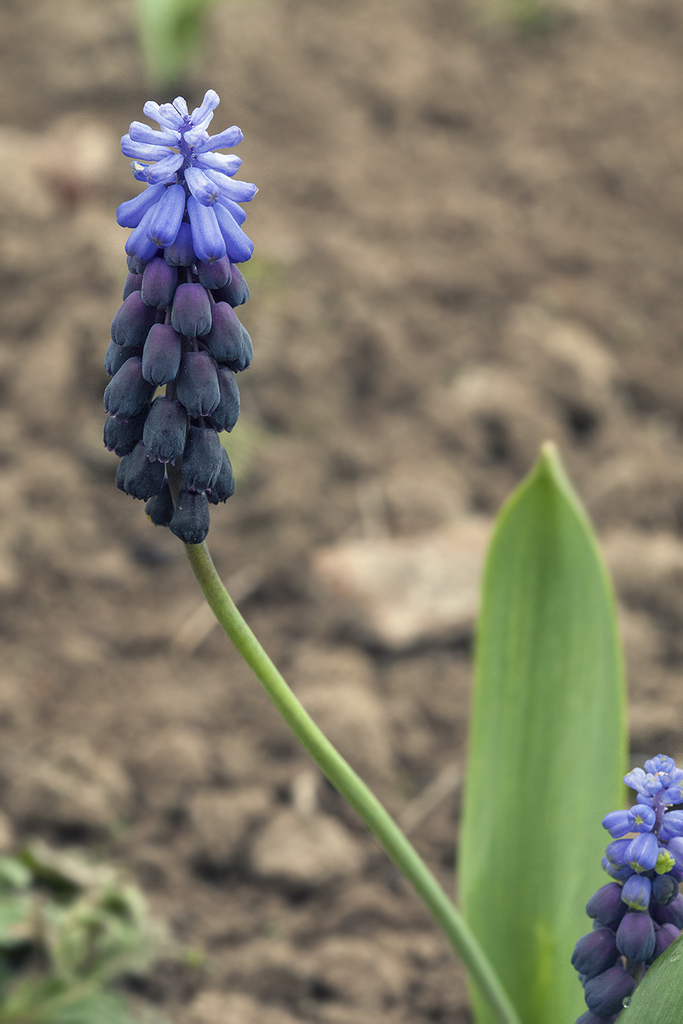
Broad-leaved Grape-hyacinth
Muscari latifolium
Muscari latifolium (broad-leaved grape hyacinth) is a species of flowering plant of the genus of the grape hyacinths (Muscari) in the family (Asparagaceae). The specific epithet latifolium means "broad-leaved".
From the article Muscari latifolium on Wikipedia (CC BY-SA), quoted section by section
Description
It is a bulbous perennial geophyte, reaching a height of 15–40 cm (6–16 in), rarely 50 cm (20 in). There are usually one, rarely two leaves present. These are 7–30 cm (3–12 in) long and 1 to 3 cm wide, upright, wide and linear to ovate-lanceolate. They are drawn together and often hood-shaped. The flower stem is slightly longer than the leaves. The inflorescence is a raceme 2–6 cm (1–2 in) long and 1.5 cm (0.59 in) wide. The fertile flowers at the base are 5–6 mm long and 3 mm wide, oblong-shaped and a deep purple colour. The sterile flowers at the top are 4–8 mm long and pale lilac or blue. The flowering period extends from April to May in the Northern Hemisphere.
Range & habitat
M. latifolium is found in southern and western Turkey, adjacent to sparse pine forests at altitudes from 1,100–1,800 m (3,609–5,906 ft).
Wikipedia: “Distribution”
How it is grown
Widely used as an ornamental plant in flower beds, M. latifolium is hardy to USDA Zone 5, and in the British Isles and all of Europe down to −20 °C (−4 °F). It has gained the Royal Horticultural Society's Award of Garden Merit.
Wikipedia: “Cultivation”
Where it lives
Recorded sightings
—
geo-referenced records in GBIF, from museums, herbaria and field observers.
Drag the globe to turn it. Dots are where records exist, not a range map; darker means more records.
In the stacks
Searching the stacks…
Every page naming Muscari latifolium in the Biodiversity Heritage Library →
This page is assembled live from iNaturalist, GBIF, Wikipedia, the Source Library and the Internet Archive. It is not yet part of the hand-edited codex. iNaturalist taxon 68356.