- Plantas
- ›Plantas vasculares
- ›Plantas con flores
- ›pastos, palmeras y parientes (monocotiledóneas)
- ›Espárragos, orquídeas, cebollas y afines
- ›Espárragos, magueyes, sotoles y parientes
- ›Jacintos y parientes
- ›Hyacintheae
- ›Muscari
- ›Pulchella
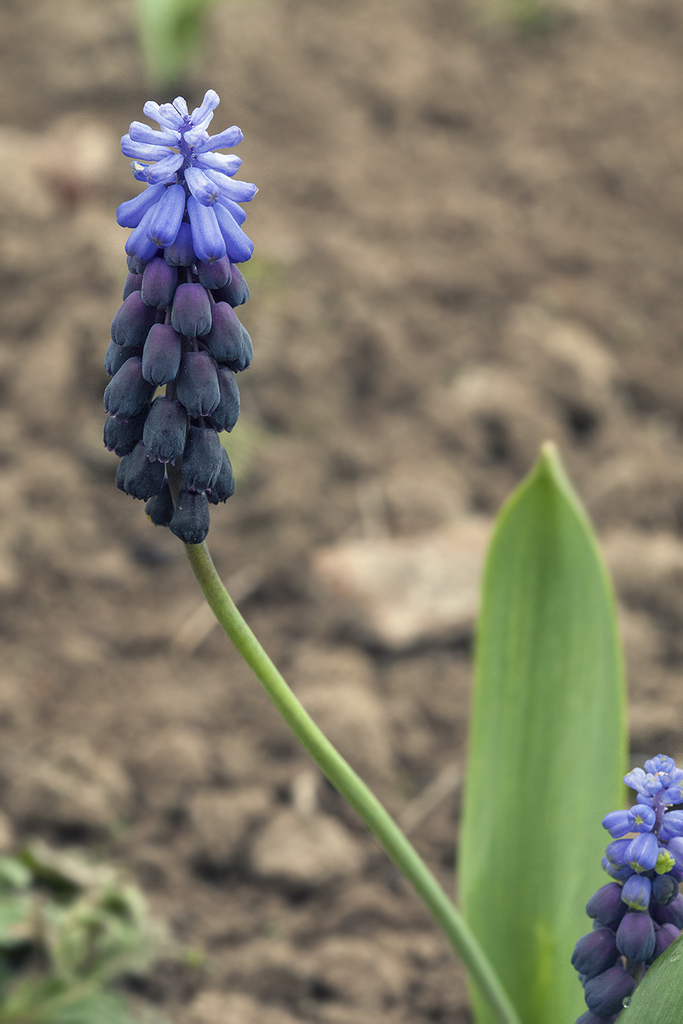
Muscari latifolium
Muscari latifolium, the broad-leaved grape hyacinth, is a species of flowering plant in the family Asparagaceae. The Latin specific epithet latifolium means "broad-leaved".
Del artículo Muscari latifolium de Wikipedia (CC BY-SA), citado sección por sección
Descripción
It is a bulbous perennial geophyte, reaching a height of 15–40 cm (6–16 in), rarely 50 cm (20 in). There are usually one, rarely two leaves present. These are 7–30 cm (3–12 in) long and 1 to 3 cm wide, upright, wide and linear to ovate-lanceolate. They are drawn together and often hood-shaped. The flower stem is slightly longer than the leaves. The inflorescence is a raceme 2–6 cm (1–2 in) long and 1.5 cm (0.59 in) wide. The fertile flowers at the base are 5–6 mm long and 3 mm wide, oblong-shaped and a deep purple colour. The sterile flowers at the top are 4–8 mm long and pale lilac or blue. The flowering period extends from April to May in the Northern Hemisphere.
Wikipedia: «Description»
Distribución y hábitat
M. latifolium is found in southern and western Turkey, adjacent to sparse pine forests at altitudes from 1,100–1,800 m (3,609–5,906 ft).
Wikipedia: «Distribution»
Cómo se cultiva
Widely used as an ornamental plant in flower beds, M. latifolium is hardy to USDA Zone 5, and in the British Isles and all of Europe down to −20 °C (−4 °F). It has gained the Royal Horticultural Society's Award of Garden Merit.
Wikipedia: «Cultivation»
Dónde vive
Avistamientos registrados
—
registros georreferenciados en GBIF, de museos, herbarios y observadores de campo.
Arrastra el globo para girarlo. Los puntos marcan dónde hay registros, no un mapa de distribución; más oscuro significa más registros.
En los depósitos
Buscando en los depósitos…
Todas las páginas que nombran Muscari latifolium en la Biodiversity Heritage Library →
Esta página se compone en directo a partir de iNaturalist, GBIF, Wikipedia, la Source Library y el Internet Archive. Aún no forma parte del códice editado a mano. Taxón 68356 de iNaturalist.