- Animals
- ›Arthropods
- ›Hexapods
- ›Insects
- ›Winged and Once-winged Insects
- ›Butterflies and Moths
- ›Butterflies
- ›Swallowtails and Parnassians
- ›Swallowtails
- ›Birdwings, Cattlehearts, and Pipevine Swallowtails
- ›Battina
- ›Battus
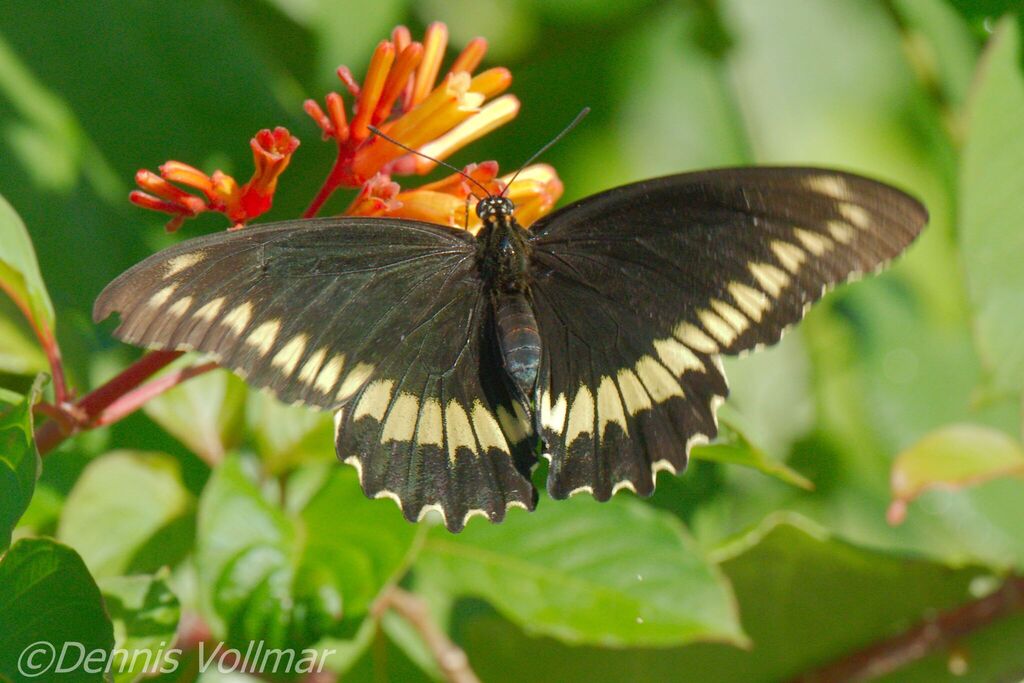
Polydamas Swallowtail
Battus polydamas
Battus polydamas, also known as the gold rim swallowtail, the Polydamas swallowtail or the tailless swallowtail, is a species of butterfly in the family Papilionidae. The species was first described by Carl Linnaeus in his 10th edition of Systema Naturae, published in 1758. Adults generally have black wings with yellow markings while the larval stage is mainly about consuming acids from toxic plants to make themselves unpalatable to predators. They are mainly found in the Neotropical region, and in many of the Caribbean islands.
From the article Battus polydamas on Wikipedia (CC BY-SA), quoted section by section
Description
The wingspan of an adult B. Polydamas is 84 to 110 mm without the tail. The top of the wings are black with a broad submarginal band formed by large yellow spots. The undersides of the forewings have the same pattern, while the hindwings have a submarginal row of red lunules. This butterfly flies from April to November in three generations in the north of its range, throughout the year in several generations in the tropics.
Wikipedia: “Morphology”
Range & habitat
The Polydamas swallowtail is widespread in the Neotropical realm throughout Mexico, Central and South America, the Caribbean, and in southern United States, including Texas and Florida. It also inhabits many Caribbean islands such as Jamaica, Cuba, Puerto Rico, Haiti and the Dominican Republic. Within this broad range, B. polydamas prefers habitats where they can access its larval host plants, particularly species in the genus Aristolochia. However, it is most often found in open woodlands, along the edges of forests, or abandoned fields, and occasionally in gardens with their preferable host plants.
Wikipedia: “Distribution and habitat”
Listen
Looking for field recordings…
Where it lives
Recorded sightings
—
geo-referenced records in GBIF, from museums, herbaria and field observers.
Drag the globe to turn it. Dots are where records exist, not a range map; darker means more records.
In the stacks
Searching the stacks…
Every page naming Battus polydamas in the Biodiversity Heritage Library →
This page is assembled live from iNaturalist, GBIF, Wikipedia, the Source Library and the Internet Archive. It is not yet part of the hand-edited codex. iNaturalist taxon 68275.