- Plants
- ›Vascular Plants
- ›conifers
- ›conifers
- ›pine family
- ›firs, hemlocks, cedars, and allies
- ›Abies
- ›Grandis
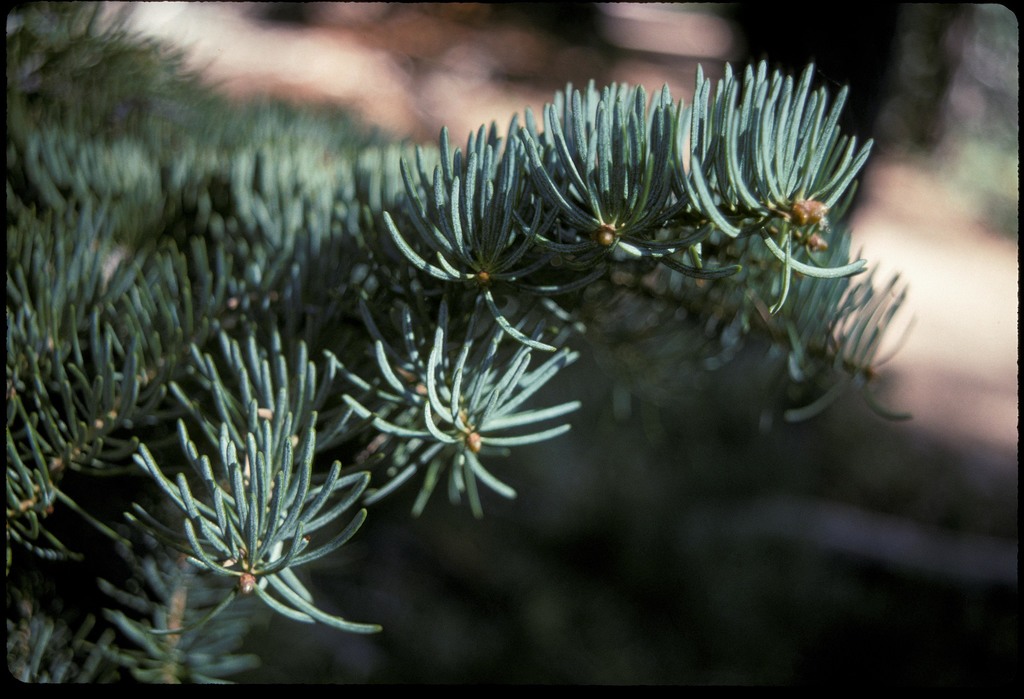
white fir
Abies concolor
Abies concolor, the white fir, concolor fir, or Colorado fir, is a coniferous tree in the pine family Pinaceae. This tree is native to the mountains of western North America, including the Sierra Nevada and southern Rocky Mountains, and into the isolated mountain ranges of southern Arizona, New Mexico, and Northern Mexico. It naturally occurs at elevations between 900 and 3,400 meters (3,000 and 11,200 ft).
It is popular as an ornamental landscaping tree and as a Christmas tree.
From the article Abies concolor on Wikipedia (CC BY-SA), quoted section by section
Description
This large evergreen conifer grows best in the central Sierra Nevada of California, where the record specimen was recorded as 74.9 meters (246 feet) tall and measured 4.6 m (15 ft) in diameter at breast height (dbh) in Yosemite National Park. The typical size of white fir ranges from 25–60 m (82–197 ft) tall and up to 2.7 m (8 ft 10 in) dbh. The largest specimens are found in the central Sierra Nevada, where the largest diameter recorded was found in Sierra National Forest at 58.5 m × 8.5 m (192 ft × 28 ft) (1972); the west slope of the Sierra Nevada is also home to the tallest specimen on record, 78.8 m (259 ft) in height. Abies concolor subsp. concolor (Rocky mountain white fir) rarely exceeds 38 m (125 ft) tall or 0.9 m (3 ft) dbh. Large (but not huge) trees in good soil range from 40 to 60 m (130 to 200 ft) tall and from 99 to 165 centimeters (39 to 65 in) dbh in California and southwestern Oregon and to 41 m (135 ft) tall and 124 cm (49 in) dbh in Arizona and New Mexico. The dead tree tops sometimes fork into new growth. The gray bark is usually at least 10 cm (4 in) thick, and brown-hued inside. …
Range & habitat
This tree is native to the mountains of western North America from the southern Cascade Range in Oregon, south throughout California and into the Sierra de San Pedro Mártir in northern Baja California, and south throughout the Colorado Plateau and southern Rocky Mountains in Utah and Colorado, and into the isolated mountain ranges of southern Arizona, New Mexico, and Northern Mexico. It naturally occurs between 900 and 3,400 m (3,000 and 11,200 ft) above sea level.
Wikipedia: “Distribution”
What it does
White fir is very closely related to grand fir (Abies grandis), and intergrades with it in central Oregon. It is also suggested that all of subspecies lowiana has experienced genetic introgression from grand fir. White fir occupies a different niche than grand fir, including dryer and higher elevation sites, being more drought tolerant and having thicker, fire-resistant bark. In Mexico, it is replaced by further close relatives, Durango fir (A. durangensis) and Mexican fir (A. mexicana). Like grand fir, white fir is more shade tolerant than Douglas fir, but less so than western hemlock and western redcedar. White fir is a climax species, which means the forest has reached complex maturity in forest succession in western coniferous forests of the U.S. White fir and yellow pine (ponderosa pine/Jeffrey pine) have co-existed for millennia in old growth forests throughout their range. In the presence of logging of large diameter trees and exclusion of cleansing wildfires, young trees have become abundant over the past two centuries. White fir had been regarded as a pest in the past by those in the lumber industry, but this opinion has changed. …
Wikipedia: “Ecology”
At the table
White fir and grand fir were used by Native Americans for medicinal use involving powdered bark or pitch to treat tuberculosis or skin ailments. The Nlaka'pamux used the bark to cover lodges and make canoes. Branches were also used as bedding. White fir is a preferred construction species because of its nail-holding ability, lightness in weight, and resistance to split, twist, and pitch. It is straight-grained, non-resinous, fine-textured, stiff, and strong. It is popular as a Christmas tree and for Christmas decoration owing to its soft needles, generally excellent needle retention and abundance. It is often marketed as concolor or white fir.
Cultivation. White fir is widely planted as an ornamental tree in parks and larger gardens, particularly some cultivars of subsp. concolor selected for very bright glaucous blue foliage, such as cv. 'Violacea'. The dwarf cultivar 'Compacta', growing to a maximum height and spread of 2.5 m (8.2 ft), has gained the Royal Horticultural Society's Award of Garden Merit.
Wikipedia: “Uses”
Where it lives
Recorded sightings
—
geo-referenced records in GBIF, from museums, herbaria and field observers.
Drag the globe to turn it. Dots are where records exist, not a range map; darker means more records.
In the stacks
Searching the stacks…
Every page naming Abies concolor in the Biodiversity Heritage Library →
This page is assembled live from iNaturalist, GBIF, Wikipedia, the Source Library and the Internet Archive. It is not yet part of the hand-edited codex. iNaturalist taxon 68087.