- Animals
- ›Arthropods
- ›Hexapods
- ›Insects
- ›Winged and Once-winged Insects
- ›Butterflies and Moths
- ›Butterflies
- ›Skippers
- ›Dicot Skippers
- ›Eudamini
- ›Eudamina
- ›Urbanus
- ›Urbanus
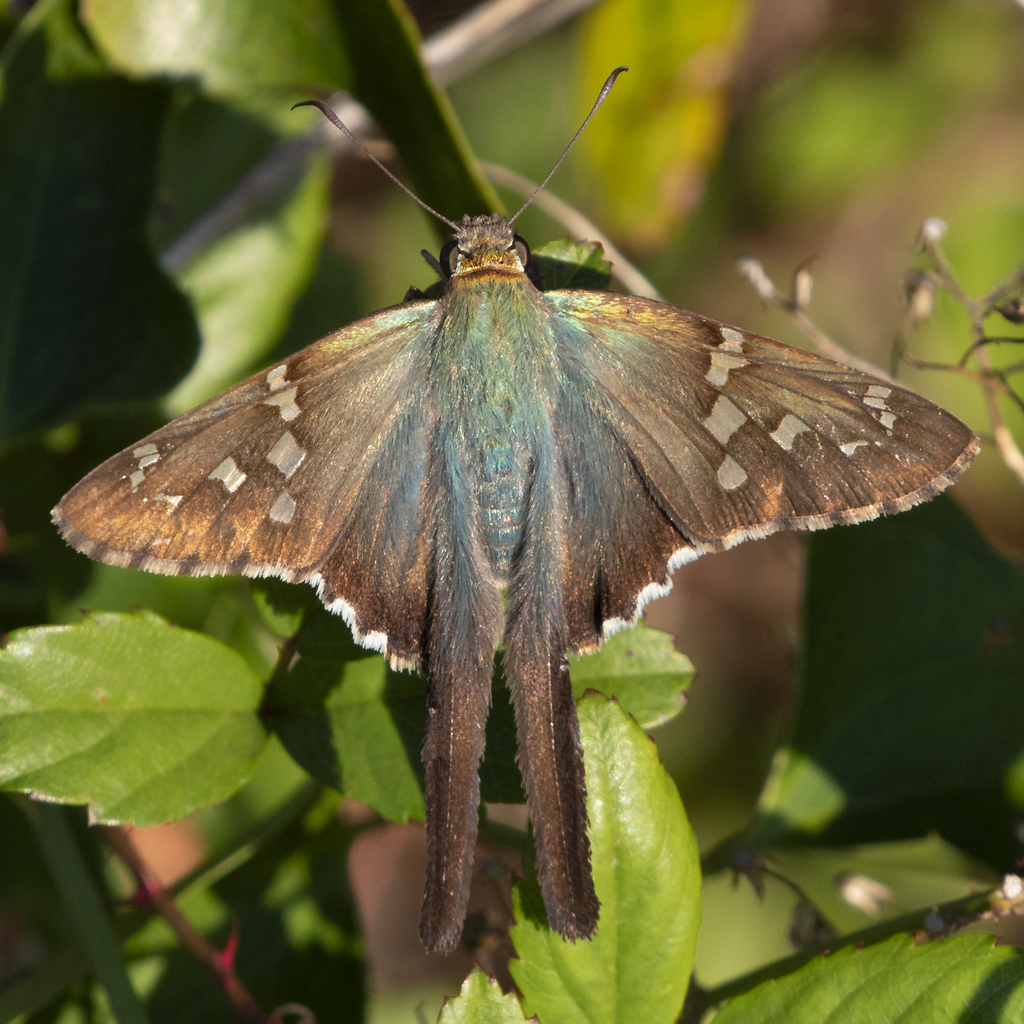
Long-tailed Skipper
Urbanus proteus
The long-tailed skipper (Urbanus proteus) is a spread-winged skipper butterfly found throughout tropical and subtropical South America, south to Argentina and north into the eastern United States and southern Ontario. It cannot live in areas with prolonged frost. It is a showy butterfly, with wings of light brown tinted with iridescent blue, and two long tails extending from the hindwings. The robust body is light blue dorsally. It has a large head, prominent eyes, and a wingspan between 4.5 and 6 centimeters.
From the article Long-tailed skipper on Wikipedia (CC BY-SA), quoted section by section
What it does
It lays white or yellow eggs, singly or in small clusters, which hatch into a caterpillar with a yellowish body and large, dark head. After two to three weeks, the caterpillar forms a pupa. Its pupa is contained in a rolled leaf and covered in fine bluish hairs. The pupa stage may last from one to three weeks, after which the adult emerges. The caterpillar of this skipper is a common pest of crops, especially beans, in the southern United States. For this reason, it is sometimes called the bean leafroller in that area. The caterpillars feed on leaves of plants in the legume family such as wisteria and butterfly peas and then roll the leaves around themselves, lining the cavity with silk, to pupate. The adults feed on nectar from flowers. Natural enemies of this species include wasp and fly parasitoids, and the Florida predatory stink bug, (Euthyrhynchus floridanus). In the fall, a nuclear polyhedrosis virus killed up to 50% of the larvae.
Wikipedia: “Life cycle”
Listen
Looking for field recordings…
Where it lives
Recorded sightings
—
geo-referenced records in GBIF, from museums, herbaria and field observers.
Drag the globe to turn it. Dots are where records exist, not a range map; darker means more records.
In the stacks
Searching the stacks…
Every page naming Urbanus proteus in the Biodiversity Heritage Library →
This page is assembled live from iNaturalist, GBIF, Wikipedia, the Source Library and the Internet Archive. It is not yet part of the hand-edited codex. iNaturalist taxon 67435.