On eBird ↗
Sooty Swift
Live sightings near you, the range map, bar charts of when it is seen, and Macaulay Library photos and recordings.
Sooty Swift
Cypseloides fumigatus
The sooty swift (Cypseloides fumigatus) is a species of swift in the family Apodidae. It is found in Argentina, Bolivia, Brazil, and Paraguay. Its natural habitats are temperate forests, subtropical or tropical moist lowland forest, subtropical or tropical moist montane forest, and heavily degraded former forest.
From the article Sooty swift on Wikipedia (CC BY-SA), quoted section by section
Description
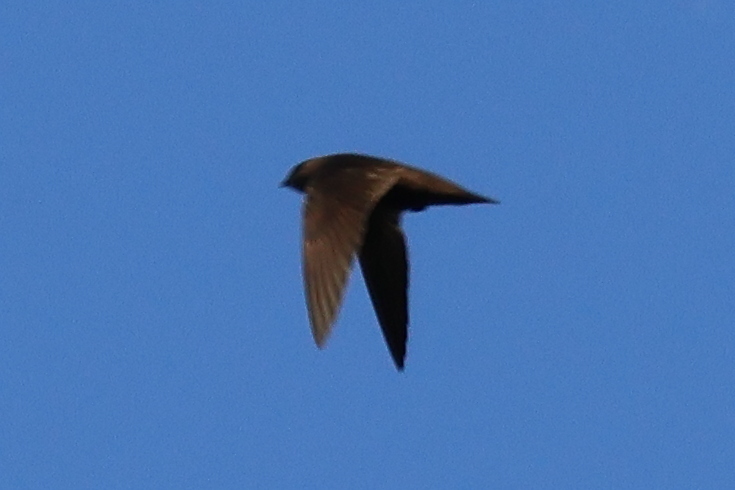
The sooty swift is about 15 cm (5.9 in) long. Males weigh about 42 g (1.5 oz) and females about 41 g (1.4 oz). The sexes have the same plumage. Adults have a brown head, a black patch around the eye, and lighter brown forehead and cheeks. Their back is a darker brown than the head. The upper side of their tail is brown and the underside a grayer brown. The upper side of the wing is mostly blackish brown and the underside somewhat lighter. Juveniles have some gray fringing on the body and wings but are otherwise like adults.
Range & habitat
The sooty swift is found from southern Minas Gerais in southeastern Brazil south to Rio Grande do Sul, eastern Paraguay, and northern Argentina's Misiones Province. There are no records in Bolivia despite its being included there in some taxonomic lists. The sooty swift has mostly been recorded over evergreen montane, tropical, and temperate forests, and also secondary forest, scrublands, and marshes. In elevation it is found between 700 and 2,100 m (2,300 and 6,900 ft).
Wikipedia: “Distribution and habitat”
What it does
Like all swifts, the sooty is an aerial insectivore, but no details of its diet are known.
Wikipedia: “Feeding”
Listen
Looking for field recordings…
Where it lives
Recorded sightings
—
geo-referenced records in GBIF, from museums, herbaria and field observers.
Drag the globe to turn it. Dots are where records exist, not a range map; darker means more records.
In the stacks
Searching the stacks…
Every page naming Cypseloides fumigatus in the Biodiversity Heritage Library →
This page is assembled live from iNaturalist, GBIF, Wikipedia, the Source Library and the Internet Archive. It is not yet part of the hand-edited codex. iNaturalist taxon 6673.