On eBird ↗
Chimney Swift
Live sightings near you, the range map, bar charts of when it is seen, and Macaulay Library photos and recordings.
Chimney Swift
Chaetura pelagica
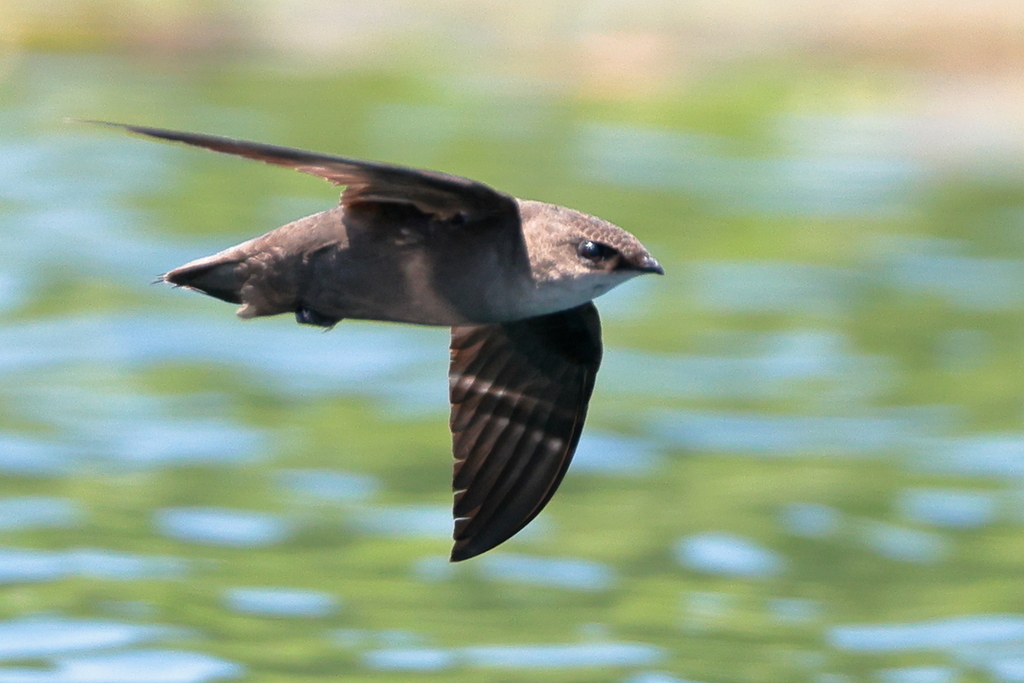
The chimney swift (Chaetura pelagica) is a bird belonging to the swift family Apodidae. A member of the genus Chaetura, it is closely related to both Vaux's swift and Chapman's swift; in the past, the three were sometimes considered to be conspecific. It has no subspecies. The chimney swift is a medium-sized, sooty gray bird with very long, slender wings and very short legs. Like all swifts, it is incapable of perching on flat surfaces, and can only perch on vertical surfaces. Many fly around all day and only come down at night when roosting.
The chimney swift feeds primarily on flying insects, but also on airborne spiders. It generally mates for life. It builds a bracket nest of twigs and saliva stuck to a vertical surface, which is almost always a human-built structure, typically a chimney; historically (before European colonists built chimneys), they nested in hollow trees (including old pileated woodpecker nest holes), a few still do so, though only rarely. The female lays 4–5 white eggs. The altricial young hatch after 19 days and fledge a month later. The average chimney swift lives 4.6 years.
From the article Chimney swift on Wikipedia (CC BY-SA), quoted section by section
Description
This is a medium-sized swift, measuring from 12 to 15 cm (4.7 to 5.9 in) in length, with a wingspan of 27 to 30 cm (11 to 12 in) and a weight ranging from 17 to 30 g (0.60 to 1.06 oz). The sexes are identical in plumage, though males average slightly heavier than females. The adult's plumage is a dark sooty olive above and grayish brown below, with a slightly paler rump and uppertail covert feathers, and a significantly paler throat. Its upperparts are the most uniformly colored of all the Chaetura swifts, showing little contrast between back and rump. Its beak is black, as are its feet and legs. Its iris is dark brown. The juvenile plumage (held by young birds for their first few months after fledging) is very similar to that of adults, but with whitish tips to the outer webs of the secondaries and tertials. The chimney swift's wings are slender, curved and long, extending as much as 1.5 in (3.8 cm) beyond the bird's tail when folded. Its wingtips are pointed, which helps to decrease air turbulence (and therefore drag) during flight. Its humerus (the bone in the inner part of the wing) is quite short, while the bones farther out (more distally) along the wing are elongated, a combination which allows the bird to flap very quickly. In flight, it holds its wings stiffly, alternating between rapid, quivering flaps and longer glides. …
Range & habitat
A widespread breeding visitor to much of the eastern half of the United States and the southern reaches of eastern Canada, the chimney swift migrates to South America for the winter. It is a rare summer visitor to the western U.S., and has been recorded as a vagrant in Anguilla, Barbados, Greenland, Jamaica, Portugal, the United Kingdom and the U.S. Virgin Islands. It is found over open country, savanna, wooded slopes and humid forests. The chimney swift's wintering grounds were only discovered in 1944, when bands from birds banded (ringed) in North America were recovered in Peru. An indigenous Peruvian had been wearing the bands as a necklace.
Wikipedia: “Distribution and habitat”
What it does
The chimney swift is a gregarious species, and is seldom seen alone. It generally hunts in groups of two or three, migrates in loose flocks of 6–20, and (once the breeding season is over) sleeps in huge communal roosts of hundreds or thousands of birds. Like all swifts, it is a superb aerialist, and only rarely seen at rest. It drinks on the wing, skimming the surface of the water with its beak. It also bathes on the wing, gliding above the surface of a body of water, briefly smacking its breast into the water, then flying off again, shaking its feathers as it goes. It has been recorded by pilots flying more than a mile above the surface of the earth, including one seen at 7,300 ft (2,200 m). It is incapable of perching upright like most birds do; instead, it clings to vertical surfaces. If it is disturbed while at rest, the chimney swift will clap its wings loudly once or twice against its body; it does this either in place, or while dropping down several feet to a lower location. This behavior can result in a loud "thundering" sound if large roosts of the birds are disturbed. The sound is thought to be the bird's way of scaring away potential predators.
Feeding. Like all swifts, the chimney swift forages on the wing. …
Wikipedia: “Behavior”
In human culture
In 1899, Mary Day of New Jersey observed a pair of chimney swifts nesting in a chimney, and noted the incubation period was 19 days. The first detailed study of chimney swifts began in 1915 by self-taught ornithologist Althea Sherman in Iowa. She commissioned a 28 foot tall tower, of a similar design to a chimney, with ladders and peep holes installed to facilitate observation. Chimney swifts nested in her tower, and for over fifteen years, she meticulously recorded her observations, filling over 400 pages. Sherman remarked that although the tower had been designed with a limited knowledge of the nesting behavior of chimney swifts, after many years of observation she believed that the original design was ideal.
Wikipedia: “History of observation”
Listen
Looking for field recordings…
Where it lives
Recorded sightings
—
geo-referenced records in GBIF, from museums, herbaria and field observers.
Drag the globe to turn it. Dots are where records exist, not a range map; darker means more records.
In the old herbals & bestiaries

In the stacks
Searching the stacks…
Every page naming Chaetura pelagica in the Biodiversity Heritage Library →
This page is assembled live from iNaturalist, GBIF, Wikipedia, the Source Library and the Internet Archive. It is not yet part of the hand-edited codex. iNaturalist taxon 6571.