On eBird ↗
Vaux's Swift
Live sightings near you, the range map, bar charts of when it is seen, and Macaulay Library photos and recordings.
Vaux's Swift
Chaetura vauxi
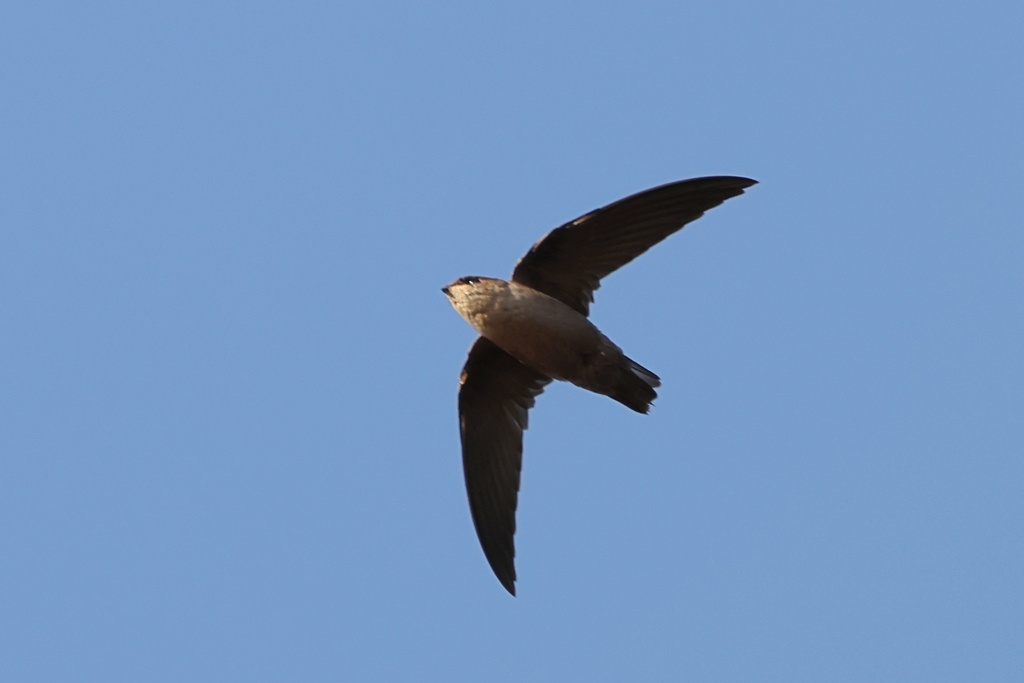
Vaux's swift (Chaetura vauxi) is a small swift native to North America, Central America, and northern South America. It was named for the American scientist William Sansom Vaux.
From the article Vaux's swift on Wikipedia (CC BY-SA), quoted section by section
Description
This is a small swift, even compared to other Chaetura species, at 10.7 to 11.2 cm (4.2 to 4.4 in) long and weighing 18 g (0.63 oz). The northern populations are slightly larger at 11.5 cm (4.5 in), probably according to the Bergmann's Rule and/or migration requirements. It has a cigar-shaped body, crescentic wings and a short bluntly squared-off tail. The head, upperparts and wings are dusky black, and the underparts, rump and tail coverts are greyish brown. The throat is paler grey, becoming whitish in northern birds. The sexes are similar, but juveniles have dusky bases to the throat feathers.
Range & habitat
Vaux's swift breeds in highlands from southern Alaska to central California and from southern Mexico, the northern Yucatán Peninsula, to eastern Panama and northern Venezuela. The United States' populations are migratory, wintering from central Mexico south through the Central American breeding range. The resident breeding birds in the southern part of the range are sometimes considered a separate species, dusky-backed swift, Chaetura richmondi. Preferred habitats include old growth coniferous or deciduous forests consisting of coniferous and deciduous vegetation; requires large, hollow trees for nesting.
Wikipedia: “Distribution and habitat”
What it does
This is a gregarious species, with flocks of 30 or more birds, and often with other swift species, such as white-collared, especially at weather fronts. It flies with a mixture of stiff wing-beats and unsteady glides. It has more varied calls than others in the genus, with a mixture of chattering, buzzes, squeaks and chips.
Feeding. The swift feeds in flight on flying insects, including beetles, wasps, termites and flying ants. It forages over forests and more open areas, including towns.
Breeding. Vaux's swift breeds in the mountains and foothills, from southeastern Alaska and Montana to central California, mainly above 700 m (2,300 ft). It builds a cup nest of twigs and saliva on a vertical surface in a dark cavity, such as a tree hole, cliff crevice or attic. It lays three white eggs between March and July. It spends winters in the tropics.
Nesting. Vaux's swift builds saucer-shaped nests of twigs or spruce and pine needles stuck to an inside surface of a hollow tree or chimney, between 20 inches and 6 feet from the bottom of the cavity.
Wikipedia: “Behaviour”
In human culture
The birds began using the site in the early 1980s in response to the loss of much of their natural roosting habitat — old growth Douglas-fir and forest snags. Vaux's swifts prefer roosting in standing hollow trees. To protect the swifts, the school stopped using its heating system during the weeks of roosting. Students and teachers wore sweaters and jackets, especially toward the end of September when classroom temperatures can drop to 50 to 60 °F (10 to 16 °C). Around 2003, the Audubon Society of Portland, school fundraisers and corporate sponsors donated $60,000 to $75,000 for an alternate school heating system which is independent of the brick chimney. The chimney is now maintained solely for the use of the birds.
Wikipedia: “History”
Listen
Looking for field recordings…
Where it lives
Recorded sightings
—
geo-referenced records in GBIF, from museums, herbaria and field observers.
Drag the globe to turn it. Dots are where records exist, not a range map; darker means more records.
In the stacks
Searching the stacks…
Every page naming Chaetura vauxi in the Biodiversity Heritage Library →
This page is assembled live from iNaturalist, GBIF, Wikipedia, the Source Library and the Internet Archive. It is not yet part of the hand-edited codex. iNaturalist taxon 6557.