- Plants
- ›Vascular Plants
- ›flowering plants
- ›monocots
- ›Agaves, Orchids, Irises, and Allies
- ›agave and allies
- ›Century plant subfamily
- ›Agave
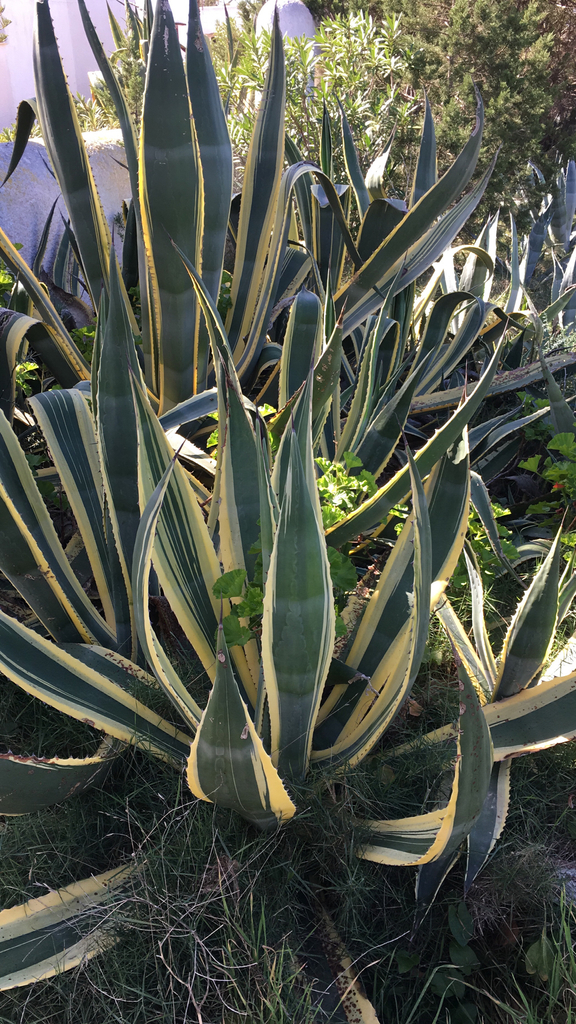
American century plant
Agave americana
Agave americana, commonly known as the century plant, maguey, or American aloe, is a flowering plant species belonging to the family Asparagaceae. It is native to Mexico and the United States, specifically Texas. This plant is widely cultivated worldwide for its ornamental value and has become naturalized in various regions, including Southern California, the West Indies, South America, the Mediterranean Basin, Africa, the Canary Islands, India, China, Thailand, New Zealand and Australia.
Despite being called "American aloe" in common parlance, Agave americana is not closely related to Aloe species.
From the article Agave americana on Wikipedia (CC BY-SA), quoted section by section
Description
The common name "century plant" stems from its monocarpic nature of flowering only once at the end of its long life. After flowering, the plant dies but produces adventitious shoots from the base, allowing its growth to continue. Although it is called the century plant, it typically lives only 10 to 30 years. It has a spread around 1.8–3.0 m (6–10 ft) with gray-green leaves measuring 0.9–1.5 m (3–5 ft) in length, each with a prickly margin and a heavy spike at the tip that can pierce deeply. Towards the end of its life, the plant produces a tall, branched stalk adorned with yellow blossoms, which can reach a height of 8–9 m (25–30 ft).
At the table
Agave americana has various uses starting in pre-Columbian Mexico. If the flower stem is cut before flowering, a sweet liquid known as aguamiel ("lit. 'honey water') can be collected from the plant's hollowed heart. This liquid can be fermented to produce the alcoholic drink called pulque or octli used in pre-Columbian Mexico. In the tequila-producing regions of Mexico, agaves are known as mezcales. Mezcal refers to the high-alcohol product obtained through fermented agave distillation, and A. americana is among the several Agave species used for this purpose. The specific mezcal known as tequila is produced from Agave tequilana, commonly referred to as "blue agave." Mezcal comes in various types, some of which may be flavored with the intensely pungent mezcal worm. Mezcal and tequila, despite being produced from agave plants, differ from pulque in their sugar extraction techniques and classification as distilled spirits. In mezcal and tequila production, the sugars are obtained by heating the piñas (or hearts) of the plants in ovens, as opposed to collecting aguamiel from the cut stalk of the plant. Therefore, if pulque were to be distilled, it would not be classified as mezcal but rather as a distinct beverage. Agaves are also found throughout Latin America and are used in similar ways. …
Wikipedia: “Cuisine”
In medicine
Agave americana contains agavasaponins and agavosides (fructans). It is used in traditional medicine to treat various ailments, and as a laxative, diuretic, and diaphoretic. In California, following its introduction, it was reported that despined leaves were split and made into a poultice for boils. However, a comprehensive review of research literature using systematic methods (scientific review) did not find sufficient data to support its effectiveness or safety. A. americana can cause severe allergic dermatitis.
Wikipedia: “Medicine”
How it is grown
A. americana is cultivated as an ornamental plant, particularly valued for its large, dramatic mature form. It is often found in modernist, xeriscapes (drought-tolerant), and desert-style cactus gardens. It is popularly used in hot climates and areas prone to drought. The plant's presence can evoke the ambiance of 18th- to 19th-century Spanish colonial and Mexican provincial areas in the Southwestern United States, California, and xeric regions of Mexico. In dry beach gardens in Florida and coastal areas of the Southeastern United States, it is a favored choice for landscaping. When grown as a houseplant, A. americana is tolerant of light levels ranging from direct sunlight to shade, and requires minimal watering. It undergoes a winter resting period at temperatures around 10 to 12 °C (50 to 54 °F). It thrives in a highly porous, sandy potting soil, should be allowed to dry out between waterings, and should be repotted annually in the spring.
Subspecies and varieties. The World Checklist of Selected Plant Families recognizes two subspecies and two varieties of A. americana. …
Wikipedia: “Cultivation”
Where it lives
Recorded sightings
—
geo-referenced records in GBIF, from museums, herbaria and field observers.
Drag the globe to turn it. Dots are where records exist, not a range map; darker means more records.
In the old herbals & bestiaries

In the stacks
Searching the stacks…
Every page naming Agave americana in the Biodiversity Heritage Library →
This page is assembled live from iNaturalist, GBIF, Wikipedia, the Source Library and the Internet Archive. It is not yet part of the hand-edited codex. iNaturalist taxon 64103.